
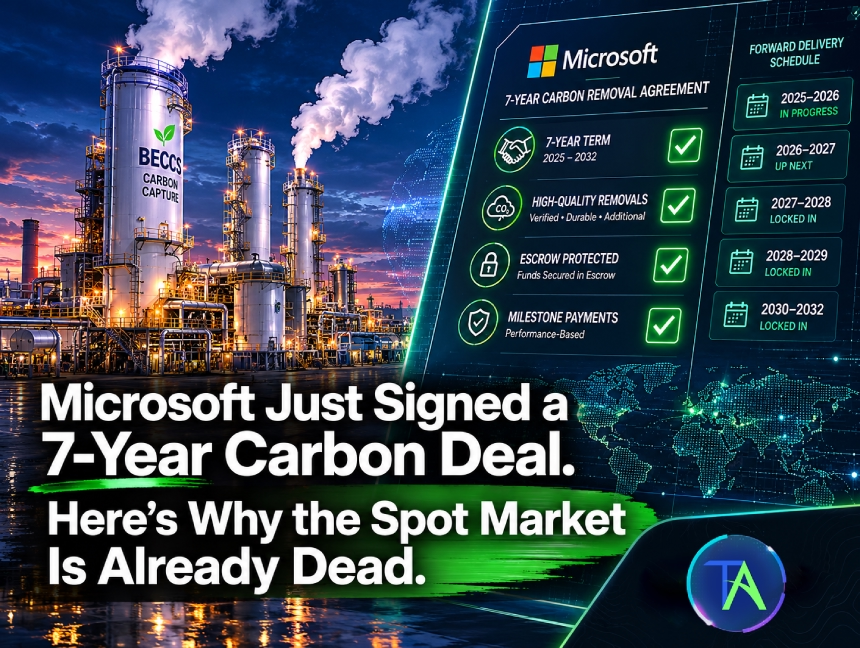
When Microsoft announced it had signed a 7-year forward contract with Stockholm Exergi for engineered carbon removals via Bioenergy with Carbon Capture and Storage (BECCS), most observers focused on the headline tonnage – 10,000 tonnes of CO₂ per year, drawn from one of the world’s first commercial BECCS facilities. But the real story wasn’t the volume. It was the structure. Microsoft didn’t go to a spot market and buy carbon credits off the shelf. They signed an offtake agreement, a legally binding, milestone-linked, forward-delivery contract stretching seven years into the future. That is not a purchase. That is an infrastructure investment. And it signals something the carbon market has been slowly building toward for a decade: carbon forward contracts for engineered removals are becoming the gold standard for serious corporate climate buyers. If you’re a corporate sustainability officer, a carbon project developer, or a fintech firm building the next generation of climate finance infrastructure, this is the moment that changes your roadmap. The Spot Market Was Never Built for Engineered Carbon For years, the voluntary carbon market (VCM) ran almost entirely on spot transactions. A company with a net-zero target in a press release would log onto a marketplace, browse available credits like a digital supermarket, retire some tonnes, and call it done. Fast, cheap, frictionless. The problem? That model was optimized for avoidance credits — forestry protection, cookstove distribution, methane flaring. These credits are abundant, relatively cheap to issue, and can be minted quickly. Spot markets are well-suited to that inventory. Engineered removals are the opposite of that. Carbon forward contracts for engineered removals exist precisely because BECCS, Direct Air Capture (DAC), and Enhanced Rock Weathering projects require enormous upfront capital — construction of specialized infrastructure, procurement of specialized equipment, regulatory permitting, and years of operational setup — before a single verified tonne is captured. No developer can raise that capital on a promise to sell spot credits someday. The numbers simply don’t work. This is exactly what Microsoft understood when it signed with Stockholm Exergi. The offtake agreement is the financing mechanism. The forward contract provides the revenue certainty that makes the project bankable. Without buyers willing to commit to carbon forward contracts for engineered removals years before delivery, most of these projects wouldn’t get financed at all. Why “7 Years” Is the Signal Everyone Missed Seven years is not an arbitrary contract length. It maps to something specific: the capital recovery cycle of a first-of-kind engineered removal facility. Stockholm Exergi’s BECCS plant required substantial investment in carbon capture retrofits on top of an existing biomass heat and power plant. Investors underwriting that capital need visibility into future revenue over a period long enough to model a return. Seven years of contracted forward delivery at a known price (or price formula) is what makes the project investable. This is how oil and gas infrastructure has been financed for decades — through long-term offtake agreements that give producers revenue certainty and give buyers supply certainty. Carbon forward contracts for engineered removals are simply applying the same mature financial logic to a new asset class. And here’s the implication that most carbon market observers haven’t fully processed yet: if engineered removals are going to scale to the gigatonne level that climate models require, they need a financial infrastructure that makes long-term offtake agreements the default transaction model, not the exception. That infrastructure doesn’t exist yet — at least not at scale. Most carbon trading platforms were built for the spot market. They handle credit issuance, registry synchronization, and retirement. They were not designed to manage the complex financial risk architecture that carbon forward contracts for engineered removals actually require. What Forward Contracts Actually Require — And Where Current Platforms Fail Let’s be specific about the technical and financial complexity involved. A carbon forward contract for engineered removals is not a futures contract you can trade on an exchange. It is a bespoke bilateral agreement that typically includes: How Carbon Plant Was Engineered for Forward Contracts — From Day One This is where Carbon Plant’s architecture becomes directly relevant — and why we designed it the way we did. When the Carbon Plant platform was conceived, the team made a foundational architectural decision: we would not build a spot market with forward contract features bolted on. We would build a forward contract engine with spot capability as a downstream feature. That decision shapes everything about how Carbon Plant handles carbon forward contracts for engineered removals. The Developer Opportunity: Building the Infrastructure Layer Here is what we believe the Microsoft-Stockholm Exergi deal actually reveals about where the carbon market is heading — and where the technology opportunity lies. The market for engineered carbon removals is growing fast. Microsoft alone has committed to becoming carbon negative by 2030 and removing all historical emissions by 2050. Similar commitments have been made by Apple, Google, Stripe, and dozens of other large corporates. The Science Based Targets initiative (SBTi) is increasingly requiring that net-zero commitments include durable removals, not just avoidance credits. All of that demand will flow through carbon forward contracts for engineered removals, because that is the only procurement structure that makes high-quality engineered removals financially viable. And all of those forward contracts will need platform infrastructure that doesn’t exist yet at scale. That is the market Techaroha builds into. If you are a carbon project developer who needs a platform to manage investor relations, forward contract documentation, milestone tracking, and credit delivery logistics — we build that. If you are a corporate sustainability team that wants to move beyond spot credit retirement and into a structured forward procurement program with proper financial controls — we build the buyer-side interface for that. If you are a financial institution, exchange operator, or climate fund that wants to create a marketplace for carbon forward contracts for engineered removals — we build the white-label infrastructure for that. The Architecture Is the Moat There is a lesson in Microsoft’s deal that applies directly to carbon market infrastructure.

In July 2026, the European Commission will deliver an assessment that could permanently end aviation’s most lucrative regulatory exemption. If the Commission determines that CORSIA, the UN’s global aviation carbon offsetting scheme, does not adequately meet Paris Agreement goals, the EU’s “stop-the-clock” mechanism ends. What follows is a legislative proposal that would extend EU Emissions Trading System (EU-ETS) obligations to all flights departing from the European Economic Area, not just intra-European routes. That is not a distant regulatory scenario. It is a timed detonation sitting on the desks of compliance officers at every major airline, cargo operator, charter group, and emissions-intensive multinational with European departure footprints. Transport & Environment, Europe’s leading clean transport advocacy group, estimates that extending the EU-ETS to all departing flights would incorporate an additional 80 million tonnes of CO₂ into the scheme, more than doubling the current 64 Mt coverage. Potential revenues could reach €12.7 billion annually. Airlines have already absorbed a 25% cut in free allowances in 2024 and 50% in 2025, with full auctioning now in effect for 2026. The regulatory gridlock is real. CORSIA’s fundamental problem is architectural: it sets no hard cap on emissions, covers only traffic growth above 85% of 2019 activity, and relies on voluntary offsetting mechanisms that independent review teams have found lack genuine additionality. For compliance regulators demanding hard, independently-verified allowances not cheap offset proxies, CORSIA is structurally insufficient. Which brings us to the central business problem that nobody in carbon technology is talking about loudly enough: the platforms enterprises rely on were not built for this moment. The Silent Infrastructure Crisis in Enterprise Carbon Management Here is the uncomfortable reality facing ESG operators, climate fintech builders, and environmental exchange operators in 2026: the carbon software stack most global enterprises use is fundamentally siloed. Platforms built for voluntary credit trading connecting to Verra’s VCS registry, Gold Standard, or the American Carbon Registry were engineered for one market logic: maximize issuance volume, minimize friction at point-of-purchase, and generate retirement certificates on demand. They are excellent at what they were designed to do. Compliance platforms — those interfacing with the EU-ETS Union Registry, the UK Emissions Trading Registry, or California’s CITSS — were built on a completely different architectural premise: rigorous MRV (Measurement, Reporting, and Verification), hard allowance caps, and auditable surrender cycles that face regulatory scrutiny. These two technology lineages have almost nothing in common. Their data models differ. Their API structures differ. Their compliance event triggers differ. Their custody logic and retirement semantics differ. Now imagine you are the head of sustainability compliance at a major European airline. You hold a portfolio of Verra-issued nature-based credits purchased to demonstrate ESG leadership under CORSIA. You also hold EU-ETS allowances (EUAs) for your intra-European routes. By mid-2027, under the proposed legislative extension, every international departure from Frankfurt, Amsterdam, or Madrid may require hard EUA surrender, not voluntary offset retirement. Your compliance team is now forced to: Every step is manual. Every step is a double-counting risk. Every step is a potential compliance penalty. This is not a workflow problem. It is a platform architecture problem — and the market has not yet produced a widely-adopted solution. This is precisely the opening that defines the next generation of hybrid carbon trading platform infrastructure. Why “Good Enough” Platforms Will Cost Operators Real Money Before mapping the solution, it is worth quantifying what infrastructure inadequacy actually costs at enterprise scale. The EU-ETS operates on strict annual surrender cycles. Operators must surrender allowances equivalent to their verified emissions by 30 April each year. Failure to surrender results in an excess emissions penalty currently set at €100 per tonne of CO₂ equivalent — and the obligation does not disappear; the shortfall carries forward. For an airline operating 2 million tonnes of international departing emissions annually, a 5% compliance miscalculation creates a €10 million penalty exposure. At scale, the cost of platform inadequacy is not theoretical — it is line-item material. Beyond penalties, there are reputational costs. ESG-rated bonds, sustainability-linked loans, and carbon-neutral claims are all vulnerable to compliance failures. Institutional investors with ESG mandates now routinely review surrender records. A single missed compliance cycle can trigger covenant breaches in sustainability-linked financing structures worth hundreds of millions. The market is also evolving faster than annual compliance cycles. Article 6.4 of the Paris Agreement — the Paris Agreement Crediting Mechanism — is now live following COP29. Japan’s GX-ETS launched in 2026 explicitly linking compliance demand with voluntary market credits. Singapore’s carbon tax is scaling to S$45/tCO₂e in 2026-27. Vietnam’s pilot ETS launched in August 2025 with a full system expected by 2029. Indonesia is moving toward a hybrid model linking trading with a carbon tax backstop. Every new jurisdiction adds another registry. Every new registry adds another siloed interface. The compliance map is fracturing faster than any single point-solution platform can adapt. The winners of the next wave of carbon tech will not be the platforms that serve one market best. They will be the operators who build — or deploy — hybrid carbon trading platform infrastructure capable of bridging compliance and voluntary markets simultaneously, across multiple jurisdictions, in real time. The Technical Architecture of a Hybrid Carbon Trading Platform Building a hybrid carbon trading platform is not a matter of bolting a voluntary market API onto an existing compliance portal. It requires rethinking the core architecture across three technical layers. Layer 1: Multi-Registry Synchronization A true hybrid carbon trading platform must maintain live, bidirectional API connections with both compliance registries and voluntary standard data providers simultaneously. This is significantly more complex than it sounds, because no two registries share a common data standard. The EU-ETS Union Registry exposes structured allowance data through EUTL (European Union Transaction Log) interfaces, with account-level holding data accessible via authorized operator credentials. The UK ETS Registry uses a parallel but non-identical structure. California’s CITSS operates on yet another framework. On the voluntary side, Verra’s API exposes credit issuance, retirement, and cancellation data; Gold Standard uses a separate credentialing model; the

The world’s largest e-commerce company didn’t come to India for mangoes. It came for methane. The Deal Nobody Expected On April 22, 2026 – Earth Day – Amazon announced something that had nothing to do with Prime delivery, AWS cloud servers, or Alexa. Amazon signed a $30 million agreement to purchase carbon credits generated by Indian rice farmers, marking one of the largest agriculture-linked carbon deals in the country to date. Let that sink in. The company that delivers everything from books to refrigerators in 24 hours just wrote a ₹250 crore cheque – not for technology, not for logistics, but for the methane that 13,000 Indian farmers agreed not to release into the atmosphere. This is not a CSR donation. This is not greenwashing PR. This is a hard commercial transaction — a purchase order for a commodity that didn’t exist 15 years ago, generated by people who have been farming rice the same way for generations. And it should make every farmer, every agri-tech founder, every corporate sustainability head, and every Indian policymaker pay very close attention. Why Amazon Came to India’s Rice Fields To understand why Amazon made this deal, you first need to understand why Indian rice fields matter to the global climate, and why that matters to a company selling cloud servers and running shoes. Traditional rice farming usually keeps fields flooded for long periods. This creates a low-oxygen environment where methane-producing bacteria thrive. Rice cultivation contributes nearly 8–10% of global methane emissions. Methane isn’t CO₂. It’s far worse in the short term. Methane is a super-pollutant roughly 27 times more potent than CO₂ over a century, and over a 20-year window, the gap is even larger. For Amazon, which has pledged to reach net-zero emissions and has signed onto The Climate Pledge, committing to the Paris Agreement goals 10 years early, reducing methane is one of the fastest levers available. And India’s rice paddies vast, measurable, and responsive to a relatively simple intervention — are among the most cost-effective places on Earth to pull that lever. The transaction is among the largest of its kind anywhere in the world and is the first deal at this scale to focus on the Indian agriculture sector. India wasn’t a compromise. It was the destination. The Simple Fix at the Heart of a ₹250 Crore Deal The farming technique that made this entire deal possible has a straightforward name: Alternate Wetting and Drying (AWD). Rather than keeping rice paddies continuously flooded — which creates oxygen-free conditions that produce methane – under AWD, fields are periodically allowed to dry, disrupting methane formation while maintaining crop yields. Farmers use a simple perforated pipe inserted into the soil to monitor water levels. When the water drops to a threshold below the surface, they irrigate again. The cycle of drying and re-flooding prevents the anaerobic conditions that bacteria need to produce methane. The results are significant. Beyond carbon reduction, these techniques have reduced irrigation water use by 30%. Less water pumped. Lower electricity or diesel costs. Same yield. And now – a carbon credit payment on top. Alongside AWD, the project also promotes Direct Seeded Rice (DSR), which eliminates the transplanting stage and reduces the overall time during which fields remain submerged. Two techniques. Proven science. Massive scale potential. The Alliance That Made It Happen Amazon didn’t walk into a Punjab village and start handing out pipes. The deal was structured through a carefully built institutional framework. The agreement is being executed through the Good Rice Alliance – a collaboration between Bayer, GenZero, and Shell Nature-Based Solutions, backed by Singapore’s Temasek. Rather than dealing directly with individual farmers, Amazon is tapping into this alliance to scale the programme efficiently. This structure is critical to understanding why the deal works, and why it hasn’t happened at scale in India before. Individual farmers cannot access global carbon markets on their own. The verification costs alone would exceed what a single smallholder could ever earn. You need aggregation, thousands of farmers pooled into a single project, and you need institutional credibility to make corporate buyers confident the credits are real. To ensure total integrity, the credits are verified via Verra’s VM0051 methodology, utilizing a triple-layer audit: on-ground field measurements, biogeochemical modeling, and satellite-based soil moisture tracking to cross-verify every claim. This is not a project running on farmer self-reporting and hope. It is a rigorous, science-backed, satellite-verified system, built precisely because the voluntary carbon market has been burned before by low-quality offsets and has demanded higher standards ever since. What Indian Farmers Actually Get The most important question in any carbon project involving smallholder farmers is always: does the money reach the people doing the work? The programme provides participating farmers with training, technical field support, and financial incentives to transition to farming practices that reduce methane emissions. This combination of technical assistance and direct financial compensation is central to the economic logic of the scheme, because smallholders typically face constraints on capital, labour, and access to information that prevent them from adopting new practices purely on the basis of long-term productivity benefits. In plain terms: farmers get trained, supported, and paid. Not just promised. The financial incentive flows as carbon credit revenue is realized — but the support structures (training, field staff, monitoring infrastructure) are front-loaded, which means farmers aren’t left to figure this out alone. The Good Rice Alliance states that improved water management can materially reduce emissions while preserving productivity. The model is designed to be scalable across rice-producing regions. The current project covers 13,000 farmers. But the methodology, the infrastructure, and now the proof-of-commercial-viability exist to scale this across millions of acres. The Bigger Signal: What Amazon’s Bet Tells the Market Corporate carbon credit purchases have historically been dominated by renewable energy projects and forestry offsets. Both have faced serious criticism — renewable energy credits are increasingly questioned for additionality (would those solar plants have been built anyway?), and forestry credits have faced scandals around permanence and verification. Agriculture-based

Something seismic happened in the carbon market on May 6, 2026. The European Commission quietly released a draft proposal that could render virtually every currently tagged CORSIA Phase 1 carbon credit ineligible for European airlines. Not a handful. Not a majority. Nearly all of them. If your business operates anywhere near carbon credit procurement, ESG compliance, or aviation sustainability — this is not background noise. This is the moment that separates platforms built for yesterday’s market from platforms engineered for tomorrow’s regulatory reality. And for companies evaluating a CORSIA carbon credit trading platform, this development dramatically changes the return-on-investment equation. Let us break down exactly what happened, what it means, and why the right CORSIA carbon credit trading platform infrastructure is now worth more than ever. What the EU’s Draft Proposal Actually Says The European Commission’s provisional framework introduces strict new eligibility criteria for carbon credits that EU-based airlines can use to meet their CORSIA obligations. The draft targets two massive credit categories that currently dominate CORSIA Phase 1 supply: High Forest, Low Deforestation (HFLD) credits — projects credited for preserving existing carbon stocks in forests — would be excluded entirely. This includes a jurisdictional REDD+ project in Guyana that alone accounts for roughly 25 million of the 33 million currently tagged Phase 1 credits in the scheme. Clean cookstove credits where the fraction of non-renewable biomass (fNRB) exceeds host country values would also face sweeping exclusion. A separate analysis published May 7, 2026 found that this single criterion could eliminate more than 90% of cookstove offsets currently available to European buyers under CORSIA. The result: of the entire existing CORSIA Phase 1 supply pool, the Commission’s draft suggests that none of the current credits meet the proposed requirements. European airlines have already begun pausing procurement. Asian buyers, watching Europe for regulatory signals, have followed suit. This is not a future risk. Procurement paralysis is happening right now. Why This Creates a Two-Tier Market – and a Platform Opportunity Here is the counterintuitive reality that most ESG teams are missing: regulatory tightening of this scale does not kill the carbon market. It restructures it — and in doing so, it creates a hard technological requirement that a generic CORSIA carbon credit trading platform simply cannot meet. The market is bifurcating. On one side: high-integrity, CORSIA-eligible credits with corresponding host-country adjustments under Article 6 of the Paris Agreement. On the other side: a vast pool of legacy credits that will trade at steep discounts or become unusable for compliance purposes entirely. The price gap between these two tiers is already widening, and it will only deepen as the EU’s final rules take shape. For any organization buying, selling, or brokering carbon credits in the aviation sector, the question is no longer whether to engage with a CORSIA carbon credit trading platform. The question is whether the platform they are using can actually tell the difference between a compliant credit and a stranded one — in real time, at scale, before procurement is committed. The answer for most legacy platforms is no. And that gap is where the ROI story for a purpose-built CORSIA carbon credit trading platform becomes compelling. The ROI Case for a CORSIA-Ready Trading Platform Let us make the financial case concrete. An airline with €50 million in annual CORSIA procurement exposure faces three scenarios without an intelligent CORSIA carbon credit trading platform: The third scenario is not a luxury feature. In a market where a single regulatory update can invalidate 90% of supply overnight, it is the difference between a functioning procurement strategy and a compliance liability. A purpose-built CORSIA carbon credit trading platform with these capabilities typically generates measurable ROI within 12 to 18 months through three compounding value streams: avoided procurement errors, transaction fee revenue for platform operators, and data licensing income from the eligibility intelligence the platform generates. Mid-market operators processing just 2 million tonnes annually at standard fee structures can generate over €2 million in platform revenue, independent of the credits they hold. What a CORSIA-Ready Platform Must Actually Do Not every CORSIA carbon credit trading platform is built to handle this level of regulatory complexity. Here is what the current environment demands, and what Techaroha engineers into every carbon trading platform we build: Why Asian Buyers Cannot Afford to Wait The market disruption from the EU’s CORSIA draft is not limited to European airlines. Asian procurement teams watching Europe for price and policy signals have already pulled back from CORSIA credit purchases. This creates a window — and a risk. The window: companies that invest in a CORSIA carbon credit trading platform infrastructure now, before the EU rules are finalized, will be positioned to procure compliant supply at current prices while demand hesitation keeps competition low. When regulatory clarity arrives and procurement restarts, compliant credit prices will spike. Early movers using a platform with intelligent eligibility filtering will have locked in supply at a fraction of post-clarity pricing. The risk: organizations that delay platform investment and continue manual procurement will find themselves competing for a radically smaller compliant credit pool — against better-equipped buyers who already know exactly which credits will survive the EU’s final rules. The asymmetry here is significant. The cost of building a purpose-built CORSIA carbon credit trading platform with Techaroha typically ranges from €120,000 to €400,000 depending on complexity. Against a potential €15 million write-down exposure for a mid-sized airline — or the opportunity cost of missing compliant supply before prices normalize — the investment calculus is straightforward. The Techaroha Advantage: Built for Regulatory Complexity Techaroha builds carbon credit trading platforms engineered for markets like this — where regulatory frameworks shift faster than manual processes can track, where credit quality determines compliance viability, and where platform infrastructure is the deciding variable between ESG credibility and ESG liability. Our CORSIA carbon credit trading platform solutions include dynamic eligibility engines, multi-registry integration, real-time CA tracking, compliance dashboards, and scenario modeling — all configurable to the specific compliance obligations of your