

Most enterprises asking about blockchain carbon trading platform security are asking the wrong version of the question. They want to know whether the technology is secure. The more important question, the one that separates financially sophisticated operators from compliance-box-checkers, is this: what is the measurable cost of getting that security wrong?
The answer is not theoretical. In 2023, a coordinated double-spend attack on a voluntary carbon registry exposed over $11 million in fraudulently claimed offsets. In 2024, a mid-market industrial firm faced €4.2 million in regulatory penalties after its carbon credit records could not withstand an EU audit, not because the credits were fake, but because its platform could not produce tamper-resistant provenance documentation. Blockchain carbon trading platform security is not a technology checkbox. It is a financial risk variable with quantifiable exposure.
This blog breaks down the security architecture that actually protects that variable and the ROI case for getting it right before your first compliance audit.
To understand why blockchain carbon trading platform security matters at an enterprise level, you first need to understand why carbon credit markets attract sophisticated fraud at a scale most operators underestimate.
Carbon credits share three characteristics that make them uniquely attractive targets for financial manipulation: they are intangible instruments, they carry no serial number visible to buyers at the point of trade, and until recently their registries operated in fragmented, semi-manual systems with limited real-time cross-referencing. A fraudster who can insert a duplicate credit into a non-blockchain registry, or who can exploit a smart contract vulnerability on a blockchain-based platform, is effectively counterfeiting a financial instrument — with far lower detection risk than counterfeiting currency.
The Integrity Council for the Voluntary Carbon Market’s 2024 market assessment found that approximately 14% of voluntary carbon credits sampled across major registries showed evidence of overclaimed sequestration or duplicate issuance. At the voluntary market’s 2025 transaction volume of over $1 billion, that means roughly $140 million in questionable instruments are actively trading in the market at any given moment.
For any enterprise whose sustainability claims rest on purchased carbon credits, blockchain carbon trading platform security is the mechanism that separates you from that $140 million contamination zone. And for any platform operator whose revenue model depends on transaction integrity, it is the mechanism that protects your entire business model from a single catastrophic breach.
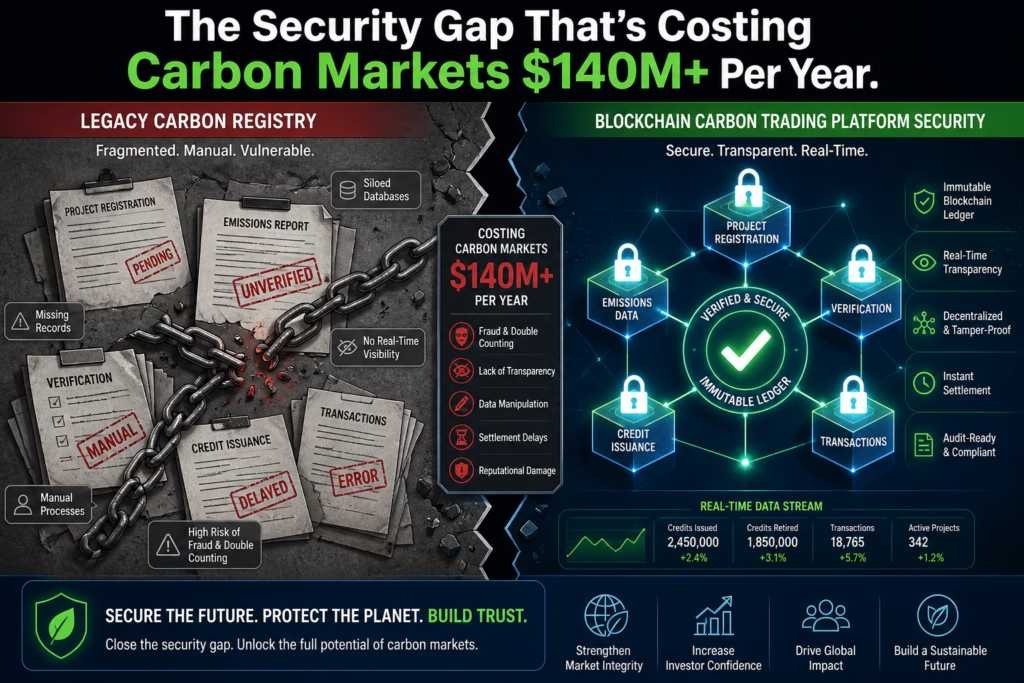
Blockchain carbon trading platform security is not a single feature — it is a layered architecture. Each layer addresses a distinct attack vector. Each also has a direct ROI implication that experienced platform operators can quantify before a single line of code is written.
The foundational security guarantee of any blockchain carbon trading platform is immutability: once a credit issuance, transfer, or retirement is recorded on-chain, it cannot be retroactively altered. This eliminates the most common attack vector in legacy carbon registries — record manipulation by insiders or database-level intrusions.
The ROI implication is direct. When your platform’s transaction records are cryptographically immutable, every credit retirement generates court-admissible documentation. That documentation converts from a nice-to-have ESG asset into a legal shield against greenwashing litigation — liability exposure that averaged $6.3 million per settlement in the EU in 2024.
Smart contracts govern the automated logic of every blockchain carbon trading platform: when a credit is issued, when it clears for purchase, when it is retired, and what quality thresholds it must meet. A vulnerability in a smart contract is not a software bug — it is an open vault.
The 2023 attack on a voluntary carbon blockchain platform exploited a reentrancy vulnerability in its credit retirement function, allowing an attacker to mark credits as retired in the platform’s UI while simultaneously re-listing them for sale. The attack went undetected for 23 days before a registry reconciliation caught the discrepancy.
Professional smart contract auditing — performed by independent cryptographic security firms before platform launch — costs between $15,000 and $80,000 depending on contract complexity. The breach described above resulted in $11 million in fraudulent credits reaching buyers. The audit cost would have been less than 0.7% of the resulting exposure. For any enterprise procuring blockchain carbon trading platform development, smart contract audit requirements should be non-negotiable in the vendor engagement.
Not everyone who interacts with a blockchain carbon trading platform should have the same permissions. A project developer submitting credits for verification has different access requirements than a corporate buyer executing a retirement, and both have different requirements than a compliance auditor pulling registry records.
Robust blockchain carbon trading platform security implements role-based access control (RBAC) at the smart contract level — not just the application interface level. This distinction matters: an interface-level access control can be bypassed by anyone with direct blockchain access. Contract-level RBAC cannot.
Combined with hardware security module (HSM) key management for administrator credentials, this layer eliminates the insider threat vector that accounts for 34% of financial platform breaches globally.
A blockchain carbon trading platform does not exist in isolation. It connects to external registries — Verra, Gold Standard, ACR, India’s BEE Registry, national compliance systems — and those integration points are security-critical surfaces.
The blockchain may be immutable, but if a malicious actor can manipulate the data feed before it reaches the chain, the chain records a fraudulent truth with perfect integrity. This is called an oracle attack — and it is one of the most sophisticated and underappreciated risks in blockchain carbon trading platform security.
Secure oracle architecture uses multi-source data validation (requiring independent confirmation from at least three registry data sources before on-chain recording), cryptographic attestation of data origin, and anomaly detection algorithms that flag statistical outliers in real-time registry feeds. Platforms built without oracle security are as vulnerable as those with no blockchain at all.
The underlying consensus mechanism of your blockchain carbon trading platform determines its fundamental security guarantees — and its energy profile, which matters for a carbon market platform where ESG optics are central to the value proposition.
Proof-of-work consensus offers high security but carries an ironic carbon cost. Proof-of-stake and delegated proof-of-stake mechanisms offer equivalent security guarantees for carbon market use cases at less than 1% of the energy consumption. Permissioned blockchain architectures — Hyperledger Fabric, Quorum — allow enterprise-grade access control while maintaining distributed ledger integrity and are increasingly favored for compliance-grade blockchain carbon trading platform security because they give regulators a defined audit pathway without exposing commercial transaction data to public blockchain explorers.
The consensus mechanism choice is a blockchain carbon trading platform security decision that cannot be changed post-deployment without a complete platform rebuild. It belongs in your architecture specification document, not in your post-launch incident review.
Carbon credit transactions carry commercially sensitive data: the counterparties involved, the volumes traded, the prices paid, and the strategic sustainability positions those trades reveal. On a public blockchain, all of that is transparent by default.
For enterprise operators, blockchain carbon trading platform security requires a clear answer to a question most platform RFPs fail to ask: which data is on-chain (and therefore public), which data is stored off-chain with cryptographic references (and therefore private but verifiable), and which data is subject to regional data residency requirements under GDPR, India’s DPDP Act, or equivalent frameworks?
A platform that records raw transaction metadata on a public blockchain may expose your procurement strategy to competitors or violate data protection regulations — while technically offering perfect ledger immutability. Proper blockchain carbon trading platform security architecture separates these concerns explicitly.
Static security is not security. Blockchain carbon trading platform security requires real-time threat monitoring: anomaly detection on transaction patterns, automated circuit breakers that pause suspicious activity pending human review, and pre-defined incident response playbooks that allow your team to respond to a security event in minutes, not days.
The average time-to-detection for a blockchain financial platform breach in 2024 was 19 days. The average cost of a breach detected within 24 hours was 58% lower than one detected after a week. Continuous monitoring infrastructure is the insurance policy that converts that cost curve into a manageable variable.
The blockchain carbon trading platform security investment case is most compelling when it is quantified. Here is the financial architecture of that investment, broken down across the risk vectors it addresses.
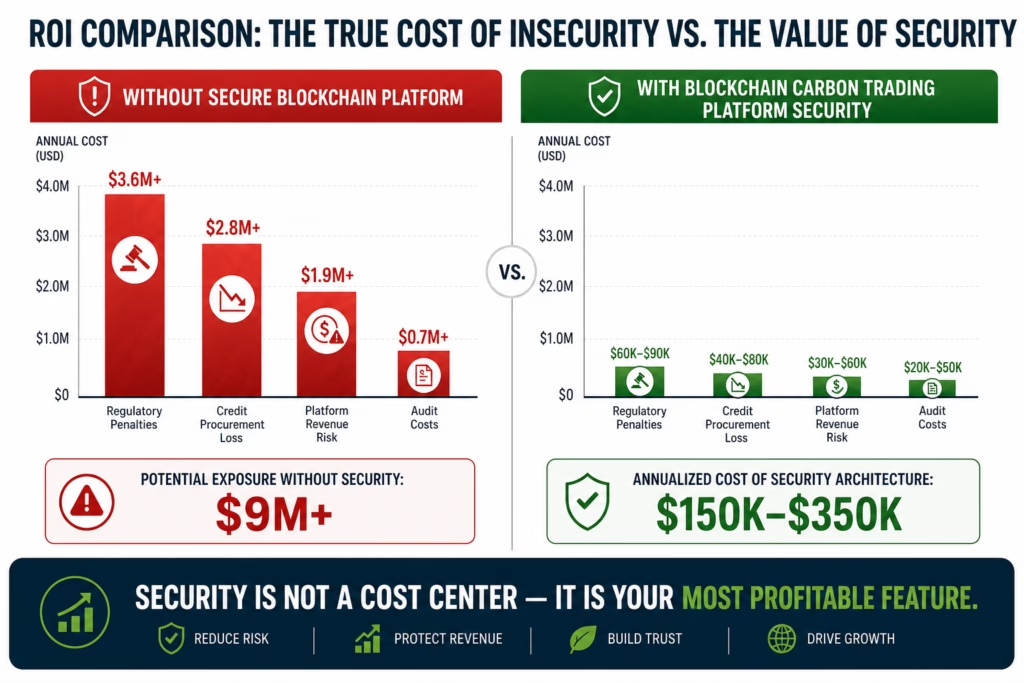
Most blockchain carbon trading platform development engagements focus on the functionality stack: credit issuance workflows, trading engine, retirement logic, reporting dashboards. Security is frequently treated as a phase-two concern — something to be addressed after launch, when trading volume justifies the investment.
That sequencing is expensive. Retrofitting security architecture into a deployed platform costs 3–6 times more than building it in from the start, because smart contract logic cannot be patched — it must be redeployed, which requires migrating existing credit records and rebuilding user trust simultaneously.
When evaluating blockchain carbon trading platform development partners, demand explicit answers to these questions before any engagement begins:
The development partner should specify their smart contract audit process and which third-party auditors they engage. They should define their oracle security architecture for registry integration — not just confirm that integration exists. They should identify which data elements are on-chain versus off-chain and provide the cryptographic bridging mechanism between them. They should confirm their consensus mechanism selection and the rationale specific to carbon market regulatory requirements. And they should provide a documented incident response protocol, not just a security SLA.
Any development partner who cannot answer these questions before scoping begins is not equipped to build production-grade blockchain carbon trading platform security.
There is a market dynamics argument for blockchain carbon trading platform security investment that goes beyond risk avoidance: it is a competitive differentiator that is available now but will not remain so for long.
Carbon markets are in the institutional adoption phase. Major financial institutions — BlackRock, HSBC, Deutsche Bank — are entering voluntary and compliance markets as buyers, intermediaries, and infrastructure investors. These institutions have enterprise security requirements that most existing carbon trading platforms, built during the earlier growth phase of the market, cannot meet. Their procurement processes include security architecture reviews that legacy platforms fail.
A blockchain carbon trading platform built to institutional-grade security standards in 2025–2026 is positioned to capture this institutional onboarding wave. Platforms that cannot demonstrate cryptographic audit trails, smart contract audit certifications, and data residency compliance will not pass institutional due diligence — regardless of how competitive their transaction fees are.
The global carbon credit trading platform market is projected to grow from $235 million in 2026 to over $1.27 billion by 2034, at a CAGR of 23.47%. Institutional capital will drive a disproportionate share of that growth. Blockchain carbon trading platform security is the entry credential for the institutional segment of that market.
Building a production-grade, security-first blockchain carbon trading platform requires expertise across three domains simultaneously: blockchain architecture, carbon market compliance, and financial platform security. These domains rarely intersect in a single development team — which is why most platforms built by pure blockchain shops fail carbon market compliance reviews, and most platforms built by traditional fintech firms lack the cryptographic security architecture that institutional carbon buyers require.
The right development and implementation partner for a blockchain carbon trading platform brings a defined track record in all three: deployed blockchain infrastructure with verified security audit histories, direct knowledge of carbon registry integration requirements across Verra, Gold Standard, BEE, and compliance registries, and a platform architecture methodology that treats blockchain carbon trading platform security as a first-principle design constraint — not a post-launch feature roadmap item.
That combination — domain expertise, security-first architecture, and regulatory knowledge — is what converts a blockchain carbon trading platform investment from a technology purchase into a defensible, compounding business asset.
The enterprises that treat blockchain carbon trading platform security as a cost to minimize will spend far more resolving the incidents that follow than they saved by cutting corners on architecture. The enterprises that treat it as a strategic investment — in regulatory resilience, institutional credibility, and platform revenue protection — will find that the ROI case for security is stronger than the ROI case for almost any other platform feature they could fund instead.
The voluntary carbon market crossed $1 billion in 2025. The global compliance market is at $113 billion and growing. The infrastructure layer that secures those transactions — cryptographically, legally, and operationally — is the most defensible position in the entire carbon economy.
The question is not whether your blockchain carbon trading platform needs enterprise-grade security. The question is whether you build that security into the platform now, or pay multiples to retrofit it after your first incident.
Ready to build a blockchain carbon trading platform with security architecture that satisfies institutional buyers, regulatory auditors, and ESG investors simultaneously? Let’s map your security requirements to a platform investment that generates measurable ROI from day one.