

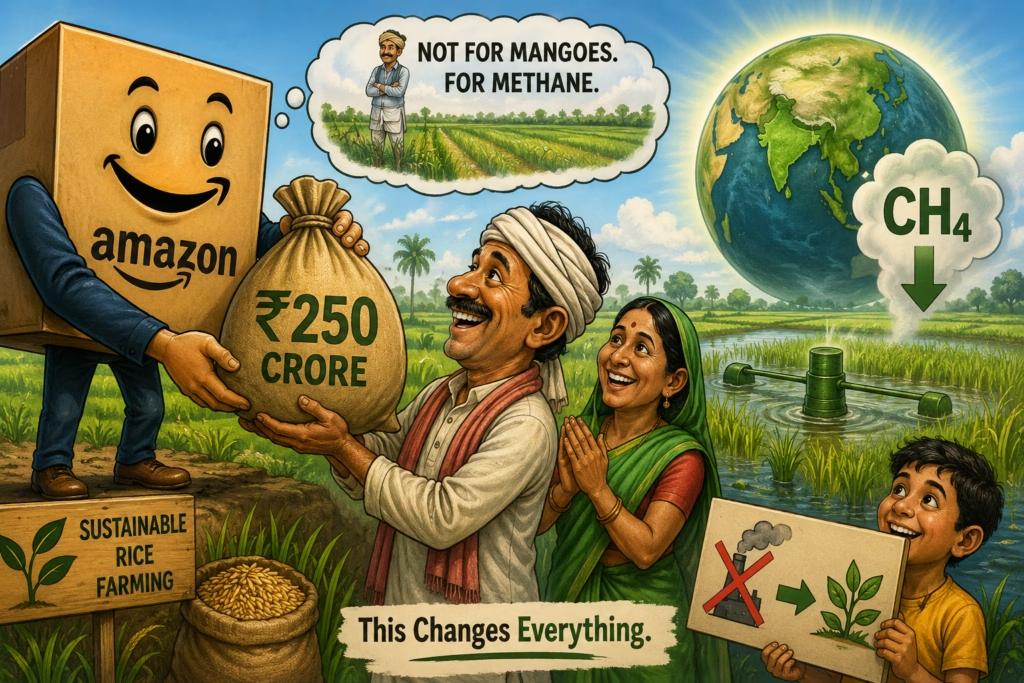
The world’s largest e-commerce company didn’t come to India for mangoes. It came for methane.
On April 22, 2026 – Earth Day – Amazon announced something that had nothing to do with Prime delivery, AWS cloud servers, or Alexa.
Amazon signed a $30 million agreement to purchase carbon credits generated by Indian rice farmers, marking one of the largest agriculture-linked carbon deals in the country to date.
Let that sink in.
The company that delivers everything from books to refrigerators in 24 hours just wrote a ₹250 crore cheque – not for technology, not for logistics, but for the methane that 13,000 Indian farmers agreed not to release into the atmosphere.
This is not a CSR donation. This is not greenwashing PR. This is a hard commercial transaction — a purchase order for a commodity that didn’t exist 15 years ago, generated by people who have been farming rice the same way for generations.
And it should make every farmer, every agri-tech founder, every corporate sustainability head, and every Indian policymaker pay very close attention.
To understand why Amazon made this deal, you first need to understand why Indian rice fields matter to the global climate, and why that matters to a company selling cloud servers and running shoes.
Traditional rice farming usually keeps fields flooded for long periods. This creates a low-oxygen environment where methane-producing bacteria thrive. Rice cultivation contributes nearly 8–10% of global methane emissions.
Methane isn’t CO₂. It’s far worse in the short term. Methane is a super-pollutant roughly 27 times more potent than CO₂ over a century, and over a 20-year window, the gap is even larger.
For Amazon, which has pledged to reach net-zero emissions and has signed onto The Climate Pledge, committing to the Paris Agreement goals 10 years early, reducing methane is one of the fastest levers available. And India’s rice paddies vast, measurable, and responsive to a relatively simple intervention — are among the most cost-effective places on Earth to pull that lever.
The transaction is among the largest of its kind anywhere in the world and is the first deal at this scale to focus on the Indian agriculture sector.
India wasn’t a compromise. It was the destination.
The farming technique that made this entire deal possible has a straightforward name: Alternate Wetting and Drying (AWD).
Rather than keeping rice paddies continuously flooded — which creates oxygen-free conditions that produce methane – under AWD, fields are periodically allowed to dry, disrupting methane formation while maintaining crop yields.
Farmers use a simple perforated pipe inserted into the soil to monitor water levels. When the water drops to a threshold below the surface, they irrigate again. The cycle of drying and re-flooding prevents the anaerobic conditions that bacteria need to produce methane.
The results are significant. Beyond carbon reduction, these techniques have reduced irrigation water use by 30%.
Less water pumped. Lower electricity or diesel costs. Same yield. And now – a carbon credit payment on top.
Alongside AWD, the project also promotes Direct Seeded Rice (DSR), which eliminates the transplanting stage and reduces the overall time during which fields remain submerged.
Two techniques. Proven science. Massive scale potential.
Amazon didn’t walk into a Punjab village and start handing out pipes. The deal was structured through a carefully built institutional framework.
The agreement is being executed through the Good Rice Alliance – a collaboration between Bayer, GenZero, and Shell Nature-Based Solutions, backed by Singapore’s Temasek. Rather than dealing directly with individual farmers, Amazon is tapping into this alliance to scale the programme efficiently.
This structure is critical to understanding why the deal works, and why it hasn’t happened at scale in India before.
Individual farmers cannot access global carbon markets on their own. The verification costs alone would exceed what a single smallholder could ever earn. You need aggregation, thousands of farmers pooled into a single project, and you need institutional credibility to make corporate buyers confident the credits are real.
To ensure total integrity, the credits are verified via Verra’s VM0051 methodology, utilizing a triple-layer audit: on-ground field measurements, biogeochemical modeling, and satellite-based soil moisture tracking to cross-verify every claim.
This is not a project running on farmer self-reporting and hope. It is a rigorous, science-backed, satellite-verified system, built precisely because the voluntary carbon market has been burned before by low-quality offsets and has demanded higher standards ever since.
The most important question in any carbon project involving smallholder farmers is always: does the money reach the people doing the work?
The programme provides participating farmers with training, technical field support, and financial incentives to transition to farming practices that reduce methane emissions. This combination of technical assistance and direct financial compensation is central to the economic logic of the scheme, because smallholders typically face constraints on capital, labour, and access to information that prevent them from adopting new practices purely on the basis of long-term productivity benefits.
In plain terms: farmers get trained, supported, and paid. Not just promised.
The financial incentive flows as carbon credit revenue is realized — but the support structures (training, field staff, monitoring infrastructure) are front-loaded, which means farmers aren’t left to figure this out alone.
The Good Rice Alliance states that improved water management can materially reduce emissions while preserving productivity. The model is designed to be scalable across rice-producing regions.
The current project covers 13,000 farmers. But the methodology, the infrastructure, and now the proof-of-commercial-viability exist to scale this across millions of acres.
Corporate carbon credit purchases have historically been dominated by renewable energy projects and forestry offsets. Both have faced serious criticism — renewable energy credits are increasingly questioned for additionality (would those solar plants have been built anyway?), and forestry credits have faced scandals around permanence and verification.
Agriculture-based methane reduction is different. Nature-based solutions, including forestry, soil, and agricultural methane abatement, are attracting higher premiums because they deliver emissions reductions that would not otherwise have occurred and because they generate co-benefits for rural livelihoods and biodiversity.
Amazon’s choice to specifically target rice methane – rather than buying cheaper, easier credits elsewhere is a deliberate market signal. The company said its focus is on “real, verifiable climate outcomes” supported by field measurements and satellite validation. Traditionally, companies bought carbon credits from the market, but now they are investing directly in projects to create their own supply.
This upstream investment model, where corporate buyers don’t just purchase credits but help build the systems that generate them, is the new frontier of high-integrity carbon markets. Microsoft recently signed a soil carbon credit deal valued at between $171 million and $228 million, and Meta agreed to a forestry credit arrangement worth up to $16 million.
Amazon’s ₹250 crore commitment to Indian rice farmers sits squarely in this emerging category of serious, high-integrity, measurable corporate climate action.
Here’s where the story gets complicated, and where Indian stakeholders need to pay attention.
A key question remains: who owns the credit – the farmer or the developer? Experts say if India sells its low-cost emission reductions, like methane cuts in agriculture, to global buyers, it may be left with more expensive options to meet its own climate targets. This is in line with the Paris Climate Agreement’s Article 6, which requires countries to adjust their emissions accounting when credits are exported.
This is not a reason to avoid carbon markets. It is a reason for India to develop a clear, sovereign policy framework around agricultural carbon credits, one that ensures India retains enough domestic offset capacity to meet its own NDC (Nationally Determined Contribution) targets while still enabling farmers to benefit from global markets.
There are also concerns around monitoring and verification systems being weak in some projects, and long delays in issuing credits. Trust remains a barrier, particularly because farmers have been promised income from “schemes” before and been disappointed.
The answer to these challenges is not to slow down. It is to build better infrastructure, better MRV (Measurement, Reporting and Verification) systems, better farmer-facing platforms, better policy guardrails, and more transparent payment mechanisms.
Industry experts say while Amazon’s deal may appear singular, it represents a larger experiment to test whether India can turn millions of small farms into a reliable, tradable climate solution, and if successful, whether it can scale across the Global South.
India has 44 million hectares under rice cultivation. The current project covers 35,000 hectares – less than 0.1% of the total area.
If the Amazon-Good Rice Alliance model proves replicable and scalable, the numbers become extraordinary:
What distinguishes India is the institutional infrastructure – research bodies like ICAR, established agri-tech players, and the ability to build last-mile farmer networks and digital monitoring systems.
The foundation exists. What’s been missing is the proof that global corporate buyers will show up with real money.
Amazon just provided that proof. To the tune of ₹250 crore.
Amazon didn’t come to India’s rice fields by accident.
They came because the science is solid, the scale is enormous, the credits are verifiable, and the cost of methane reduction through AWD is among the lowest available anywhere in the world.
They came because India’s 93 million farming households represent the largest untapped carbon abatement workforce on the planet.
The question now is whether Indian institutions, agri-tech platforms, FPOs, and policymakers can build the infrastructure to ensure that the next ₹250 crore, and the ₹2,500 crore after that, reaches Indian farmers directly, keeps value within India’s rural economy, and positions India not just as a supplier of cheap offsets, but as the global leader in high-integrity agricultural carbon markets.
That work is already underway.
And it starts with 13,000 farmers who changed how they water their rice.
Techaroha is building India’s carbon credit infrastructure. connecting verified agricultural projects, corporate buyers, and farmer communities on a single transparent platform.
If you’re an FPO, agri-business, or corporate sustainability team looking to engage with India’s agricultural carbon market, let’s talk.