
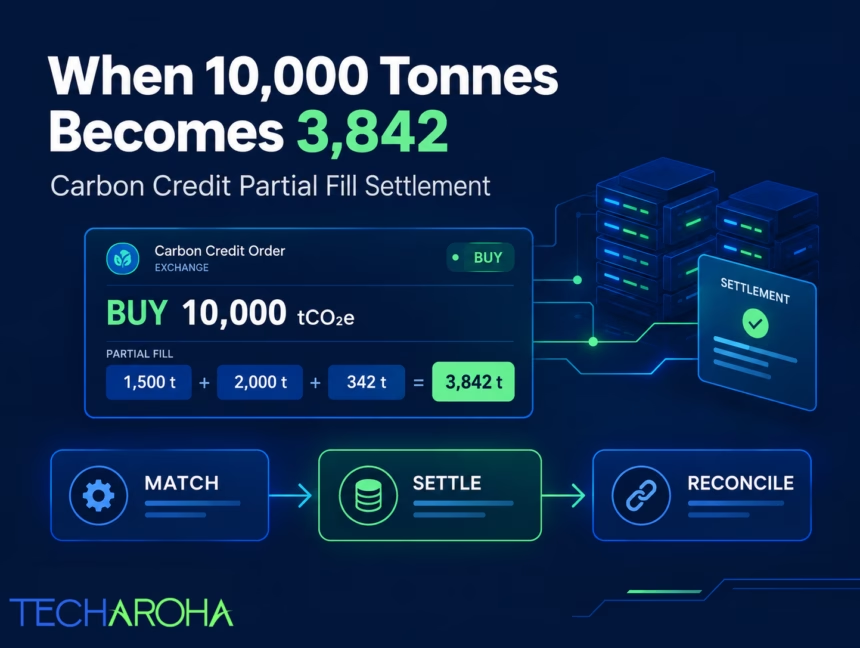
A carbon exchange can display a beautiful order book and still have fundamentally broken trading infrastructure. The real test begins when a buyer submits an order for 10,000 tonnes, but the matching engine can only execute 3,842 tonnes across multiple eligible sellers. What happens to the remaining 6,158 tonnes? More importantly: This is where carbon credit partial fill settlement becomes an architecture problem rather than a UI feature. Traditional exchange infrastructure already understands partial fills. Carbon markets make the problem harder because the underlying asset isn’t simply “10,000 units.” A carbon order can depend on vintage, methodology, geography, project, registry, authorization status, corresponding adjustment, removal/reduction classification, co-benefits, eligibility rules and available inventory.That means the matching engine cannot simply ask: “Does price match?” It needs to ask: “Does price match and does this exact inventory satisfy the buyer’s eligibility constraints at execution time?” And settlement has to preserve that decision. Why Partial Fills Are More Complicated in Carbon Markets Consider this order: Order Parameter Buyer Requirement Quantity 10,000 tCO₂e Maximum price $18/t Registry Approved registry Vintage 2022–2025 Methodology Removal Geography Eligible jurisdictions Eligibility Corporate procurement criteria Time-in-force IOC The order enters the exchange. The engine finds: But Seller D’s inventory subsequently fails an eligibility check. The executable quantity is therefore 3,840 tonnes, not 8,340. That single change creates several state transitions. Order state NEW → PARTIALLY_FILLED → CANCELLED/EXPIRED Inventory state AVAILABLE → RESERVED → TRADED → SETTLED Settlement state PENDING → PARTIALLY_SETTLED → SETTLED Registry state TRANSFER_REQUESTED → CONFIRMED / FAILED A production platform must maintain these states independently without allowing them to contradict one another. That is the core challenge behind carbon credit partial fill settlement. 1. Start With the Matching Engine, Not Settlement Settlement problems are frequently symptoms of weak execution architecture. A robust carbon exchange should separate at least these logical layers: The important architectural principle is that matching creates an execution commitment; settlement fulfils that commitment.Settlement should not independently decide what was traded. If the settlement service recalculates eligibility or price independently from the matching engine, the platform can create discrepancies between: That is precisely what an exchange operator wants to avoid. Read: The Authorization Wall: How Custom Carbon Exchanges Must Architect for Article 6 Corresponding Adjustments 2. Eligibility Must Be Part of Matching A common architecture mistake is to treat eligibility as a front-end filter. For example: “Show the buyer only CORSIA-eligible credits.” That is not enough. The eligibility decision needs to survive all the way into execution. Suppose a buyer wants 5,000 tonnes of eligible inventory. The matching engine finds three lots: Seller Available Price Eligibility Executable A 1,200 $14.80 Yes 1,200 B 2,000 $15.10 Yes 2,000 C 3,000 $15.40 No 0 The engine should not match 5,000 tonnes and “sort out eligibility later.” The correct result is: 3,200 tonnes executable + 1,800 tonnes residual. This distinction becomes especially important when eligibility can change because of: For institutional trading, eligibility should therefore be represented as a versioned execution condition, not simply a UI attribute. 3. Order Types Determine Partial-Fill Behaviour Not every order should behave the same way. A carbon exchange may support several order instructions depending on its market design. Order Type Partial Fill? Typical Behaviour Limit Yes Execute available eligible quantity and leave residual Market Usually yes Execute against eligible liquidity subject to protection rules IOC Yes Fill available quantity immediately; cancel residual FOK No Execute only if entire eligible quantity can be filled GTC Yes Leave residual active until filled/cancelled/expired GTD Yes Remain active until specified expiry Smart Order Yes Route across eligible liquidity sources For carbon credit partial fill settlement, this distinction matters because the residual order is not necessarily another settlement. The platform must clearly separate: Executed quantity from Remaining quantity For example: The settlement engine must never accidentally treat the original 10,000 tonnes as the settled amount. 4. Partial Fill Is an Execution Event, Not an Order Event This is a subtle but critical architecture decision. One order can generate multiple executions. For example: The order has therefore executed: 3,842 tonnes But the exchange has three separate execution records. Each execution should have its own immutable identifiers and economic details. At minimum: This event-level structure is what makes downstream reconciliation possible. 5. The Smart Order Router Has a Different Job A smart order router should not simply find the cheapest credit. It should find the best executable eligible liquidity according to the exchange’s routing policy. Imagine: The router can evaluate: This becomes particularly valuable when the exchange operates as an aggregation layer rather than a single order book. The router should also preserve execution provenance. If 10,000 tonnes are sourced through four venues, the platform needs to know exactly where every tonne originated. 6. The Hard Part: Carbon Credit Partial Fill Settlement This is where many marketplace architectures become fragile. Suppose: Buyer order = 10,000 tonnes The engine executes: Total: 3,842 tonnes Settlement should operate on the 3,842-tonne execution set, not the original order. A simplified flow looks like: The settlement orchestrator should maintain a state machine rather than a single Boolean such as: settled = true A more useful model is: That distinction becomes essential when registry APIs are asynchronous or unreliable. 7. Registry Confirmation Should Not Be Treated as a Synchronous Assumption Carbon exchanges often depend on external registry infrastructure. The exchange might successfully execute a trade, but the registry transfer could: Therefore: Trade execution ≠ registry settlement. The platform needs a durable settlement workflow. For example: The exact ordering can vary depending on custody and counterparty-risk design, but the state transitions must be explicit. 8. Idempotency Is Mandatory Imagine the registry confirms a transfer. Your webhook receives the confirmation. The service processes it. Then the same webhook arrives again. If the system simply says: “Transfer confirmed → add 1,500 tonnes” you have a serious accounting problem. Instead, settlement events need unique evidence identifiers. For example: The settlement processor should verify whether that evidence has already been consumed. Conceptually: This is one of the most important

Building a carbon exchange is not primarily a software decision. It is an ownership, liquidity, compliance, and time-to-market decision. Here is how founders and CTOs should actually choose between building, buying, or going white-label. You have the business model.You know who will supply the credits.You may already have project developers, corporate buyers, brokers, or investors interested.Then someone asks the uncomfortable question: “Are we building the exchange ourselves, buying existing software, or launching on a white-label platform?” That decision can determine how much control you have three years from now. Get it wrong, and you can end up with a platform that launches quickly but cannot support your compliance model, a custom system that consumes a year of capital before generating liquidity, or a white-label solution that looks like your exchange but behaves like someone else’s product. That is why the build vs buy carbon exchange decision should not be reduced to development cost. The real question is:Which implementation route gives your business the right combination of speed, control, compliance, economics and future ownership?There are three realistic routes: The right answer depends on what you are actually trying to own. Build vs Buy Carbon Exchange: Start With the Business Model, Not the Software A common mistake is starting with a feature checklist. “Does it have an order book?”“Does it support wallets?”“Does it have an admin dashboard?”“Can buyers purchase credits?” Those questions matter, but they come too late. A carbon exchange is not simply a website where tonnes are listed.Behind every transaction may be: The implementation route should therefore follow the business model and market structure. If your exchange is fundamentally different from existing platforms, customization becomes strategically important.If your model is conventional and speed is everything, buying may make sense.If you need your own brand and customer relationship without funding an entire exchange architecture from scratch, white-label can be the middle ground. The Three Carbon Exchange Routes Factor Custom Build Buy Existing Platform White-Label Initial speed Slowest Fast Fastest Upfront investment Highest Low–Medium Medium Customization Very High Limited Medium–High Brand ownership Full Depends on vendor Usually high IP ownership Negotiable/full Vendor-owned Usually vendor-owned core Registry integration Custom Depends on vendor Configurable Compliance logic Designed around your model Vendor constraints Depends on architecture Scalability Designed for your roadmap Product-dependent Depends on shared architecture Vendor dependency Lower High High Best for Strategic exchange operators Standard requirements Fast market entry But there is a more important distinction. You are not choosing between three software packages. You are choosing where your competitive advantage will live. Option 1: Build a Custom Carbon Exchange A custom build means the exchange is engineered around your requirements rather than forcing your requirements into somebody else’s product.This does not necessarily mean writing every component from zero.A competent development partner can use established engineering patterns, cloud infrastructure, security frameworks, payment infrastructure, and reusable components while custom-building the business-critical layers. Build makes sense when you need: The biggest advantage is control. You decide how credits are represented.You decide which attributes affect eligibility.You decide how orders are matched.You decide how settlement works.You decide which integrations become core infrastructure. That control becomes particularly valuable when the market evolves. A regulation changes.A registry changes its integration model.A new credit category becomes commercially important. Your buyer requires a new settlement mechanism. With a custom platform, those changes become engineering decisions rather than vendor negotiations. But a custom build has a serious disadvantage. Time. A serious exchange cannot be treated like a standard marketplace website. Architecture, security, testing, registry integrations, matching, settlement, and operational controls all take engineering effort. That means custom development is usually a poor choice for a company that simply wants to “test whether people will buy carbon credits.” It becomes much more attractive when the exchange itself is intended to become a long-term business asset. Option 2: Buy an Existing Carbon Exchange Platform Buying software is attractive because it appears to eliminate the hardest part of the problem. The vendor has already built: You configure it and launch. For a company with standard requirements, this can be perfectly reasonable. Buy when: But there is a question founders often forget to ask: What happens when your business becomes more successful than the software you bought? That is the real risk. A platform can be excellent today and still become restrictive tomorrow. Imagine that your exchange eventually needs: If the vendor cannot support those changes, your growth becomes constrained by someone else’s product roadmap. The hidden cost of buying The licence fee is only one part of the equation. You should evaluate: Licence + integration + customization + migration + vendor dependency + switching cost A cheap platform can become expensive if every meaningful change requires paid customization. Option 3: White-Label Carbon Exchange This is where the decision becomes more interesting. A white-label carbon exchange allows you to launch under your own brand while using an underlying platform infrastructure provided by another company. For a company that wants market presence quickly, this can be attractive.You can potentially get: without financing every component of the platform from scratch.The critical word, however, is architecture. Not every white-label solution is actually suitable for carbon markets. A generic crypto exchange with a new logo is not automatically a carbon exchange. Carbon credits have attributes that influence whether a transaction is valid. For example: A serious white-label architecture therefore needs more than a branded front end.It needs appropriate tenant isolation, configurable business rules, registry integrations, permissions, transaction controls, and compliance-aware workflows. Read our Article- What Does a Carbon Exchange Actually Cost to Build? A Module-by-Module Breakdown The Build vs Buy Carbon Exchange Decision Matrix Instead of asking which route is “best,” score each route against your actual requirements. Decision Factor Build Buy White-Label Budget sensitivity ★★ ★★★★★ ★★★★ Speed to launch ★★ ★★★★ ★★★★★ Product differentiation ★★★★★ ★★ ★★★ Platform control ★★★★★ ★★ ★★★ Compliance customization ★★★★★ ★★ ★★★★ Registry flexibility ★★★★★ ★★–★★★ ★★★ Long-term ownership ★★★★★ ★★ ★★★ Engineering independence ★★★★★ ★★ ★★★ MVP validation ★★★ ★★★★★ ★★★★★

Six updates moved carbon markets between August 15 and August 21, 2026, and every one of them points to the same unresolved question: can your compliance carbon trading infrastructure actually keep pace with a regulatory landscape that’s rewriting its own rulebook every few days? The EU published binding CBAM guidance. European allowances ticked higher on compliance buying. Australia moved to strip integrity risk out of its ACCU scheme. Latin American nations wired CORSIA aviation logic into domestic markets. ICVCM opened new methane and fuel-substitution methodologies for consultation. And a Japanese trading house opened direct accounts on two of the world’s largest voluntary registries. None of these updates are isolated. Together, they describe a market where compliance carbon trading infrastructure has to absorb cross-border tax logic, price volatility, methodology governance, and multi-registry connectivity, all at once, all in the same week. This post walks through all six updates and what each one demands from the platforms sitting underneath them. 1. EU CBAM Implementation Rules: Embedded Emissions Just Got a Rulebook The European Commission published its definitive-period guidance package covering embedded emissions calculations, free allocation adjustments, and sector-specific monitoring for CBAM’s compliance phase. The guidance spells out how importers must calculate specific embedded emissions, apply the free allocation adjustment factor, and use default values only when actual data isn’t available, with penalty surcharges starting at 10% in 2026 for anyone who leans on defaults instead of verified figures. Here’s what that means operationally for anyone building or buying compliance carbon trading infrastructure right now: A platform without native CBAM logic forces importers back into spreadsheets at the exact moment the Commission has made spreadsheet-based estimation the most expensive option on the table. 2. EU ETS Price Surge: Late-Week Compliance Buying Tightens the Market European carbon allowances ticked upward late in the week, driven by increased industrial compliance buying on secondary exchanges. This wasn’t a speculative spike; it was obligated entities covering their positions ahead of looming reporting deadlines and CBAM’s tightening certificate-holding requirements. That distinction matters, because compliance-driven price moves behave differently than speculative ones, they cluster around regulatory deadlines and tend to repeat on a predictable calendar. Price Driver Speculative Buying Compliance Buying (this week) Timing pattern Reacts to news, unpredictable Clusters near reporting/surrender deadlines Volume behavior Spikes and reverses quickly Sustained buying pressure into the deadline What software needs to do Volatility alerts, risk limits Deadline-aware forecasting, position tracking Client impact Trading desks, hedge funds Obligated industrial entities, compliance teams Compliance carbon trading infrastructure that can distinguish these two patterns gives brokers and desks something far more useful than a price feed: a reason behind the move, and a forecast for when it’s likely to happen again. 3. ACCU Scheme Integrity Overhaul: Australia Builds a Kill Switch for Bad Methods Australia introduced the Carbon Credits and Other Legislation Amendment (Integrity and Transparency) Bill 2026 to Parliament, giving the government a new power to issue Integrity Risk Method Declarations that can force existing projects onto safer, updated crediting methods, or strip a method’s ability to generate credits altogether. The reform follows years of scrutiny stemming from the Chubb Review and targets the exact failure mode that’s damaged buyer confidence in nature-based credits before: a method that looked sound at registration turning out, years later, to overstate abatement. For any platform trading ACCUs or similarly structured credits, this changes what “listing a credit” needs to mean: This is a governance problem hiding inside a trading problem, and compliance carbon trading infrastructure that ignores method-level risk is exposing every buyer on the platform to a risk they can’t see coming. 4. LATAM Aviation Integration: CORSIA Logic Goes Domestic Latin American nations moved this period to integrate elements of the UN’s CORSIA aviation framework alongside market-stabilizing ETS mechanisms into their own domestic carbon schemes. That’s a meaningful architectural shift: instead of treating CORSIA compliance as a separate, aviation-only reporting exercise, these markets are folding aviation offset demand and supply-stabilization logic directly into the same domestic infrastructure used for broader compliance trading. What that means for platform architecture: Compliance carbon trading infrastructure built for a single scheme type breaks the moment a region decides to blend aviation and general compliance logic into one market, exactly what’s happening here. 5. ICVCM Methodology Feedback: Methane and Fuel Substitution Enter Public Consultation ICVCM-accredited standards opened new methodologies covering industrial methane abatement and fuel substitution protocols for public consultation this period. Methodology consultation windows are quiet events on the surface, no price moves, no headlines, but they’re exactly the kind of update that determines which credit types will carry Core Carbon Principles approval a year from now, and which will lose buyer confidence for lacking it. For platforms and brokers, a consultation period is an early warning system: Compliance carbon trading infrastructure that only reflects a credit’s current approval status, and not its pending methodology reviews, is giving buyers a rearview mirror when they need a windshield. 6. Japanese Exchange Expansion: Hamabo Opens Direct Registry Access Japanese trading house Hamabo established direct accounts with Verra and Xpansiv this period, expanding its international carbon offset operations beyond Japan’s domestic J-Credit scheme and Tokyo Stock Exchange carbon market. The move lets Hamabo access voluntary carbon credits directly through two of the largest global registry and exchange infrastructures instead of relying solely on domestic supply, a supply base that’s been outpaced by corporate demand for years. This is a small operational story with a large infrastructure implication: as more Asian corporates and trading houses follow Hamabo’s path, multi-registry connectivity stops being a nice-to-have and becomes table stakes. Compliance carbon trading infrastructure that only speaks to a single registry is already behind the market Hamabo just stepped into. Why Six Updates in One Week Is the Real Story Look at what happened between August 15 and August 21 as a single pattern instead of six separate news items. The EU tightened its border tax rulebook. European allowances moved on compliance deadlines. Australia built a mechanism to strip bad methods out of circulation.

Ask a compliance manager at an airline or a steel manufacturer how they buy carbon credits, and “spot market” is rarely the honest answer. Compliance obligations under EU ETS, CORSIA, or India’s CCTS don’t arrive as a single, predictable invoice. They arrive as a moving liability tied to a price that can swing 15% in a quarter because of a Market Stability Reserve adjustment, a sector expansion, or a court ruling nobody priced in. A procurement head who buys 100,000 tonnes on the spot market today has no protection if the compliance deadline price spikes before their next purchase window. That’s not a trading inconvenience; it’s a budgeting crisis waiting to happen, and it’s exactly why a carbon credit derivatives platform has become the missing layer in nearly every exchange built in the last three years. This post is for the people who feel that gap directly: commodity trading desk heads evaluating whether to add carbon to their book, green fintech founders whose spot exchange keeps losing institutional clients to “real” hedging venues, and CTOs told to “add options” without anyone explaining what that actually requires under the hood. We’re not pitching a finished product here we’re walking through how a serious engineering team architects a carbon credit derivatives platform, so you have a benchmark for whatever build or vendor conversation comes next. The Industry Friction: Why Spot-Only Exchanges Lose Institutional Buyers Corporate compliance buyers airlines under CORSIA, cement and steel majors under EU ETS, and increasingly Indian obligated entities under CCTS rarely trade only spot credits, for one simple reason: spot exposure is unhedged exposure. A treasury team managing a multi-million-dollar annual compliance liability needs tools that look far more like a commodities desk than a retail offsetting app. Here’s what that demand actually looks like in practice: A spot-only exchange simply has no vocabulary for any of this. And the buyers who need it most commodity trading desks, ESG-focused institutional funds, and large compliance obligors will not migrate to a platform that can’t speak their language. This is the single biggest reason exchange founders lose institutional deal flow to legacy commodities infrastructure repurposed for carbon: their own software never grew past spot. A carbon credit derivatives platform is what closes that gap. It doesn’t replace the spot order book it sits alongside it, giving the same exchange the ability to serve a hedge fund’s quant desk and a mid-sized manufacturer’s compliance officer with equally serious tooling. What a Carbon Credit Derivatives Platform Actually Has to Do Strip away the trading-floor jargon, and a carbon credit derivatives platform is solving three linked engineering problems, and any team evaluating a build in-house or outsourced should be judging the architecture against exactly these three: Get those three right, and a carbon credit derivatives platform stops being a “nice to have” feature bolted onto a spot exchange. It becomes the reason a commodity trading desk chooses one venue over another because structured risk tooling, not credit availability, is usually the deciding factor for institutional flow. Read: The 3-Day Wire Transfer Is Killing Your Carbon Deal: Architecting Cross-Border Carbon Credit Settlement Software Designing the Options & Automated Collateral Management Microservice The architectural core of any credible carbon credit derivatives platform is what we’d call an Options & Automated Collateral Management Microservice: a dedicated engine that sits apart from the spot matching engine, handling pricing, margin, and liquidation logic for every structured position on the exchange. Here’s the conceptual flow for a single options trade, from order entry to settlement: Step What Happens Who Sees It 1. Order intake Buyer submits a call or put option order with strike price, expiry, and premium bid Trader sees a standard options ticket 2. Real-time pricing The engine prices the contract using implied volatility derived from historical carbon price data and live order book depth Invisible; happens in milliseconds 3. Collateral haircut check The system pulls the counterparty’s credit-quality signal and applies a dynamic haircut to posted collateral Risk desk sees the adjusted margin requirement 4. Position opening Once margin clears, the contract is opened and logged against both counterparties Both parties see an active position in their dashboard 5. Continuous margin monitoring The engine re-evaluates collateral value against the position’s mark-to-market exposure on every price tick Risk team sees live margin utilization 6. Automated liquidation (if triggered) If collateral value breaches the maintenance threshold, the system unwinds the position per pre-agreed rules Counterparty receives an immediate liquidation notice Each of those six steps depends on engineering that a generic exchange codebase does not include out of the box. Building a carbon credit derivatives platform means designing three distinct subsystems, and each one deserves its own architectural decision. 1. The Real-Time Matching and Pricing Layer This is the buyer-facing surface of a carbon credit derivatives platform: an order book that handles calls, puts, and forward contracts alongside spot orders, without forcing every asset type through the same matching logic. Options pricing on carbon credits can’t simply borrow Black-Scholes wholesale; carbon markets have thinner liquidity, regulatory event risk (an MSR adjustment or a CORSIA phase change can move price more than any equity earnings call), and correlation patterns between compliance and voluntary credit tiers that a generic options engine has never seen. A serious matching layer blends standard options mathematics with carbon-specific volatility inputs pulled from historical price behavior around known regulatory events. 2. The Independent Credit-Rating Collateral Engine This is the layer that makes a carbon credit derivatives platform trustworthy to an institutional desk, and it’s also the piece most generic exchange builds skip entirely. Rather than treating every counterparty’s collateral the same way, the engine pulls independent credit-quality signals — the kind of ratings work done by firms like Sylvera and BeZero and applies a dynamic haircut to posted collateral based on that score. In practice, that means: This is the exact mechanism institutional trading desks expect from any serious derivatives venue, carbon or otherwise: collateral value that reflects independent, third-party risk assessment rather than