
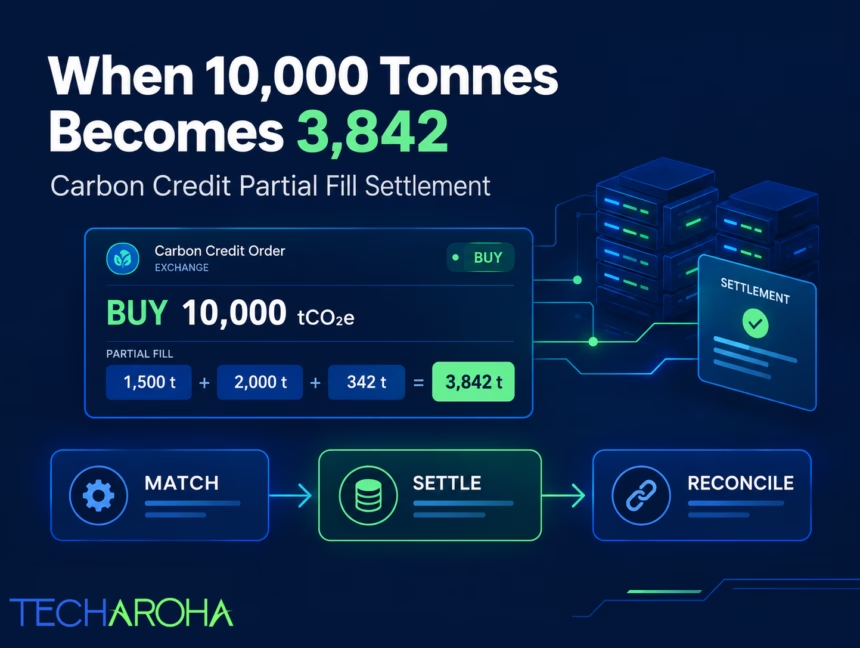
A carbon exchange can display a beautiful order book and still have fundamentally broken trading infrastructure. The real test begins when a buyer submits an order for 10,000 tonnes, but the matching engine can only execute 3,842 tonnes across multiple eligible sellers. What happens to the remaining 6,158 tonnes? More importantly: This is where carbon credit partial fill settlement becomes an architecture problem rather than a UI feature. Traditional exchange infrastructure already understands partial fills. Carbon markets make the problem harder because the underlying asset isn’t simply “10,000 units.” A carbon order can depend on vintage, methodology, geography, project, registry, authorization status, corresponding adjustment, removal/reduction classification, co-benefits, eligibility rules and available inventory.That means the matching engine cannot simply ask: “Does price match?” It needs to ask: “Does price match and does this exact inventory satisfy the buyer’s eligibility constraints at execution time?” And settlement has to preserve that decision. Why Partial Fills Are More Complicated in Carbon Markets Consider this order: Order Parameter Buyer Requirement Quantity 10,000 tCO₂e Maximum price $18/t Registry Approved registry Vintage 2022–2025 Methodology Removal Geography Eligible jurisdictions Eligibility Corporate procurement criteria Time-in-force IOC The order enters the exchange. The engine finds: But Seller D’s inventory subsequently fails an eligibility check. The executable quantity is therefore 3,840 tonnes, not 8,340. That single change creates several state transitions. Order state NEW → PARTIALLY_FILLED → CANCELLED/EXPIRED Inventory state AVAILABLE → RESERVED → TRADED → SETTLED Settlement state PENDING → PARTIALLY_SETTLED → SETTLED Registry state TRANSFER_REQUESTED → CONFIRMED / FAILED A production platform must maintain these states independently without allowing them to contradict one another. That is the core challenge behind carbon credit partial fill settlement. 1. Start With the Matching Engine, Not Settlement Settlement problems are frequently symptoms of weak execution architecture. A robust carbon exchange should separate at least these logical layers: The important architectural principle is that matching creates an execution commitment; settlement fulfils that commitment.Settlement should not independently decide what was traded. If the settlement service recalculates eligibility or price independently from the matching engine, the platform can create discrepancies between: That is precisely what an exchange operator wants to avoid. Read: The Authorization Wall: How Custom Carbon Exchanges Must Architect for Article 6 Corresponding Adjustments 2. Eligibility Must Be Part of Matching A common architecture mistake is to treat eligibility as a front-end filter. For example: “Show the buyer only CORSIA-eligible credits.” That is not enough. The eligibility decision needs to survive all the way into execution. Suppose a buyer wants 5,000 tonnes of eligible inventory. The matching engine finds three lots: Seller Available Price Eligibility Executable A 1,200 $14.80 Yes 1,200 B 2,000 $15.10 Yes 2,000 C 3,000 $15.40 No 0 The engine should not match 5,000 tonnes and “sort out eligibility later.” The correct result is: 3,200 tonnes executable + 1,800 tonnes residual. This distinction becomes especially important when eligibility can change because of: For institutional trading, eligibility should therefore be represented as a versioned execution condition, not simply a UI attribute. 3. Order Types Determine Partial-Fill Behaviour Not every order should behave the same way. A carbon exchange may support several order instructions depending on its market design. Order Type Partial Fill? Typical Behaviour Limit Yes Execute available eligible quantity and leave residual Market Usually yes Execute against eligible liquidity subject to protection rules IOC Yes Fill available quantity immediately; cancel residual FOK No Execute only if entire eligible quantity can be filled GTC Yes Leave residual active until filled/cancelled/expired GTD Yes Remain active until specified expiry Smart Order Yes Route across eligible liquidity sources For carbon credit partial fill settlement, this distinction matters because the residual order is not necessarily another settlement. The platform must clearly separate: Executed quantity from Remaining quantity For example: The settlement engine must never accidentally treat the original 10,000 tonnes as the settled amount. 4. Partial Fill Is an Execution Event, Not an Order Event This is a subtle but critical architecture decision. One order can generate multiple executions. For example: The order has therefore executed: 3,842 tonnes But the exchange has three separate execution records. Each execution should have its own immutable identifiers and economic details. At minimum: This event-level structure is what makes downstream reconciliation possible. 5. The Smart Order Router Has a Different Job A smart order router should not simply find the cheapest credit. It should find the best executable eligible liquidity according to the exchange’s routing policy. Imagine: The router can evaluate: This becomes particularly valuable when the exchange operates as an aggregation layer rather than a single order book. The router should also preserve execution provenance. If 10,000 tonnes are sourced through four venues, the platform needs to know exactly where every tonne originated. 6. The Hard Part: Carbon Credit Partial Fill Settlement This is where many marketplace architectures become fragile. Suppose: Buyer order = 10,000 tonnes The engine executes: Total: 3,842 tonnes Settlement should operate on the 3,842-tonne execution set, not the original order. A simplified flow looks like: The settlement orchestrator should maintain a state machine rather than a single Boolean such as: settled = true A more useful model is: That distinction becomes essential when registry APIs are asynchronous or unreliable. 7. Registry Confirmation Should Not Be Treated as a Synchronous Assumption Carbon exchanges often depend on external registry infrastructure. The exchange might successfully execute a trade, but the registry transfer could: Therefore: Trade execution ≠ registry settlement. The platform needs a durable settlement workflow. For example: The exact ordering can vary depending on custody and counterparty-risk design, but the state transitions must be explicit. 8. Idempotency Is Mandatory Imagine the registry confirms a transfer. Your webhook receives the confirmation. The service processes it. Then the same webhook arrives again. If the system simply says: “Transfer confirmed → add 1,500 tonnes” you have a serious accounting problem. Instead, settlement events need unique evidence identifiers. For example: The settlement processor should verify whether that evidence has already been consumed. Conceptually: This is one of the most important

Ask a compliance manager at an airline or a steel manufacturer how they buy carbon credits, and “spot market” is rarely the honest answer. Compliance obligations under EU ETS, CORSIA, or India’s CCTS don’t arrive as a single, predictable invoice. They arrive as a moving liability tied to a price that can swing 15% in a quarter because of a Market Stability Reserve adjustment, a sector expansion, or a court ruling nobody priced in. A procurement head who buys 100,000 tonnes on the spot market today has no protection if the compliance deadline price spikes before their next purchase window. That’s not a trading inconvenience; it’s a budgeting crisis waiting to happen, and it’s exactly why a carbon credit derivatives platform has become the missing layer in nearly every exchange built in the last three years. This post is for the people who feel that gap directly: commodity trading desk heads evaluating whether to add carbon to their book, green fintech founders whose spot exchange keeps losing institutional clients to “real” hedging venues, and CTOs told to “add options” without anyone explaining what that actually requires under the hood. We’re not pitching a finished product here we’re walking through how a serious engineering team architects a carbon credit derivatives platform, so you have a benchmark for whatever build or vendor conversation comes next. The Industry Friction: Why Spot-Only Exchanges Lose Institutional Buyers Corporate compliance buyers airlines under CORSIA, cement and steel majors under EU ETS, and increasingly Indian obligated entities under CCTS rarely trade only spot credits, for one simple reason: spot exposure is unhedged exposure. A treasury team managing a multi-million-dollar annual compliance liability needs tools that look far more like a commodities desk than a retail offsetting app. Here’s what that demand actually looks like in practice: A spot-only exchange simply has no vocabulary for any of this. And the buyers who need it most commodity trading desks, ESG-focused institutional funds, and large compliance obligors will not migrate to a platform that can’t speak their language. This is the single biggest reason exchange founders lose institutional deal flow to legacy commodities infrastructure repurposed for carbon: their own software never grew past spot. A carbon credit derivatives platform is what closes that gap. It doesn’t replace the spot order book it sits alongside it, giving the same exchange the ability to serve a hedge fund’s quant desk and a mid-sized manufacturer’s compliance officer with equally serious tooling. What a Carbon Credit Derivatives Platform Actually Has to Do Strip away the trading-floor jargon, and a carbon credit derivatives platform is solving three linked engineering problems, and any team evaluating a build in-house or outsourced should be judging the architecture against exactly these three: Get those three right, and a carbon credit derivatives platform stops being a “nice to have” feature bolted onto a spot exchange. It becomes the reason a commodity trading desk chooses one venue over another because structured risk tooling, not credit availability, is usually the deciding factor for institutional flow. Read: The 3-Day Wire Transfer Is Killing Your Carbon Deal: Architecting Cross-Border Carbon Credit Settlement Software Designing the Options & Automated Collateral Management Microservice The architectural core of any credible carbon credit derivatives platform is what we’d call an Options & Automated Collateral Management Microservice: a dedicated engine that sits apart from the spot matching engine, handling pricing, margin, and liquidation logic for every structured position on the exchange. Here’s the conceptual flow for a single options trade, from order entry to settlement: Step What Happens Who Sees It 1. Order intake Buyer submits a call or put option order with strike price, expiry, and premium bid Trader sees a standard options ticket 2. Real-time pricing The engine prices the contract using implied volatility derived from historical carbon price data and live order book depth Invisible; happens in milliseconds 3. Collateral haircut check The system pulls the counterparty’s credit-quality signal and applies a dynamic haircut to posted collateral Risk desk sees the adjusted margin requirement 4. Position opening Once margin clears, the contract is opened and logged against both counterparties Both parties see an active position in their dashboard 5. Continuous margin monitoring The engine re-evaluates collateral value against the position’s mark-to-market exposure on every price tick Risk team sees live margin utilization 6. Automated liquidation (if triggered) If collateral value breaches the maintenance threshold, the system unwinds the position per pre-agreed rules Counterparty receives an immediate liquidation notice Each of those six steps depends on engineering that a generic exchange codebase does not include out of the box. Building a carbon credit derivatives platform means designing three distinct subsystems, and each one deserves its own architectural decision. 1. The Real-Time Matching and Pricing Layer This is the buyer-facing surface of a carbon credit derivatives platform: an order book that handles calls, puts, and forward contracts alongside spot orders, without forcing every asset type through the same matching logic. Options pricing on carbon credits can’t simply borrow Black-Scholes wholesale; carbon markets have thinner liquidity, regulatory event risk (an MSR adjustment or a CORSIA phase change can move price more than any equity earnings call), and correlation patterns between compliance and voluntary credit tiers that a generic options engine has never seen. A serious matching layer blends standard options mathematics with carbon-specific volatility inputs pulled from historical price behavior around known regulatory events. 2. The Independent Credit-Rating Collateral Engine This is the layer that makes a carbon credit derivatives platform trustworthy to an institutional desk, and it’s also the piece most generic exchange builds skip entirely. Rather than treating every counterparty’s collateral the same way, the engine pulls independent credit-quality signals — the kind of ratings work done by firms like Sylvera and BeZero and applies a dynamic haircut to posted collateral based on that score. In practice, that means: This is the exact mechanism institutional trading desks expect from any serious derivatives venue, carbon or otherwise: collateral value that reflects independent, third-party risk assessment rather than
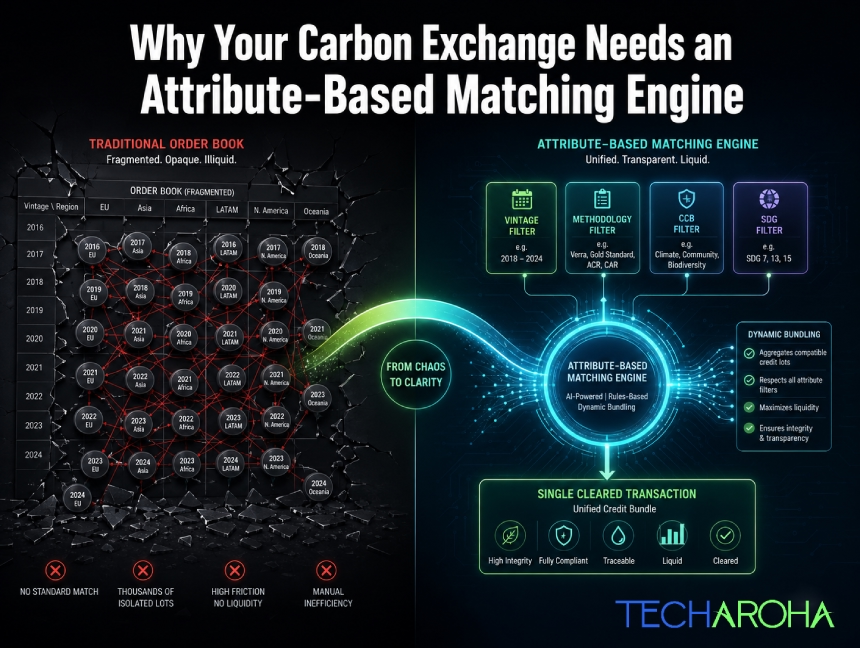
The trading infrastructure built for stocks and Bitcoin will systematically destroy liquidity in any carbon exchange. Here is the architectural fix and the exact engineering logic behind it. Carbon markets are at an inflection point. Voluntary carbon credit issuances have grown into a multi-hundred-billion-dollar projected market, institutional buyers are entering at scale, and Article 6.4 is formalizing cross-border credit flows in ways that would have seemed theoretical five years ago. Exchange founders are raising capital. Trading desks are staffing up. And almost every single one of them is about to make the same catastrophic infrastructure mistake. They are going to build a Central Limit Order Book (CLOB). The CLOB is the gold standard of financial exchange architecture. It powers the NYSE. It underpins every top-tier crypto exchange. It is fast, transparent, price-time priority-driven, and battle-tested. For carbon credits, it is the wrong tool in precisely the way that a pneumatic drill is the wrong tool for a surgical procedure. Not ineffective in general. Lethally ineffective here. This article is a precise technical and economic explanation of why, and a blueprint for the architecture that actually works: the carbon credit trading platform matching engine built on attribute-indexed, parameter-based order resolution. If you are building or operating a carbon exchange, a carbon trading desk, or evaluating infrastructure for a voluntary carbon market platform, this is the engineering decision that will determine whether your liquidity pool deepens or evaporates. Part 1: Why the CLOB Destroys Carbon Liquidity – The Structural Problem A Central Limit Order Book works on one foundational assumption: The asset is fungible. One share of AAPL is identical to every other share of AAPL. One Bitcoin is identical to every other Bitcoin. The order book can aggregate all bids and all asks into a single depth ladder because every unit on both sides of the book represents the same underlying thing. Carbon credits are not the same underlying thing. A 2021 cookstove credit from a Gold Standard-certified project in rural Kenya and a 2025 direct-air-capture credit from a Climeworks facility in Iceland are both “one tonne of CO₂ equivalent.” That is where the similarity ends.They have different: And, critically, they clear at prices that can differ by a factor of 10 or more. Institutional buyers do not treat them as interchangeable. Compliance frameworks do not treat them as interchangeable. Even voluntary corporate buyers with qualitative net-zero targets frequently cannot treat them as interchangeable without triggering greenwashing liability. What Happens When You Force Carbon Credits Into a CLOB? The matching engine identifies the asset by symbol. To maintain the fiction of fungibility across radically different credits, you have only two options: In a mature carbon market with: …you end up with thousands of discrete order books. Each one is individually empty. A liquidity pool that should be $50 million deep becomes: The consequences are predictable: The platform appears broken because, functionally, it is. This is not hypothetical. It is exactly why the voluntary carbon market spent years operating primarily as an OTC market conducted through brokers and phone calls. The asset’s heterogeneity made exchange-style infrastructure practically non-functional for real trading.A carbon credit trading platform matching engine that copies traditional financial exchange architecture without accounting for this reality will simply recreate that illiquidity problem at scale. Part 2: The Right Architecture – Attribute-Based Matching Over an Indexed Credit Graph The correct mental model for a carbon exchange is not a stock exchange. It is closer to a parametric procurement engine. The kind of system that allows a large corporate buyer to issue a single tender specification (“supply 10,000 units of this type of component, meeting these tolerances, at under this price”) and have the system dynamically identify, aggregate, and clear supply from multiple disparate sources to fulfill the single order. Applied to carbon, the architecture has three layers. Layer 1: The Credit Attribute Graph (Transactional Database) Every credit lot is stored as a structured object with a rich attribute schema not merely a quantity and price.A credit record contains: This is a normalized relational schema in your primary transactional database. PostgreSQL is an appropriate choice for ACID compliance on settlements. But the transactional database alone cannot power real-time matching at query complexity levels that carbon requires. Write about our blog that explains- The Ghost Credit Trap: What No One Tells You About Carbon Registry API Integration Layer 2: The Attribute Index (Elasticsearch or Redis Search) This is the layer many platforms either skip or implement incorrectly. The carbon credit trading platform matching engine requires a secondary search index optimized for: Elasticsearch Advantages Redis Search Advantages For institutional-scale exchanges, a hybrid architecture makes sense: Example Redis Search Schema With this index in place, the matching engine can execute parametric queries in real time. A buyer placing an order like “Buy 10,000 tonnes of any Nature-Based Removal, vintage 2023 or later, CCB certified, under $18 per tonne” translates directly to an indexed query: Example Buyer Query Buyer requests: Buy 10,000 tonnes of any Nature-Based Removal, vintage 2023+, CCB certified, under $18/tonne. This query executes against the in-memory index in under 5 milliseconds and returns every matching available lot ranked by price, regardless of which project, geography, or vintage within the buyer’s specification each lot originates from. Layer 3: The Dynamic Bundling and Clearing Algorithm The search query returns a ranked list of available lots. The matching engine’s clearing algorithm then executes a greedy fulfillment sweep: The buyer receives a single trade confirmation -10,000 tonnes cleared at a volume-weighted average price of $16.43/tonne across 7 credit lots, not 7 individual trade notifications across 7 empty order books. The seller-side experience is equally clean: individual lot holders have their available inventory consumed by the engine, with settlement proceeds routed per standard clearing logic. This is the structural breakthrough. The carbon credit trading platform matching engine does not require both sides to agree on a specific lot. It requires only that a buyer’s parameter specification encompasses the seller’s lot attributes. The parameter space is the order

Carbon credit management platform infrastructure is becoming the backbone of a rapidly expanding global carbon market. As voluntary carbon markets surpass $2 billion annually and compliance schemes accelerate across India, Europe, Japan, and Singapore, the industry faces a growing challenge: operational scalability. Beyond concerns about credit integrity, outdated processes, manual workflows, and verification bottlenecks are creating costly inefficiencies that could erase billions in market value, making modern carbon market infrastructure more critical than ever. This blog identifies six specific operational bottlenecks that break carbon credit management platforms at the point that matters most: after a deal has been agreed, before the value is delivered. If you are building, operating, or commissioning a platform for the carbon market, these are the failure points your architecture needs to address by design. Bottleneck 1: Credit State Synchronization Lag Every carbon credit management platform maintains an internal representation of credit status: available, reserved, transferred, retired. The problem is that this internal state and the registry’s confirmed state are almost never in sync. When a buyer initiates a purchase, the platform marks the credit as “reserved.” But the underlying registry — Verra, Gold Standard, India’s Grid Controller CCC registry — has not confirmed the transfer yet. That confirmation window can stretch from hours to days depending on the registry’s processing schedule and batch synchronization cycle. In securities markets, clearinghouses enforce T+2 settlement cycles. Carbon markets have no equivalent standard, with OTC bilateral trades routinely settling on T+5 to T+30 timelines. For a corporate buyer claiming carbon neutrality for a reporting period, a multi-day status ambiguity is not merely inconvenient. It is a compliance exposure. If the credit status reads “reserved but unconfirmed” at a reporting deadline, the underlying climate claim is technically unsupported. A purpose-built carbon credit management platform addresses this through event-driven registry synchronization: webhook listeners to registry APIs that reflect confirmed state changes in near real-time, rather than batch-syncing on a 24-hour schedule. This alone compresses the synchronization window from days to minutes. Bottleneck 2: MRV Data Ingestion Delays Measurement, Reporting, and Verification is the legitimacy foundation of every carbon credit. It is also where most carbon credit management platforms quietly collapse under operational load. MRV data arrives from inconsistent sources: IoT sensors on industrial equipment, satellite deforestation analysis feeds, field agent reports in PDF format, third-party verifier spreadsheets, and manual laboratory results. Each source has different formatting, frequency, and unit conventions. Most platforms receive this data and process it manually — a compliance officer downloads a file, reformats it, and uploads it to a registry-submission template. Thallo’s research found that eliminating unnecessary verification wait times could double the speed of credit issuance. The constraint is rarely the verifier’s judgment. It is the time cost of assembling, normalizing, and submitting heterogeneous data. An operationally mature carbon credit management platform replaces this manual pipeline with an automated MRV ingestion engine: a structured data layer that accepts multiple input formats via API, CSV, or OCR-extracted PDF, normalizes against approved emission factor libraries, and auto-generates pre-filled registry submission drafts. Verification reviewers work from structured packages rather than raw field exports. This alone can compress verification cycles from six weeks to two — without reducing regulatory rigor. Bottleneck 3: Counterparty Onboarding Friction New participants joining a carbon credit management platform must pass KYC/AML screening, project eligibility verification, and registry credential linkage before they can transact. For compliance markets, these checks are mandatory. For the voluntary carbon market, they are increasingly expected by institutional buyers. The operational failure is in implementation. Most platforms run these checks manually through compliance teams using separate systems that do not connect to the trading layer. A corporate buyer wanting to acquire BECCS credits may wait four to eight weeks for account activation — during which the available credits are purchased by another buyer, and the deal that was ready to close does not. This is an integration architecture problem, not a regulatory one. Embedding KYC/AML API workflows directly into the onboarding flow — with automated document verification, sanctions screening, and registry credential provisioning — compresses the onboarding cycle from weeks to days without reducing due diligence standards. For operators wanting to serve institutional counterparties at scale, onboarding velocity is a direct revenue variable. Bottleneck 4: Settlement Without Programmatic Escrow The most under-discussed structural risk in carbon trading is counterparty exposure — the risk that one party to a bilateral deal fails to deliver after the other has committed. In securities markets, central clearing manages this risk. In most carbon markets, it is managed by contract, phone calls, and trust. Most carbon credit management platforms lack native escrow-and-release logic. When a buyer agrees to purchase verified emission reductions at a fixed price, the platform records the agreement. But the actual mechanics of delivery — payment confirmation, credit transfer trigger, registry retirement confirmation — are executed manually by operations teams on both sides. This creates simultaneous dual exposure. The buyer has paid but cannot confirm delivery until the registry reflects the transfer. The seller has transferred credits but cannot confirm payment until bank settlement clears. A carbon credit management platform with programmatic escrow eliminates both exposures through an atomic swap: funds are locked in escrow at trade agreement, credits are held in a platform-controlled staging account, and both are released simultaneously only when both confirmation conditions are satisfied. This is not sophisticated financial engineering. It is standard financial infrastructure logic applied to a market that has not historically demanded it — until institutional capital began entering carbon markets and bringing institutional risk standards with it. Bottleneck 5: Credit Lifecycle Custody Fragmentation A carbon credit does not simply exist at a fixed address. It moves — from registry issuance through a developer account, through broker inventory, into a buyer’s holding account, through optional secondary transfers, and finally into retirement. Each step changes custody. Each custody change should be atomically recorded. In practice, most carbon credit management platforms track custody state across parallel silos: the platform database holds one version, the registry holds another (typically