

Imagine waiting in line for months to see your favorite band perform live. You missed the official ticket drop, so you bought a ticket from a reseller online. You stand outside the arena, stadium lights buzzing, heart pounding with excitement. You hand your smartphone to the attendant at the turnstile. They swipe your barcode under the scanner. BEEP. Red light. “Sorry, this ticket was already scanned two hours ago.” Your stomach drops. The seller didn’t sell you a fake ticket they sold you a real ticket, but they emailed the exact same PDF to five other people. The first person through the gate got in. You got locked out. If you’ve ever bought a concert ticket, you already understand the biggest hidden headache in the multi-billion-dollar green economy: how to make sure the carbon credit you buy actually belongs to you and only you. The Invisible Asset Problem Whether it’s a concert seat or a carbon credit, you are buying something you can’t physically hold in your hands. When a eco-conscious business wants to offset its pollution, it buys a carbon credit. One credit typically represents one metric tonne of carbon kept out of the atmosphere like paying a crew to pull 1,000 kilograms of plastic waste out of a polluted river or planting a row of trees. Because you can’t touch a “tonne of saved carbon,” buying one requires total trust. And just like the concert ticket market, the world of carbon trading has its own versions of reseller scams and gate errors. The 3 “Ticket Traps” of Carbon Trading When platforms sell carbon credits without proper digital records, buyers fall into three common traps: 1. The Duplicate PDF (Double-Selling) 2. The Fake Promoter (Phantom Projects) 3. The Box-Office Delay (“Ghost Credits”) Enter “Digital Proof”: The Ultimate Gate Scanner To stop scalpers, modern concert venues stopped using paper tickets and switched to dynamic, encrypted QR codes that change every few seconds and immediately lock out copies the second they are scanned. In the carbon market, that technology is called Digital Proof. Digital Proof is an un-hackable, automated digital record attached to every single credit. It serves as four things at once: When a business buys a credit backed by solid digital proof, three things happen instantly: How to Avoid Buying “Fake” Green Claims If your business is looking to purchase carbon credits—or if you’re evaluating a platform that sells them—ask these three quick questions before making a purchase: Clean Rivers, Real Receipts When a worker pulls 1,000 kg of garbage from a river, that hard work deserves to be recognized and funded. And when a company steps up to pay for that cleanup, they deserve to know their money actually made a difference—without worrying about duplicate receipts or ghost claims. By treating carbon credits with the same security and live verification as a high-stakes event ticket, we make sure that every dollar spent on the environment leads to real, measurable change on Earth. How Techaroha Helps At Techaroha, we build custom exchanges and registries with built-in Digital Proof of Carbon Credits like our FSA-registered Carbon Plant and Planet First Registry. We design live, tamper-proof systems fitted to your local rules, ensuring your buyers never get turned away by fake or duplicate credits.
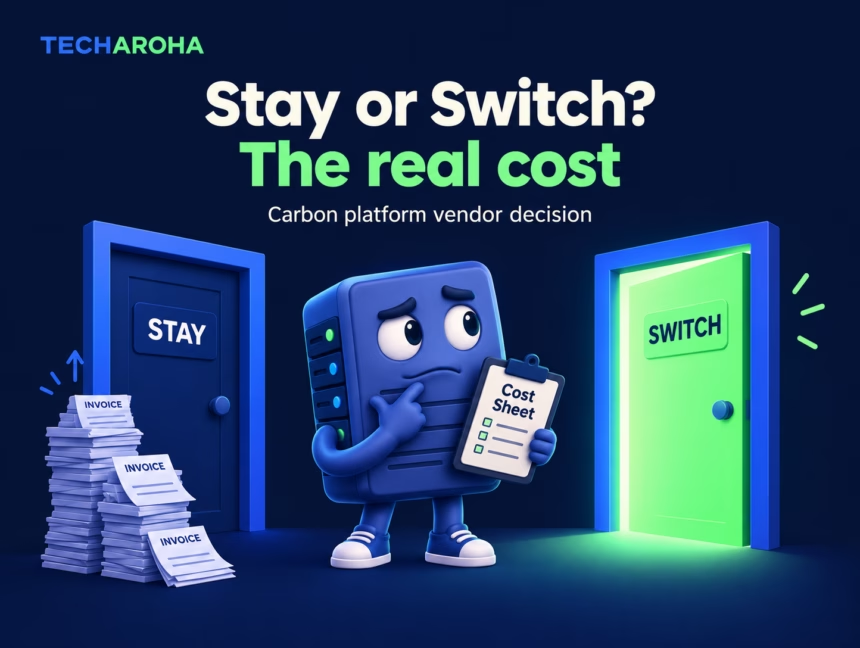
Read this if: you run a live carbon exchange or marketplace, your vendor quotes more for every change request, and you have started to wonder whether you should switch carbon trading software vendor before the next quarter’s invoice arrives. Most owners in that position do nothing. Migration looks risky, so the current vendor gets another year. The risk of leaving is visible and vivid. The cost of staying is spread across invoices, delayed launches and workarounds, so it never shows up as a single line anyone has to defend. This post puts both sides on the same sheet so you can decide with numbers instead of instinct. Why owners hesitate to switch carbon trading software vendor, and what it costs them If you own the exchange but not the roadmap, four costs are running quietly in the background. 1. The change-request premium. A new fee tier, a new registry, a new asset class. Each one is quoted as a project, and each quote tends to be higher than the last because the codebase gets harder to touch. The trend matters more than any single quote. 2. Delay cost. When a feature takes three months instead of three weeks, the revenue it would have earned in those ten weeks is gone. A buyer who wanted a forward contract product signed with a competitor instead. 3. Workaround labour. Every gap the platform cannot handle becomes a spreadsheet, a manual reconciliation or a late-night support task. Your ops team is paying the vendor’s technical debt in salary. 4. Control risk. If the vendor decides your feature is not on their roadmap, or gets acquired, or raises prices, you have no lever. You are a tenant in your own business. You can put a number on all four. The next section shows how, and the section after it does the same for leaving. Price the decision to switch carbon trading software vendor on one sheet A useful comparison has two columns, each covering the same 24-month window. Cost line Staying Leaving Licence or retainer fees Current annual fees, plus expected increases Fees on the new platform, if any Change requests Last 4 quarters of quotes, trended forward Build cost of the same changes on the new stack Delay cost Revenue lost per month of delay, times months delayed Lower after cutover, but count the migration months Workaround labour Ops hours per week, times loaded hourly cost Should fall; estimate honestly Migration project Zero Discovery, data mapping, build, testing, parallel run Dual-running period Zero Two platforms live for a period, typically several weeks Downtime and error risk Ongoing risk of incident Risk during cutover; price the mitigation, not the fear Exit and IP costs Hidden until you try to leave Data export, code ownership, contract notice Here is an illustrative example. These numbers are made up to show the method, not to predict yours. Run that forward 24 months and staying often costs more than a scoped migration. It does not always. That is why you build the sheet before making the call, and why the answer should sometimes be “stay and renegotiate.” Why migration feels riskier than it is The fear is legitimate, but it usually attaches to the wrong thing. When owners consider a decision to switch carbon trading software vendor, they worry about “the migration” as one giant event. It is actually three separate problems, and each has a known way to handle it. Treat them separately and the project stops being one frightening leap. How to migrate trade history without losing it Trade history is data you own, and it should leave the old platform in a form you control. The sequence that tends to work: If the old platform’s records and the registry disagree today, you want to know before migration, not after. That finding is worth having on its own. (Multi-registry platforms should also read our note on registry API integration deadlines, since registry changes land on the same calendar as your migration.) How to cut over without downtime Downtime is an engineering choice, not a law of nature. Exchanges that switch carbon trading software vendor without a trading halt generally follow the same pattern. Read your contract before you read proposals Some of the biggest costs of leaving sit in the agreement you already signed. Check these before you talk to any new vendor: If you do not own your code, the cost of leaving is partly a cost of rebuilding. That is worth knowing early because it changes the sheet. When you should stay Switching is not always the right answer. Stay, and renegotiate, when: A good second opinion will tell you this. If an advisor recommends leaving without seeing your numbers, be cautious about the advice. Decision guide Your situation Likely direction Quotes rising each quarter, features late, no code access Leave, after scoping the switch Quotes stable, delivery on time, roadmap shared Stay and renegotiate terms Platform works, but registry sync or reconciliation is fragile Fix or decouple that layer first Vendor acquired, sunsetting or unresponsive Leave, on a planned timeline Unsure Get an independent assessment before deciding How Techaroha approaches a decision to switch carbon trading software vendor When an owner is weighing whether to switch carbon trading software vendor, we start with an assessment, not a rebuild. Before we propose anything, we look at your current architecture, your registry connections, your change-request history and your contract position, then tell you whether leaving pays back. Sometimes the honest answer is to stay. Our carbon work is not theoretical. We built Carbon Plant, an FSA-registered NFT-based carbon credit exchange, and Planet First Registry, the registry infrastructure behind it. Both run on the same concerns this post covers: credit lifecycle, registry reconciliation and trade integrity. If you want the wider picture of what a carbon exchange platform involves, see our carbon credit exchange platform page. Get your numbers Download the Switch-or-Stay Cost Sheet. It is the two-column model from this post, ready to fill in

Every carbon exchange looks fine at 200 trades a day. The order book renders, settlement clears, the registry syncs, and nobody questions the architecture underneath it. Then volume triples in a single compliance-driven quarter, three new registries get added, and the same platform that felt production-ready starts throwing errors nobody can explain. This is not a bad luck story. It is a carbon exchange scalability problem, and it is almost always predictable months before it becomes visible to traders. We have architected and built live carbon market infrastructure – Carbon Plant, an FSA-registered NFT-based carbon credit exchange, and Planet First Registry, the registry layer underneath it. What follows is the failure map we walk exchange CTOs and operators through when their existing platform starts showing cracks: the twelve places carbon exchange scalability actually breaks, why each one is harder in carbon markets than in a typical trading system, and what an honest fix looks like. If your platform is handling growing order flow, adding registries, or onboarding institutional counterparties and you are seeing timeouts, mismatched balances, or settlement delays, this is written for you. Why Carbon Exchange Scalability Is a Different Problem Than Exchange Scalability A commodities exchange scales by adding compute. A carbon exchange has to scale a much messier dependency chain: registry data that arrives asynchronously, credits with vintage/methodology/geography attributes that change eligibility mid-trade, and settlement that depends on external systems the exchange doesn’t control. Generic trading infrastructure assumes the asset is fungible the moment it clears the order book. Carbon credits are not. Two “identical” tonnes can have different corresponding-adjustment status, different registry confirmation states, or different retirement eligibility, and all of that has to be tracked correctly while order volume climbs. That is the real reason carbon exchange scalability fails differently, and earlier, than scalability failures in conventional finance. The 12 Infrastructure Failure Points Behind Poor Carbon Exchange Scalability 1. Registry Mismatch Under Load At low volume, a manual reconciliation between your internal ledger and the registry’s record is manageable. At higher volume, registry confirmations arrive out of order, some fail silently, and your internal state drifts from the registry’s actual state. This single gap is the most common root cause of carbon exchange scalability complaints we see in audits. 2. Synchronous Assumptions About Asynchronous Registries Many platforms are built assuming a registry call returns instantly. In production, registries (Verra, Gold Standard, Puro, national registries) respond on their own schedule, sometimes with delays measured in hours. A platform that treats registry confirmation as synchronous will queue, time out, or double-process under real load. 3. Settlement Recalculating Instead of Reusing Execution Data If your settlement service independently recalculates price or eligibility instead of using exactly what the matching engine already decided, you get discrepancies the moment concurrent trades increase. Settlement should fulfil a commitment, not re-derive one. 4. Fee Engine Drift Across Currencies and Tiers Fee logic that works cleanly for one currency and one tier starts drifting the moment you add multi-currency settlement or tiered institutional pricing. Rounding errors that were invisible at ten trades a day become audit findings at ten thousand. 5. Stale Eligibility States Eligibility (jurisdiction, vintage, corresponding adjustment, methodology) is often checked once, at order entry, and never re-verified at execution. Under higher concurrency, the gap between “checked” and “executed” widens, and credits that were eligible when queued may not be eligible when they finally trade. 6. Concurrency Bugs in the Matching Engine A matching engine that works correctly for sequential orders can behave incorrectly under concurrent load, double-matching the same inventory, or allowing two buyers to reserve the same lot simultaneously. This is a classic carbon exchange scalability failure because it only appears once real trading volume creates genuine concurrency. 7. No Idempotency on Registry Webhooks Registries retry webhooks. If your settlement processor treats every webhook delivery as a new event instead of checking for a unique evidence identifier, a single confirmation can get applied twice, and your credit balances quietly become wrong. 8. Partial Fill Handling That Loses Track of Residuals An order for 10,000 tonnes that only fills 6,200 tonnes needs the platform to track the executed amount and the residual amount as two distinct, immutable records. Platforms that treat the original order size as the settled amount create reconciliation problems that compound with every partial fill. 9. Multi-Tenant Isolation Gaps For platforms serving multiple aggregators, project developers, or white-label clients, tenant isolation that works at low volume can leak under load: one tenant’s query load or data can bleed into another’s, a serious compliance issue as much as a technical one. 10. Database Contention on Shared Inventory Tables A single, unpartitioned inventory table becomes a bottleneck the moment several matching processes need to read and lock the same rows. This is one of the more fixable causes of poor carbon exchange scalability, but it requires re-architecting data access patterns, not just adding servers. 11. Audit Trail Gaps Under High Throughput Compliance-grade reporting needs an immutable, queryable record of every state transition – order, execution, settlement, registry transfer. Systems built for low volume often log selectively; at scale, gaps in that trail become a regulatory exposure, not just an inconvenience. 12. No Circuit Breakers for External Dependencies When a registry API slows down or a payment rail has an outage, a platform without circuit breakers will let failures cascade into the matching engine and order intake. A resilient exchange isolates external failures instead of letting them take down live trading. Why These Failures Are Specific to Carbon Markets Failure Point Why It’s Worse in Carbon Markets Than General Trading Registry mismatch External registries are not owned by the exchange and respond asynchronously Stale eligibility Eligibility depends on vintage, methodology, geography — not just price and quantity Partial fills Inventory is not fungible; eligible lots differ by attribute, not just price Multi-tenant isolation Aggregator and white-label models are far more common than in traditional exchanges Audit trail gaps Compliance regimes (Article 6, CCTS, CORSIA) require traceability generic exchanges don’t
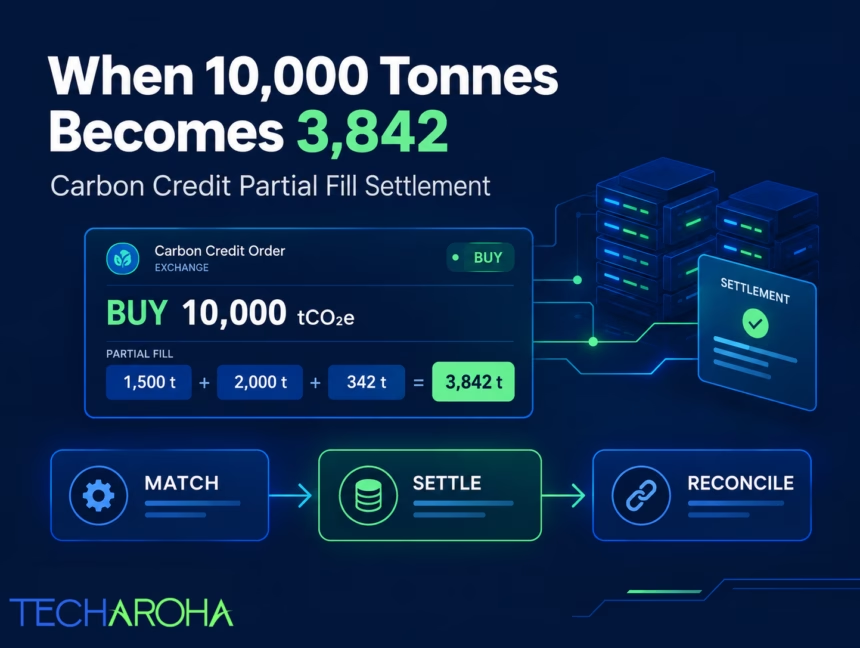
A carbon exchange can display a beautiful order book and still have fundamentally broken trading infrastructure. The real test begins when a buyer submits an order for 10,000 tonnes, but the matching engine can only execute 3,842 tonnes across multiple eligible sellers. What happens to the remaining 6,158 tonnes? More importantly: This is where carbon credit partial fill settlement becomes an architecture problem rather than a UI feature. Traditional exchange infrastructure already understands partial fills. Carbon markets make the problem harder because the underlying asset isn’t simply “10,000 units.” A carbon order can depend on vintage, methodology, geography, project, registry, authorization status, corresponding adjustment, removal/reduction classification, co-benefits, eligibility rules and available inventory.That means the matching engine cannot simply ask: “Does price match?” It needs to ask: “Does price match and does this exact inventory satisfy the buyer’s eligibility constraints at execution time?” And settlement has to preserve that decision. Why Partial Fills Are More Complicated in Carbon Markets Consider this order: Order Parameter Buyer Requirement Quantity 10,000 tCO₂e Maximum price $18/t Registry Approved registry Vintage 2022–2025 Methodology Removal Geography Eligible jurisdictions Eligibility Corporate procurement criteria Time-in-force IOC The order enters the exchange. The engine finds: But Seller D’s inventory subsequently fails an eligibility check. The executable quantity is therefore 3,840 tonnes, not 8,340. That single change creates several state transitions. Order state NEW → PARTIALLY_FILLED → CANCELLED/EXPIRED Inventory state AVAILABLE → RESERVED → TRADED → SETTLED Settlement state PENDING → PARTIALLY_SETTLED → SETTLED Registry state TRANSFER_REQUESTED → CONFIRMED / FAILED A production platform must maintain these states independently without allowing them to contradict one another. That is the core challenge behind carbon credit partial fill settlement. 1. Start With the Matching Engine, Not Settlement Settlement problems are frequently symptoms of weak execution architecture. A robust carbon exchange should separate at least these logical layers: The important architectural principle is that matching creates an execution commitment; settlement fulfils that commitment.Settlement should not independently decide what was traded. If the settlement service recalculates eligibility or price independently from the matching engine, the platform can create discrepancies between: That is precisely what an exchange operator wants to avoid. Read: The Authorization Wall: How Custom Carbon Exchanges Must Architect for Article 6 Corresponding Adjustments 2. Eligibility Must Be Part of Matching A common architecture mistake is to treat eligibility as a front-end filter. For example: “Show the buyer only CORSIA-eligible credits.” That is not enough. The eligibility decision needs to survive all the way into execution. Suppose a buyer wants 5,000 tonnes of eligible inventory. The matching engine finds three lots: Seller Available Price Eligibility Executable A 1,200 $14.80 Yes 1,200 B 2,000 $15.10 Yes 2,000 C 3,000 $15.40 No 0 The engine should not match 5,000 tonnes and “sort out eligibility later.” The correct result is: 3,200 tonnes executable + 1,800 tonnes residual. This distinction becomes especially important when eligibility can change because of: For institutional trading, eligibility should therefore be represented as a versioned execution condition, not simply a UI attribute. 3. Order Types Determine Partial-Fill Behaviour Not every order should behave the same way. A carbon exchange may support several order instructions depending on its market design. Order Type Partial Fill? Typical Behaviour Limit Yes Execute available eligible quantity and leave residual Market Usually yes Execute against eligible liquidity subject to protection rules IOC Yes Fill available quantity immediately; cancel residual FOK No Execute only if entire eligible quantity can be filled GTC Yes Leave residual active until filled/cancelled/expired GTD Yes Remain active until specified expiry Smart Order Yes Route across eligible liquidity sources For carbon credit partial fill settlement, this distinction matters because the residual order is not necessarily another settlement. The platform must clearly separate: Executed quantity from Remaining quantity For example: The settlement engine must never accidentally treat the original 10,000 tonnes as the settled amount. 4. Partial Fill Is an Execution Event, Not an Order Event This is a subtle but critical architecture decision. One order can generate multiple executions. For example: The order has therefore executed: 3,842 tonnes But the exchange has three separate execution records. Each execution should have its own immutable identifiers and economic details. At minimum: This event-level structure is what makes downstream reconciliation possible. 5. The Smart Order Router Has a Different Job A smart order router should not simply find the cheapest credit. It should find the best executable eligible liquidity according to the exchange’s routing policy. Imagine: The router can evaluate: This becomes particularly valuable when the exchange operates as an aggregation layer rather than a single order book. The router should also preserve execution provenance. If 10,000 tonnes are sourced through four venues, the platform needs to know exactly where every tonne originated. 6. The Hard Part: Carbon Credit Partial Fill Settlement This is where many marketplace architectures become fragile. Suppose: Buyer order = 10,000 tonnes The engine executes: Total: 3,842 tonnes Settlement should operate on the 3,842-tonne execution set, not the original order. A simplified flow looks like: The settlement orchestrator should maintain a state machine rather than a single Boolean such as: settled = true A more useful model is: That distinction becomes essential when registry APIs are asynchronous or unreliable. 7. Registry Confirmation Should Not Be Treated as a Synchronous Assumption Carbon exchanges often depend on external registry infrastructure. The exchange might successfully execute a trade, but the registry transfer could: Therefore: Trade execution ≠ registry settlement. The platform needs a durable settlement workflow. For example: The exact ordering can vary depending on custody and counterparty-risk design, but the state transitions must be explicit. 8. Idempotency Is Mandatory Imagine the registry confirms a transfer. Your webhook receives the confirmation. The service processes it. Then the same webhook arrives again. If the system simply says: “Transfer confirmed → add 1,500 tonnes” you have a serious accounting problem. Instead, settlement events need unique evidence identifiers. For example: The settlement processor should verify whether that evidence has already been consumed. Conceptually: This is one of the most important