

Every carbon exchange looks fine at 200 trades a day. The order book renders, settlement clears, the registry syncs, and nobody questions the architecture underneath it. Then volume triples in a single compliance-driven quarter, three new registries get added, and the same platform that felt production-ready starts throwing errors nobody can explain. This is not a bad luck story. It is a carbon exchange scalability problem, and it is almost always predictable months before it becomes visible to traders. We have architected and built live carbon market infrastructure – Carbon Plant, an FSA-registered NFT-based carbon credit exchange, and Planet First Registry, the registry layer underneath it. What follows is the failure map we walk exchange CTOs and operators through when their existing platform starts showing cracks: the twelve places carbon exchange scalability actually breaks, why each one is harder in carbon markets than in a typical trading system, and what an honest fix looks like. If your platform is handling growing order flow, adding registries, or onboarding institutional counterparties and you are seeing timeouts, mismatched balances, or settlement delays, this is written for you. Why Carbon Exchange Scalability Is a Different Problem Than Exchange Scalability A commodities exchange scales by adding compute. A carbon exchange has to scale a much messier dependency chain: registry data that arrives asynchronously, credits with vintage/methodology/geography attributes that change eligibility mid-trade, and settlement that depends on external systems the exchange doesn’t control. Generic trading infrastructure assumes the asset is fungible the moment it clears the order book. Carbon credits are not. Two “identical” tonnes can have different corresponding-adjustment status, different registry confirmation states, or different retirement eligibility, and all of that has to be tracked correctly while order volume climbs. That is the real reason carbon exchange scalability fails differently, and earlier, than scalability failures in conventional finance. The 12 Infrastructure Failure Points Behind Poor Carbon Exchange Scalability 1. Registry Mismatch Under Load At low volume, a manual reconciliation between your internal ledger and the registry’s record is manageable. At higher volume, registry confirmations arrive out of order, some fail silently, and your internal state drifts from the registry’s actual state. This single gap is the most common root cause of carbon exchange scalability complaints we see in audits. 2. Synchronous Assumptions About Asynchronous Registries Many platforms are built assuming a registry call returns instantly. In production, registries (Verra, Gold Standard, Puro, national registries) respond on their own schedule, sometimes with delays measured in hours. A platform that treats registry confirmation as synchronous will queue, time out, or double-process under real load. 3. Settlement Recalculating Instead of Reusing Execution Data If your settlement service independently recalculates price or eligibility instead of using exactly what the matching engine already decided, you get discrepancies the moment concurrent trades increase. Settlement should fulfil a commitment, not re-derive one. 4. Fee Engine Drift Across Currencies and Tiers Fee logic that works cleanly for one currency and one tier starts drifting the moment you add multi-currency settlement or tiered institutional pricing. Rounding errors that were invisible at ten trades a day become audit findings at ten thousand. 5. Stale Eligibility States Eligibility (jurisdiction, vintage, corresponding adjustment, methodology) is often checked once, at order entry, and never re-verified at execution. Under higher concurrency, the gap between “checked” and “executed” widens, and credits that were eligible when queued may not be eligible when they finally trade. 6. Concurrency Bugs in the Matching Engine A matching engine that works correctly for sequential orders can behave incorrectly under concurrent load, double-matching the same inventory, or allowing two buyers to reserve the same lot simultaneously. This is a classic carbon exchange scalability failure because it only appears once real trading volume creates genuine concurrency. 7. No Idempotency on Registry Webhooks Registries retry webhooks. If your settlement processor treats every webhook delivery as a new event instead of checking for a unique evidence identifier, a single confirmation can get applied twice, and your credit balances quietly become wrong. 8. Partial Fill Handling That Loses Track of Residuals An order for 10,000 tonnes that only fills 6,200 tonnes needs the platform to track the executed amount and the residual amount as two distinct, immutable records. Platforms that treat the original order size as the settled amount create reconciliation problems that compound with every partial fill. 9. Multi-Tenant Isolation Gaps For platforms serving multiple aggregators, project developers, or white-label clients, tenant isolation that works at low volume can leak under load: one tenant’s query load or data can bleed into another’s, a serious compliance issue as much as a technical one. 10. Database Contention on Shared Inventory Tables A single, unpartitioned inventory table becomes a bottleneck the moment several matching processes need to read and lock the same rows. This is one of the more fixable causes of poor carbon exchange scalability, but it requires re-architecting data access patterns, not just adding servers. 11. Audit Trail Gaps Under High Throughput Compliance-grade reporting needs an immutable, queryable record of every state transition – order, execution, settlement, registry transfer. Systems built for low volume often log selectively; at scale, gaps in that trail become a regulatory exposure, not just an inconvenience. 12. No Circuit Breakers for External Dependencies When a registry API slows down or a payment rail has an outage, a platform without circuit breakers will let failures cascade into the matching engine and order intake. A resilient exchange isolates external failures instead of letting them take down live trading. Why These Failures Are Specific to Carbon Markets Failure Point Why It’s Worse in Carbon Markets Than General Trading Registry mismatch External registries are not owned by the exchange and respond asynchronously Stale eligibility Eligibility depends on vintage, methodology, geography — not just price and quantity Partial fills Inventory is not fungible; eligible lots differ by attribute, not just price Multi-tenant isolation Aggregator and white-label models are far more common than in traditional exchanges Audit trail gaps Compliance regimes (Article 6, CCTS, CORSIA) require traceability generic exchanges don’t
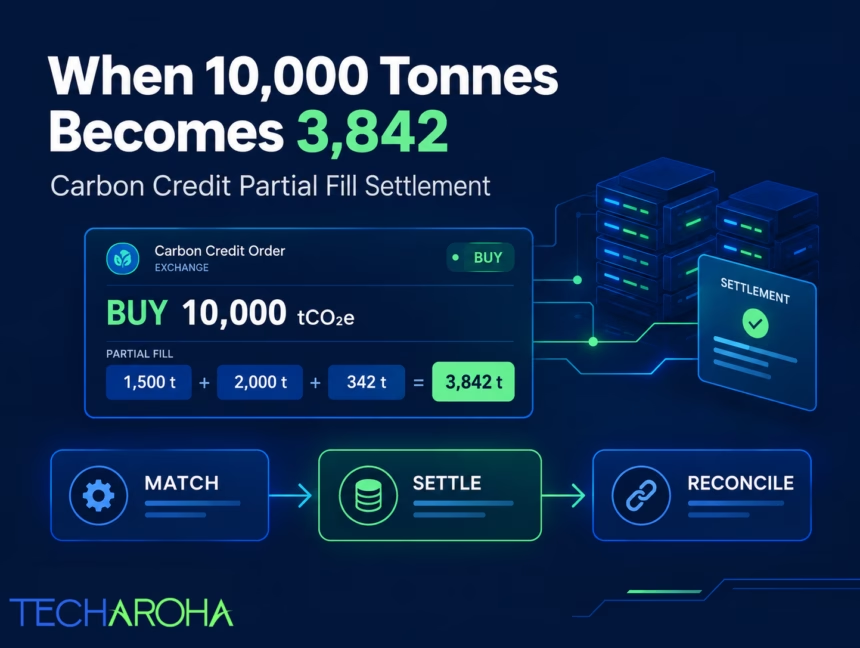
A carbon exchange can display a beautiful order book and still have fundamentally broken trading infrastructure. The real test begins when a buyer submits an order for 10,000 tonnes, but the matching engine can only execute 3,842 tonnes across multiple eligible sellers. What happens to the remaining 6,158 tonnes? More importantly: This is where carbon credit partial fill settlement becomes an architecture problem rather than a UI feature. Traditional exchange infrastructure already understands partial fills. Carbon markets make the problem harder because the underlying asset isn’t simply “10,000 units.” A carbon order can depend on vintage, methodology, geography, project, registry, authorization status, corresponding adjustment, removal/reduction classification, co-benefits, eligibility rules and available inventory.That means the matching engine cannot simply ask: “Does price match?” It needs to ask: “Does price match and does this exact inventory satisfy the buyer’s eligibility constraints at execution time?” And settlement has to preserve that decision. Why Partial Fills Are More Complicated in Carbon Markets Consider this order: Order Parameter Buyer Requirement Quantity 10,000 tCO₂e Maximum price $18/t Registry Approved registry Vintage 2022–2025 Methodology Removal Geography Eligible jurisdictions Eligibility Corporate procurement criteria Time-in-force IOC The order enters the exchange. The engine finds: But Seller D’s inventory subsequently fails an eligibility check. The executable quantity is therefore 3,840 tonnes, not 8,340. That single change creates several state transitions. Order state NEW → PARTIALLY_FILLED → CANCELLED/EXPIRED Inventory state AVAILABLE → RESERVED → TRADED → SETTLED Settlement state PENDING → PARTIALLY_SETTLED → SETTLED Registry state TRANSFER_REQUESTED → CONFIRMED / FAILED A production platform must maintain these states independently without allowing them to contradict one another. That is the core challenge behind carbon credit partial fill settlement. 1. Start With the Matching Engine, Not Settlement Settlement problems are frequently symptoms of weak execution architecture. A robust carbon exchange should separate at least these logical layers: The important architectural principle is that matching creates an execution commitment; settlement fulfils that commitment.Settlement should not independently decide what was traded. If the settlement service recalculates eligibility or price independently from the matching engine, the platform can create discrepancies between: That is precisely what an exchange operator wants to avoid. Read: The Authorization Wall: How Custom Carbon Exchanges Must Architect for Article 6 Corresponding Adjustments 2. Eligibility Must Be Part of Matching A common architecture mistake is to treat eligibility as a front-end filter. For example: “Show the buyer only CORSIA-eligible credits.” That is not enough. The eligibility decision needs to survive all the way into execution. Suppose a buyer wants 5,000 tonnes of eligible inventory. The matching engine finds three lots: Seller Available Price Eligibility Executable A 1,200 $14.80 Yes 1,200 B 2,000 $15.10 Yes 2,000 C 3,000 $15.40 No 0 The engine should not match 5,000 tonnes and “sort out eligibility later.” The correct result is: 3,200 tonnes executable + 1,800 tonnes residual. This distinction becomes especially important when eligibility can change because of: For institutional trading, eligibility should therefore be represented as a versioned execution condition, not simply a UI attribute. 3. Order Types Determine Partial-Fill Behaviour Not every order should behave the same way. A carbon exchange may support several order instructions depending on its market design. Order Type Partial Fill? Typical Behaviour Limit Yes Execute available eligible quantity and leave residual Market Usually yes Execute against eligible liquidity subject to protection rules IOC Yes Fill available quantity immediately; cancel residual FOK No Execute only if entire eligible quantity can be filled GTC Yes Leave residual active until filled/cancelled/expired GTD Yes Remain active until specified expiry Smart Order Yes Route across eligible liquidity sources For carbon credit partial fill settlement, this distinction matters because the residual order is not necessarily another settlement. The platform must clearly separate: Executed quantity from Remaining quantity For example: The settlement engine must never accidentally treat the original 10,000 tonnes as the settled amount. 4. Partial Fill Is an Execution Event, Not an Order Event This is a subtle but critical architecture decision. One order can generate multiple executions. For example: The order has therefore executed: 3,842 tonnes But the exchange has three separate execution records. Each execution should have its own immutable identifiers and economic details. At minimum: This event-level structure is what makes downstream reconciliation possible. 5. The Smart Order Router Has a Different Job A smart order router should not simply find the cheapest credit. It should find the best executable eligible liquidity according to the exchange’s routing policy. Imagine: The router can evaluate: This becomes particularly valuable when the exchange operates as an aggregation layer rather than a single order book. The router should also preserve execution provenance. If 10,000 tonnes are sourced through four venues, the platform needs to know exactly where every tonne originated. 6. The Hard Part: Carbon Credit Partial Fill Settlement This is where many marketplace architectures become fragile. Suppose: Buyer order = 10,000 tonnes The engine executes: Total: 3,842 tonnes Settlement should operate on the 3,842-tonne execution set, not the original order. A simplified flow looks like: The settlement orchestrator should maintain a state machine rather than a single Boolean such as: settled = true A more useful model is: That distinction becomes essential when registry APIs are asynchronous or unreliable. 7. Registry Confirmation Should Not Be Treated as a Synchronous Assumption Carbon exchanges often depend on external registry infrastructure. The exchange might successfully execute a trade, but the registry transfer could: Therefore: Trade execution ≠ registry settlement. The platform needs a durable settlement workflow. For example: The exact ordering can vary depending on custody and counterparty-risk design, but the state transitions must be explicit. 8. Idempotency Is Mandatory Imagine the registry confirms a transfer. Your webhook receives the confirmation. The service processes it. Then the same webhook arrives again. If the system simply says: “Transfer confirmed → add 1,500 tonnes” you have a serious accounting problem. Instead, settlement events need unique evidence identifiers. For example: The settlement processor should verify whether that evidence has already been consumed. Conceptually: This is one of the most important

Every regional forestry aggregator we’ve spoken to this year has the same quiet frustration sitting under their pitch deck. They’re sitting on a few hundred verified projects – methane capture, avoided deforestation, agroforestry blocks spread across three or four states and every single credit gets sold through somebody else’s marketplace. Somebody else’s brand. Somebody else’s 5–10% commission, taken off the top of every trade, forever. Ask an aggregator managing 300+ projects what that commission actually costs them over a five-year horizon, and most haven’t run the number. Once they do, the room goes quiet. On $40M of annual trade volume, an 8% marketplace cut is $3.2M a year handed to a third party for what amounts to hosting an order book. That’s not a fee. That’s a tax on not owning your own infrastructure. So the aggregator goes looking for an alternative: build our own exchange. And that’s where the second wall shows up. A serious matching and clearing engine – the kind that can survive a compliance audit, handle fractional credit settlement, and route trades without corrupting a ledger takes a competent engineering team 12 to 18 months to build from a blank repository. Most aggregators don’t have 18 months of runway to spend on infrastructure before they’ve sold a single credit through it. This piece is for the people caught in that exact gap: aggregator CEOs tired of paying rent on someone else’s venue, regional brokerages that want a compliant trading brand of their own, and platform operators trying to figure out whether they should be the one licensing multi-tenant infrastructure to all of the above. We’re not selling you a shrink-wrapped product here. We’re walking through how a serious engineering team actually architects a white-label carbon trading platform built for multi-tenancy, so you have a real technical benchmark before your next build, license, or outsourcing conversation. The Real Industry Friction: Two Bad Options, No Third Path Talk to enough project developers and a pattern emerges. They’re stuck choosing between two options that both cost them something they can’t get back. Neither of these is really a choice. It’s a trade-off between bleeding money slowly and bleeding time you don’t have. The market has quietly created a third option that almost nobody outside specialist engineering circles talks about clearly: a white-label carbon trading platform built on multi-tenant SaaS architecture, where one underlying exchange engine powers dozens of independently branded, independently governed sub-exchanges. The difference between this and generic “white-label” pitches you’ve probably already seen from crypto-exchange vendors is architectural, not cosmetic. A crypto white-label slaps a new logo on a shared front end. A properly engineered white-label carbon trading platform for carbon aggregators has to isolate tenant data at the database layer, run independent matching logic per tenant, and route registry connections separately for every sub-exchange because carbon compliance obligations don’t forgive shortcuts the way a token swap does. What Changed Between January and August 2026 and Why It Matters Here Carbon market infrastructure has moved fast this year, and almost every shift makes the case for multi-tenant architecture stronger, not weaker. Put together, these shifts describe a market where owning your venue’s brand and your venue’s compliance logic are becoming the same requirement, not two separate nice-to-haves. Architecting a Multi-Tenant Carbon Exchange: The Four Layers That Actually Matter Strip away the marketing language, and a genuinely multi-tenant white-label carbon trading platform rests on four architectural decisions. Get any one of them wrong and the “weeks, not months” promise quietly becomes another 12-month build. 1. Tenant-Isolated Database Schemas with Row-Level Security The foundational decision is how tenant data actually sits in the database, because this single choice determines both your security posture and your ability to onboard new aggregators quickly. RLS done properly means a compliance auditor reviewing Tenant A’s trade history can never accidentally see so much as a row header belonging to Tenant B, even under a misconfigured application query. That’s not a nice-to-have. That’s the difference between a platform an institutional buyer will sign with and one their legal team kills in diligence. 2. Dedicated Matching Worker Threads Per Tenant This is the layer most white-label vendors get wrong, because it’s tempting to run one shared matching engine across every tenant to save infrastructure cost. Don’t. Read: Carbon Trading Platform Revenue Model: Complete Breakdown 3. Dynamic API Routing and Registry Connectivity Per Tenant A multi-tenant carbon exchange isn’t just serving different logos to different users; it’s routing genuinely different backend connections depending on which tenant a request belongs to. Routing Concern Single-Tenant Approach Multi-Tenant SaaS Approach Registry connections One hardcoded integration (e.g., Verra only) Dynamic per-tenant registry mapping (Verra, Gold Standard, Puro, ACCU) Fee schedules One fee logic for the whole exchange Per-tenant fee configuration, enforced at the API gateway Branding & domain Single domain, single UI theme Tenant-specific subdomain, white-label theme, and email templates Compliance ruleset One jurisdiction’s rules baked into logic Configurable ruleset per tenant (CCTS, ACCU, CORSIA-domestic, EU ETS) Onboarding new tenant Requires a new deployment New tenant record + config, live same week The dynamic routing layer is what actually collapses the 12–18 month build into weeks because standing up a new sub-exchange stops being an engineering project and becomes a configuration task: create the tenant record, assign the registry mappings, set the fee schedule, apply the brand theme, go live. 4. Compliance-Aware Tenant Governance The fourth layer is the one institutional buyers actually probe hardest during diligence, and it’s the one generic exchange-in-a-box vendors almost never build properly: governance controls that let a platform operator enforce baseline compliance standards across every tenant, while still letting each aggregator run their own branded venue. Weeks, Not Months: What the Compressed Timeline Actually Looks Like None of this works as a slide-deck promise unless the phased rollout is genuinely realistic. Here’s what a properly architected multi-tenant core makes possible for a new tenant going live: Compare that to the 12–18 month timeline of building a matching and clearing engine from a blank

CORSIA Phase I closes out its compliance window between 2024 and 2026, and something quietly expensive has been happening on every desk trading Article 6-eligible inventory: CORSIA settlement lag. Not price risk. Not supply risk, although that exists too. A slower, more mechanical problem: the gap between when a trade is agreed and when it actually clears, and it is costing airlines, brokers, and exchanges real money every single week. This post is for the people who feel that gap directly: exchange founders building compliance-grade trading infrastructure, CTOs responsible for uptime and settlement integrity, and ESG or carbon fund managers who need certainty that the credit they bought this morning will still be theirs, cleanly, by end of day. Why CORSIA Settlement Lag Exists in the First Place CORSIA-eligible credits carry a specific compliance signature: a host-country Letter of Authorization (LoA) confirming that a Corresponding Adjustment (CA) has been or will be applied under Article 6 of the Paris Agreement. That signature is what separates a credit airlines can legally retire against their CORSIA obligation from a credit that looks identical on paper but carries none of that protection. The problem is where that verification actually happens. On most platforms today, it happens manually, after the trade is agreed, not before. A compliance officer or broker pulls a PDF, checks a registry reference number by eye, maybe emails a national registry contact to confirm a host-country attestation, and only then releases funds or clears the trade. During CORSIA’s most active trading hours, that manual review queue backs up. What should be a same-day settlement becomes a multi-day wait, and that wait is CORSIA settlement lag in its purest form. In numbers, the shape of the problem looks like this: Factor Manual Verification Reality LoA/PDF cross-check time Hours to multiple days per trade National registry API response variance Inconsistent across host countries, no unified standard Peak-hour trade backlog Queued behind other manual reviews Double-selling exposure High, since sovereign registries do not talk to each other in real time Counterparty risk during lag window Rises with every hour price moves against either side None of this is a compliance failure in the legal sense. Every credit involved may be perfectly legitimate. The failure is architectural: verification sits in a slow, disconnected, human-mediated layer instead of inside the settlement pipeline itself. The Software Problem Nobody Is Pricing In Here is the part that gets missed in most CORSIA commentary, which tends to stay at the policy level. CORSIA settlement lag is not a regulatory problem waiting on ICAO or a host government. It is a systems design problem, and it sits squarely inside the exchange’s own technology stack. Three specific failure modes show up again and again on platforms that have not solved this: Each of these failure modes translates directly into either a lost trade, a compliance exception that has to be manually unwound, or a client who moves their volume to a competitor with faster clearing. CORSIA settlement lag is not an inconvenience. It is a line item. Why Batch Verification Cannot Scale With CORSIA Phase I Demand Most exchanges built their compliance-checking logic the same way they built everything else in the voluntary carbon market era: as an overnight batch job or a manual queue, because volumes were low enough that nobody needed anything faster. CORSIA changes that math completely. Phase I demand for CORSIA-eligible emissions units runs into the hundreds of millions of tonnes, against a supply of authorized inventory that has consistently lagged behind. That imbalance means every unit with a confirmed corresponding adjustment carries a real premium, and premium assets attract fast-moving, high-frequency trading behavior — exactly the environment where batch-style verification breaks down first. Reduce CORSIA settlement lag using batch logic, and the fix is temporary at best. Volume simply outgrows the review queue again within a quarter. This is the same category of design mistake carbon market infrastructure keeps repeating: putting compliance-critical logic in the slowest layer of the system instead of the fastest. The Engineering Solution: An API Middleware and Verification Oracle The fix is not more people reviewing PDFs faster. It is a structural change to where and when verification happens. The pattern that actually resolves CORSIA settlement lag is a dedicated API Middleware and Verification Oracle — a service layer that sits between the order matching engine and every national Article 6 registry endpoint a platform touches. Here is how that architecture actually functions in practice: This is the architectural difference between a platform that treats CORSIA settlement lag as an unavoidable cost of doing business, and one that treats it as a solved engineering problem. What Changes for Airlines, Brokers, and Compliance Desks The people reading this closely — airline compliance managers, carbon brokers, institutional trading desks — are the ones who feel CORSIA settlement lag as risk exposure, not abstraction. Here is what an automated CA verification oracle actually changes for each of them: A Comparison: Manual Review vs. Oracle-Verified Settlement Dimension Manual PDF/Batch Review API Middleware and Verification Oracle Verification timing After trade agreement Before order matches Time to clear Hours to multiple days Seconds to minutes Double-selling protection Weak, relies on human cross-checking Structural, enforced at the settlement layer Scalability under Phase I volume Breaks down under peak load Scales with registry API throughput Audit trail Manually assembled, inconsistent Cryptographically verifiable, automatic Institutional buyer confidence Erodes with each delayed trade Reinforced by consistent, fast clearing Why This Cannot Be Bolted on as a Front-End Feature A recurring mistake in carbon market software is treating compliance verification as something that can live in the interface layer, a checkbox a trader could, in theory, bypass through a direct API integration or an internal override. CORSIA settlement lag will not actually go away if the oracle only checks orders placed through a website UI while institutional desks connecting through a raw API skip the check entirely. The verification oracle has to be enforced at the settlement layer itself, where funds