

There is a quiet infrastructure crisis unfolding inside the global carbon market right now. It is not about carbon prices.It is not about project pipelines. The real divide will come down to one technical question:Can your registry connect and operate within the global carbon ecosystem – or will it remain isolated? Can your carbon registry interoperability development actually connect to the world? Techaroha Most can’t. And the regulatory clock is no longer ticking — it has already struck. In May 2026, three simultaneous regulatory earthquakes redrew the technical requirements for every carbon credit registry, trading platform, and compliance system on earth. The platforms that survive this shift will not be the oldest, the best-funded, or the most established. They will be the ones that were built or rebuilt around carbon registry interoperability development as a foundational architectural principle, not an afterthought. This article is for CTOs, platform architects, ESG technology leads, and founders of national registries and carbon exchanges who need to understand what interoperability now means technically, why legacy architecture fails at this specific requirement, and what a compliant, API-first carbon registry interoperability development roadmap looks like in practice. The Three Regulatory Events That Rewrote the Technical Rulebook 1. The UN Supervisory Body’s Article 6.4 Interoperability Mandate The UN Supervisory Body’s updated draft procedures for the Article 6.4 Mechanism Registry contain a requirement that most technology teams have not yet processed in full: national registries are no longer permitted to operate as standalone systems. Under Article 6.4, every national registry must synchronize credit issuance, transfer, retirement, and corresponding adjustment records with the UNFCCC’s centralized hub in near-real time. The purpose is structural — to eliminate the double-counting that has quietly plagued voluntary carbon markets for a decade. The implication is technical: carbon registry interoperability development is no longer optional compliance architecture. It is the compliance architecture. For registries built on monolithic, siloed databases — the kind that were “good enough” when carbon was a voluntary instrument — this requirement cannot be met by patching existing systems. It requires a foundational rebuild around API-first data exchange, standardized authentication protocols, and event-driven synchronization. That is not a feature. That is a platform philosophy. What this means technically: Your registry must expose issuance, transfer, and retirement events as authenticated API endpoints that the UNFCCC hub can consume in real time. Read-only integrations will not satisfy the corresponding adjustment tracking requirement, which demands bidirectional write-access with cryptographic audit trails. 2. India’s CERC May 2026 Notification: Voluntary to Compliance, Overnight On May 5, 2026, India’s CERC issued the final rules for Carbon Credit Certificate (CCC) trading under the Carbon Credit Trading Scheme. This single notification converted what was previously the world’s most active voluntary carbon market into a regulated compliance market — with hard enforcement deadlines, mandatory audit trails, and power exchange trading requirements. The implications for carbon registry interoperability development are specific and immediate: The pain point is not understanding the regulation. The pain point is carbon registry interoperability development that was never built to connect to a regulated compliance infrastructure — and now must. 3. The dMRV Imperative: Methane and ODS Credits Demand Real-Time Data High-impact project categories — methane reduction, ozone depleting substance destruction, industrial gas elimination — have surged in market interest because of their high Global Warming Potential multipliers. A single tonne of methane destroyed is worth 25 times a tonne of CO₂ equivalent. Institutional buyers are chasing this inventory. But these projects are not static. They generate emissions data continuously — from gas capture meters, industrial sensors, satellite monitoring instruments, and IoT field devices. Without digital Measurement, Reporting, and Verification (dMRV) integration, these credits remain locked behind manual verification workflows that cost $50,000–$200,000 per project cycle and take 18–24 months. Carbon registry interoperability development in 2026 must include dMRV hook architecture: pre-built API connectors that allow satellite imagery providers, IoT sensor platforms, and industrial monitoring systems to push verified emissions data directly into the registry’s MRV workflow — triggering automated credit issuance rather than waiting for a human verifier to compile a PDF. This is not a future roadmap item. Projects submitting to methodologies approved in 2026 will be expected to demonstrate digital monitoring capability. Registries and platforms that cannot consume structured dMRV data feeds will be excluded from the highest-margin credit categories in the market. Why “Isolated” Carbon Platforms Fail the Interoperability Test Legacy carbon platforms were not built badly. They were built for a market that no longer exists. The voluntary carbon market of 2015–2022 rewarded platforms that were comprehensive in isolation — platforms that handled issuance, tracking, reporting, and buyer-seller matching within a single, self-contained system. Connectivity to external registries was a nice-to-have feature, typically implemented via manual CSV exports and periodic reconciliation. The compliance carbon market of 2026 rewards platforms that are minimal in isolation and rich in connections — platforms whose core value is the reliability and security of their connections to external systems: the UNFCCC hub, national registries, power exchanges, MRV data providers, and audit systems. This is not an incremental upgrade. It is an architectural inversion. And it is precisely why carbon registry interoperability development has become the single most commercially critical technical discipline in the carbon market technology stack. The failure modes of isolated platforms in this environment are specific: What Carbon Registry Interoperability Development Actually Requires Carbon registry interoperability development is not an API wrapper bolted onto an existing platform. It is a set of architectural commitments that must be made at the foundation of a system — or systematically retrofitted through a purpose-built integration layer. The technical components of a fully interoperable carbon registry in 2026 are: The Commercial Window Is Narrow — And It Is Open Right Now The firms that will capture the infrastructure positions in the 2026 carbon market are not the firms with the biggest marketing budgets. They are the firms that complete their carbon registry interoperability development in the next 90–180 days — before the wave of compliance deadlines forces industrial obligated
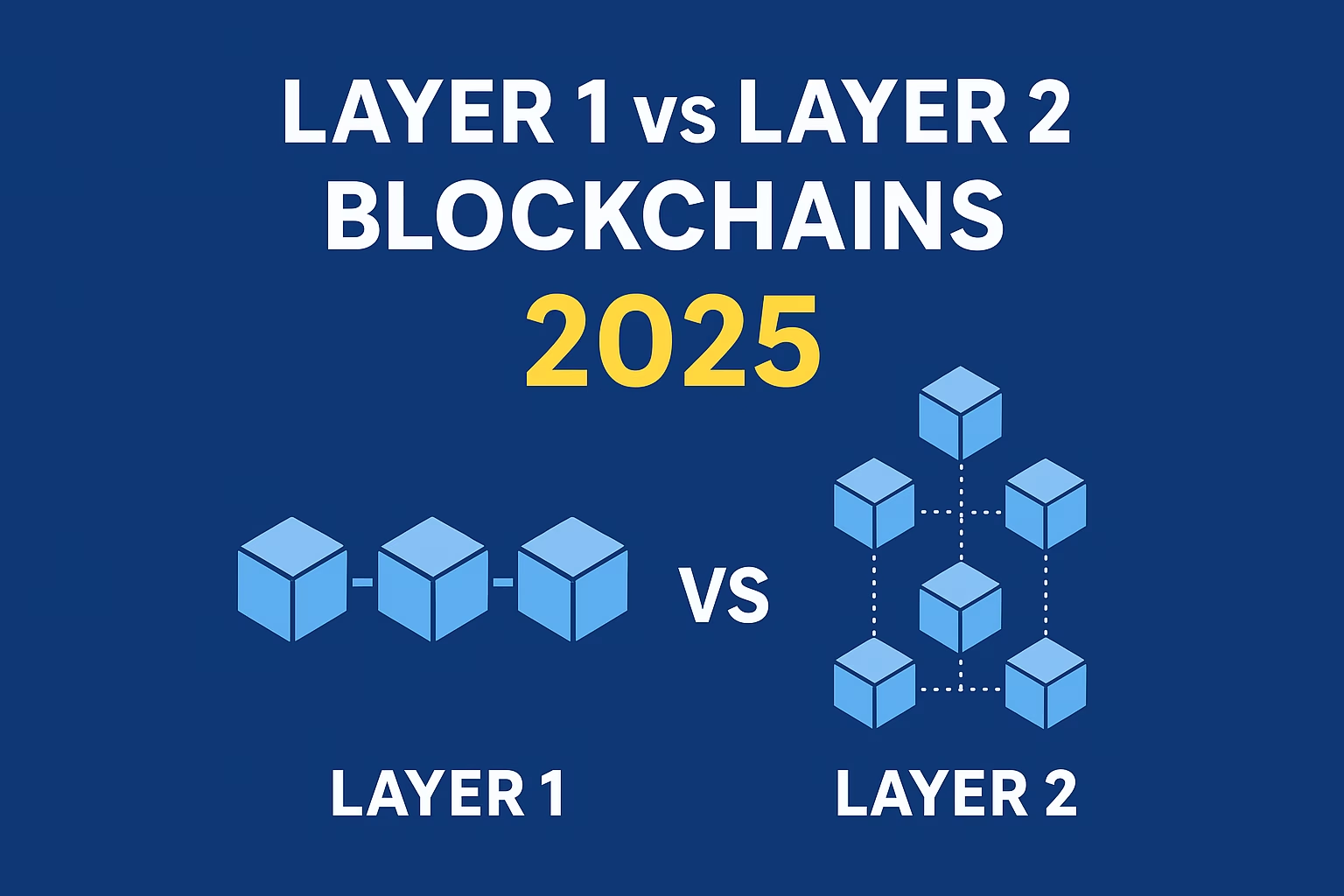
If you have been looking into blockchains technology and cryptocurrencies for the past few years, you’re probably heard the terms layer 1 and layer 2 more than once. Whether you’re an investor actually putting time into where to allocate your capital, a developer pondering where to build your next dApp, or just a mildly invested crypto nerd who wants to sound cool at the dinner party, the layer 1 vs. layer 2 discussion is relevant. In 2025, this debate has only grown louder. Ethereum still dominates much of the developer and DeFi ecosystem, but Solana, Avalanche, and other Layer 1s are pushing boundaries. Meanwhile, Layer 2s like Arbitrum, Optimism, zkSync, and Base are scaling Ethereum in ways that seemed almost impossible just a few years ago. So, which will you choose? Layer 1 or Layer 2? Let’s dig deeper. What Are Layer 1 Blockchains? A Layer 1 blockchain is the base layer, or protocol, which transaction is recorded digitally on the network. Examples of layer 1s include Bitcoin and Ethereum. All activity happens “on-chain”, with either miners or validators validating it on the blockchain, which records every transaction. Layer 1s provide: Examples of Layer 1s in 2025: Again, we should think of Layer 1 as the “main highway.” Every car (transaction) goes on the same highway, and the overall network decides how to manage traffic. What Are Layer 2 Blockchains? A Layer 2 blockchain that sits on top of Layer 1 for the purpose to add improvements to scalability, efficiency, or cost. Instead of competing with the base layer, it extends it. The most notable example: Ethereum Layer 2s. Gas fees on Ethereum were prohibitive to the point simple swaps were costing $100+. This gave rise to Layer 2s. Types of Layer 2s: Layer 2 is like adding express lanes to the main highway. Cars move faster, but still anchor their legitimacy to the main Layer 1 road. Why the Distinction Matters in 2025 Here’s the reality: blockchain adoption is growing beyond DeFi and NFTs. Supply chain systems, gaming, RWAs, CBDCs, and corporate sustainability credits are starting to utilize relatable public or hybrid blockchains. This demand gives rise to the following three friction points: That’s why the Layer 1 vs Layer 2 conversation isn’t just academic. – it outlines where businesses and developers and investors are going to build and deploy real applications. The Case for Layer 1 Pros Cons Real-World Example In the 2021 bull run, when Ethereum users were paying over $200 per transaction at the height of congestion, it no longer made sense for the casual user and developers were forced to explore other networks. Some left for Solana (fast, cheap), others waited for Ethereum’s scaling roadmap to evolve. The Case for Layer 2 Pros Cons Real-World Example In 2023-2024 Arbitrum and Optimism saw huge growth in TVL (total value locked with billions of liquidity in DeFi). Coinbase even launched Base, a Layer 2 chain on Ethereum, subsequently legitimizing L2s as more than experimental… they were now the default scaling strategy for Ethereum. Layer 1 vs Layer 2: Which Is Better The real answer is not one is universally “better“, it’s about fit for purpose. Hybrid Approaches: The Future Is Multi-Layered By 2025, we will predominantly see hybrid models developed: This means you don’t really have to choose strictly one way or the other. Developers are designing and building with modularity in mind, utilizing Layer 1 security, and Layer 2 scalability. Final Thoughts The rise of Layer 1 vs Layer 2 blockchains isn’t a war with a clear winner. It’s more like the evolution of the internet itself. In the early days, websites had to choose between dial-up and DSL. Today, we take broadband for granted. Similarly, in the future, users won’t ask, “Am I on L1 or L2?” They’ll just expect apps to be fast, cheap, and secure. The best builders and investors today will anticipate that reality and position themselves accordingly. So, if you’re asking: Layer 1 or Layer 2? The smarter answer is: both — strategically, depending on your needs. FAQs on Layer 1 vs Layer 2 Blockchains 1. What is the difference between Layer 1 and Layer 2 blockchains? Layer 1 blockchains are base networks that processes and secures transactions directly (e.g.: Ethereum, Solana, Bitcoin). Layer 2 blockchains are scaling solutions built on top of layer 1 blockchains that improve the speed and cost of transactions, while Layer 1 still secures the transaction. 2. Is Ethereum a Layer 1 or Layer 2? Ethereum is a layer 1 blockchain, however it has many layer 2 solutions on top of it to help with the scaling and reducing gas fees. (e.g.: Arbitrum, Optimism, zkSync) 3. Why do we need Layer 2 blockchains if Layer 1 exists? Layer 1 blockchains often suffer from scalability issues, such as high gas fees and low throughput. Layer 2 blockchains and solutions allow for improved scalability and reduce costs for the user by processing transactions offchain or in batches. 4. Which is more secure: Layer 1 or Layer 2? Layer 1 blockchains are generally more secure since they validate everything on-chain. Layer 2 blockchains get their security from the layer 1 blockchain they are built on, however there can sometimes be vulnerabilities in the infrastructure and bridges around them. 5. Are Layer 2 blockchains the future of Ethereum? Yes. Ethereum’s roadmap is heavily dependent on scaling with layer 2 rollups, ideally Ethereum will act as a settlement layer, while most user activity happens on Layer 2. 6. Which is cheaper: Layer 1 or Layer 2? Layer 2 blockchains are much cheaper. A swap on Arbitrum might cost a few cents, and on Layer 1 Ethereum the same swap could cost a few dollars especially during peak times. 7. Should I build my dApp on Layer 1 or Layer 2? It depends on what you are trying to do. If you need max security and liquidity choose a Layer 1 like Ethereum. If you need fast, low-cost transactions – think

The worldwide push toward sustainability has thrust carbon credits into the heart of corporate and governmental Climate change fighting plans. Yet today’s carbon credit markets are plagued by issuers trading in opacity, double counting, and suboptimal validation. Here is where blockchain can help. We are utilizing blockchain to symmetrize carbon credits; tokenizing, storing and trading of them on a registries – making such credits theoretically traceable, and significantly slashing shady practices on the carbon market, effectively enabling businesses of any size to buy, sell, or retire these without encountering bureaucratic or financial barriers. This guide will take you through the steps to create a blockchain carbon credit platform, as well as demonstrate projects that are already doing it, and answer the big questions we hear most. Why Use Blockchain for Carbon Credit Platforms? But before we get into how to build a carbon credits platform, we should discuss what makes blockchain such a great tool for managing carbon tokens: Step 1: Define the Platform Objectives Begin by determining whom you are creating the platform for and what problem it solves. Here are a few possible goals:- Also, consider what type of network you want to use: Will it be a public blockchain such as Ethereum, Polygon, or BNB Chain, or will you opt for a private or consortium chain with limited access? Step 2: Choose the Right Blockchain Architecture Scalability, cost, and adoption are dictated by blockchain architecture. Options include: EVM-Compatible Chains (Ethereum, Polygon, Avalanche) : Excellent for interoperability & smart contracts. Famous for its strong smart contract functionality and large development community, Ethereum is a public blockchain. Scalability and transaction speed are the ones that bother people when using it, since it provides transparency/shared ledger and decentralization. Private Permissioned Chains (Hyperledger Fabric, Quorum) : For Governments and enterprises who are interested in control. Hyperledger Fabric is a blockchain framework intended for enterprise applications that offers a modular architecture. It provides private transactions and confidential contracts, perfect for businesses who want to protect sensitive data. Its scalability and support for pluggable consensus mean that organizations can adapt the system to their own requirements. Corda: Designed for financial institutions, Corda is a permissioned blockchain with a focus on privacy and transactions directly between parties. Because of its special consensus mechanism, relevant parties could access transaction records for the purpose of enhancing the privacy protection. Step 3: Tokenize Carbon Credits Carbon credits must have a digital form to be traded on blockchain. Tokenization transforms each of the verified credits (which is usually 1 ton of CO₂) into a digital asset: ERC-20 tokens : To fungible carbon credits (This is for the purpose of general trading). ERC-721 NFTs : Unique credits paired w/ certain projects & complete with metadata (project location, details about the project, verification docs). Example: You have a reforestation project in Brazil which generates 10,000 credits, you now have 10,000 NFTs with geo-tagging + verification documents. Benefits of Tokenization: Step 4: Build Core Platform Modules For an effective carbon credit blockchain platform, we required a few important modules: Carbon Credit Issuance Module Marketplace & Trading Exchange Registry & Retirement System Verification & Compliance Tools User Wallet Integration Step 5: Integrate Smart Contracts Smart contracts are contracts with terms written directly into code. In carbon credit trade, smart contracts are able to automatize the operations concerning the release, transfer, and retirement of carbon credits through predefined conditions. The automation of these processes reduces intermediary intervention, transaction costs, and time as well. A business looking to offset its emissions, for example, might negotiate a smart contract which automatically buys the necessary credits when certain constraints are met (which simplifies the process and guarantees that the business remains in compliance). Smart contracts are the Lego bricks of automation: This eliminates intermediaries and reduces costs. Step 6: Add Transparency Features In order to gain trust, platforms have to provide an easy way for the stakeholders to verify the credits. Transparency features include: Step 7: Ensure Scalability & Security Scalability is important as potentially thousands of credits could be issued per day. Security measures: Step 8: Launch & Onboard Stakeholders Once the platform is ready: Real-World Examples of Blockchain Carbon Platforms These examples show the growing adoption of blockchain in climate solutions. Benefits of Blockchain-Based Carbon Credit Platforms Transparency & Trust Efficiency & Automation Global Accessibility Cost Reduction Real-Time Tracking Enhanced Market Liquidity Inclusive Participation Regulatory Compliance & Auditability Data Integration with IoT & AI Boosting Corporate Sustainability Reputation Cost of a blockchain-based carbon credit platform development It is an expensive proposition to create a sophisticated carbon trading system. The final price depends on the location of your development team, the functionality of your platform, the blockchain you pick and whether or not you. It’s easy to become bogged down in the weeds of pricing, however, be it a white label carbon credit platform, or a customized one-of-a-kind project built from the ground up. Prices can vary from $60,000 for standard platforms to over $200,000 for comprehensive solutions. Conclusion The carbon credits market can be revolutionized by blockchain technology, which can make it transparent, less convoluted, efficient, and fraud-proof. From tokenized credits, to facilitating frictionless trading across the globe, blockchain-based platforms guarantee trust and scalability in combating climate change. We at TechAroha are professionals in providing customized blockchain solutions including carbon credits platform, tokenization infrastructure and ESG solutions. We integrate sustainability with state-of-the-art blockchain technology to enable businesses, governments and NGOs to create the climate markets of the future. FAQs: Blockchain Carbon Credit Platforms What is a blockchain-based carbon credit platform?A digital platform based on blockchain technology for financing of carbon credits and withdrawal of those from trading with traceability and full transparency. How does tokenizing carbon credits work? Every credit is then tokenized into a digital token (fungible ERC-20 or NFT ERC-721) and is a crypto-certificate of 1T of CO₂ removed or avoided. Why build carbon credits on the blockchain and not traditional registries? Facilitate global access independently through Blockchain; it is double