

The carbon credit market is no longer experimental. Compliance markets were valued at $113.1 billion in 2024 and are projected to reach $458 billion by 2034, according to global climate finance projections from institutions such as the World Bank and market analysts at BloombergNEF. But here’s the strategic question most enterprises miss: Are you participating in the carbon market — or owning the infrastructure it runs on? Because the real money isn’t in buying or selling credits.It’s in owning the platform where they trade. If you are considering building a carbon credit trading platform, this is not a sustainability play. It’s a financial infrastructure play. Why Platform Owners Always Win Stock exchanges don’t speculate on stocks.They monetize access, execution, listings, and data. Carbon marketplaces operate the same way. Every event on your platform becomes billable: The strongest carbon credit marketplace revenue model is not a single stream.It is a layered revenue architecture. The 6-Layer Carbon Marketplace Revenue Stack High-performing platforms activate all six. 1. Foundation Layer – Transaction Fees 2–5% per trade is industry standard. Example:500,000 tonnes annually at $40/tonne3% fee = $600,000/year At 2M tonnes, that becomes $2.4M/year. Transaction fees scale automatically with liquidity. 2. Recurring Layer – Enterprise Subscriptions Turn your marketplace into SaaS. Typical structure: Even 50 enterprise subscribers generate $2.4M/year in recurring revenue — independent of trade activity. This stabilizes cash flow and increases valuation multiples. 3. Supply Layer – Project Origination & Listing Fees Most platforms monetize buyers.Smart platforms monetize both sides. Charge: Each project becomes a multi-year revenue source over a 10–25 year lifecycle. 4. Data Layer – Analytics & Intelligence Licensing Every trade generates proprietary data: Package it as: Data licensing is typically the highest-margin stream. You build once.You monetize repeatedly. 5. Trust Layer – Verification-as-a-Service Premium verified credits trade significantly higher. If your platform integrates workflows aligned with standards like: You can charge processing fees for streamlined verification. Trust increases price per tonne.Higher price per tonne increases your transaction revenue. 6. Expansion Layer – White-Label Licensing Banks, sustainability consultancies, and energy companies may want branded exchanges without building from scratch. White-label licensing typically includes: This expands your footprint without proportional sales expansion. What Real ROI Looks Like (Year 3 Scenario) Conservative mid-sized marketplace: Total: $11.4M+ annually From infrastructure built once. This is why revenue architecture matters before development begins. 🇮🇳 India’s Carbon Market: A Strategic Timing Window India is rapidly formalizing its compliance ecosystem through the Carbon Credit Trading Scheme (CCTS) under the guidance of the Ministry of Power and operational oversight by the Bureau of Energy Efficiency. This signals structural demand for: India is in an early infrastructure build phase. That creates a first-mover advantage for enterprises that launch compliant carbon trading platforms now — before regulatory maturity locks in dominant players. Build Decision: Custom vs. Off-the-Shelf Off-the-shelf solutions: Custom-built carbon exchange software: Development investment typically ranges from $150,000–$500,000 depending on complexity. At enterprise subscription levels, that can be recovered within 12–18 months. After that, infrastructure compounds. The Strategic Shift: From Participant to Infrastructure Owner When voluntary markets scale toward projected multi-billion-dollar levels this decade, the largest beneficiaries will not be occasional traders. They will be the infrastructure owners. The enterprises that: Those are the platforms that build durable, defensible, high-margin revenue engines. If You’re Evaluating a Carbon Credit Trading Platform The key question is not: “Can we enter the carbon market?” The real question is: “How do we design a platform that monetizes every layer of the ecosystem?” We work with enterprises, sustainability leaders, financial institutions, and climate-tech founders to: If you’re serious about building infrastructure instead of renting space on someone else’s, the architecture decisions you make today determine whether you build a $2M tool — or a $20M platform. Contact Techaroha to build robust platform for the Carbon Credit Trading Platform
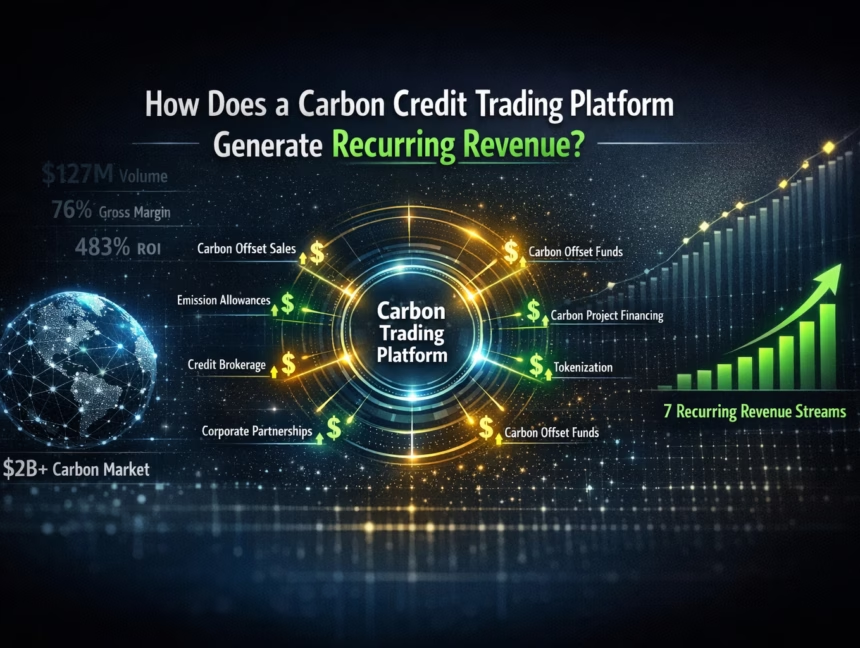
The carbon credit market surpassed $2 billion in 2024, yet most enterprises still view carbon trading platforms as cost centers rather than revenue engines. This perspective misses a critical opportunity: properly architected carbon credit trading platforms don’t just facilitate compliance—they generate seven distinct recurring revenue streams that compound over time. When GreenTech Solutions launched their carbon credit trading platform in Q2 2023, they projected break-even within 36 months. Instead, they achieved profitability in month 11 and generated $3.2 million in recurring revenue by month 18—a 280% ROI that transformed their business model entirely. This isn’t an isolated success story. It’s the predictable outcome when a carbon credit trading platform’s revenue model architecture prioritizes infrastructure ownership over transaction participation. The Fatal Flaw in Traditional Carbon Trading Approaches Most organizations approach carbon markets as buyers: they purchase offsets through third-party exchanges, pay transaction fees, and move on. This transactional mindset surrenders control of three valuable assets: Market intelligence. Every transaction generates data about pricing trends, buyer behavior, and project performance. Third-party platforms capture and monetize this intelligence while participants remain blind to market dynamics. Customer relationships. When you trade on someone else’s infrastructure, they own the relationship with both sides of every transaction. You’re a data point in their network effect, not the architect of it. Revenue potential. Transaction fees represent just the visible cost. The invisible cost is the platform’s ability to generate revenue from marketplace operations, data licensing, and ecosystem services—none of which flows to participants. A carbon credit trading platform revenue model built on infrastructure ownership reverses this equation entirely. Revenue Stream #1: Transaction Fees at Scale The most obvious carbon credit trading platform revenue model component is transaction fees, but scale dynamics make this far more valuable than simple arithmetic suggests. A platform charging 2.5% per transaction on $50 million in annual volume generates $1.25 million. But here’s where compounding accelerates: as network participants grow, transaction velocity increases exponentially, not linearly. When GreenTech onboarded their first corporate buyer processing $2 million annually, that seemed modest. But that buyer brought their supply chain—14 suppliers who collectively needed $18 million in offsets. Each new participant didn’t just add their volume; they multiplied connection potential across the entire network. By month 24, GreenTech’s platform was processing $127 million annually—2.5x their initial projections—driven entirely by network compounding effects. Their carbon credit trading platform revenue model had transformed from a linear fee collector into an exponential value accelerator. Implementation insight: Set graduated fee structures that decrease with volume but increase with ecosystem depth. A buyer trading $100K pays 2.5%; a buyer who brings three suppliers pays 2.2%. This incentivizes network growth while protecting margins. Revenue Stream #2: Registry Integration as a Service Every carbon credit requires verification across multiple registries: Verra, Gold Standard, Climate Action Reserve, and regional authorities. Manual registry management costs enterprises $45,000-$85,000 annually in staff time and consulting fees. A carbon credit trading platform revenue model that automates registry integration captures this value through SaaS subscriptions. GreenTech charges $12,000 annually per enterprise for automated registry connectivity, compliance monitoring, and retirement documentation. With 47 enterprise clients by month 18, this single revenue stream generated $564,000 in recurring annual revenue—with 94% gross margins since infrastructure costs don’t scale linearly with users. The technical architecture enabling this involves API connections to registry databases, smart contract automation for retirement workflows, and cryptographic verification that documentation matches blockchain records. Once built, this infrastructure serves unlimited users at minimal marginal cost. Implementation insight: Offer tiered registry access. Basic tier covers major registries (Verra, Gold Standard); premium tier includes regional registries and custom project verification. This creates upsell opportunities while serving different market segments. Revenue Stream #3: Data Intelligence Licensing Blockchain-based carbon platforms generate unprecedented transparency into market behavior. This data—properly anonymized and aggregated—becomes extraordinarily valuable to three distinct buyer categories: Financial institutions need carbon market intelligence for climate risk modeling, ESG investment strategies, and carbon-linked financial products. GreenTech licenses quarterly market intelligence reports to six institutional investors at $85,000 annually each—$510,000 in pure data revenue. Corporate strategists require forward-looking insights into carbon pricing, regulatory trends, and offset availability. Procurement teams planning 18-24 months ahead will pay premium rates for predictive analytics only platform operators can generate. Technology vendors building adjacent services (ESG reporting software, supply chain carbon tracking, sustainability disclosure platforms) need benchmark data to validate their own product claims. The carbon credit trading platform revenue model advantage here is defensibility. You’re not selling commodity information available elsewhere—you’re monetizing proprietary behavioral patterns only your infrastructure can observe. Implementation insight: Start with annual reports sold to existing participants, then expand to external licensing. This tests demand with minimal risk while building data products that external buyers will value. Revenue Stream #4: Premium Verification Services Standard carbon credits trade at $15-$40 per ton. Premium-verified credits with enhanced due diligence command $65-$120 per ton because they carry lower reputational risk for buyers facing intense sustainability scrutiny. A carbon credit trading platform revenue model can capture this premium through verification-as-a-service. GreenTech established partnerships with three independent verification bodies and built automated workflows connecting project documentation, satellite imagery, IoT sensor data, and third-party audits. Buyers pay a 15% premium for enhanced verification, of which GreenTech retains 8% and passes 7% to verification partners. On $31 million in premium-verified transactions, this generated $2.48 million in incremental revenue—while actually reducing verification timelines from 4-6 months to 11-14 days. The technical differentiation lies in automation. Traditional verification requires manual documentation review, site visits, and committee approvals. Blockchain platforms can trigger automated verification workflows when IoT sensors confirm project milestones, satellite imagery validates forest conservation, or energy meters document renewable generation. Implementation insight: Build verification partnerships before launch. Credible third-party validators provide legitimacy that blockchain alone cannot deliver, especially in regulated industries with conservative compliance cultures. Revenue Stream #5: White-Label Platform Licensing Once your carbon credit trading platform demonstrates market traction, adjacent industries need similar infrastructure. A renewable energy consortium needs member-only credit trading. A manufacturing trade association wants supply chain carbon tracking. A

The global carbon credit market crossed $2 billion in 2024, yet nearly 73% of small and mid-sized businesses remain locked out. High minimum purchase requirements, rigid contract sizes, and manual trading processes make participation impractical for organizations with modest emissions footprints. Fractional carbon credit tokenization changes this dynamic by transforming verified carbon credits into divisible digital assets that can be traded, owned, and retired in precise quantities. Instead of purchasing entire credits in bulk, organizations can access carbon markets with accuracy, flexibility, and lower capital commitments—while platform operators unlock new revenue at scale. This is no longer experimental. Companies deploying tokenized carbon credit platforms are achieving 300%+ ROI within 18 months, expanding buyer access by over 400%, and dramatically improving credit utilization. The $30,000 Entry Barrier: Why Traditional Carbon Markets Fail SMEs Conventional carbon markets were built for enterprise buyers. A typical transaction requires minimum purchases of 1,000 credits or more, translating to $30,000–$50,000 per deal. For a regional logistics firm emitting 200 tons annually, this means buying five times more offsets than needed—or not participating at all. According to 2024 market research: This creates a systemic contradiction: organizations best positioned to adopt sustainability practices are excluded by infrastructure designed for large buyers only. How Fractional Carbon Credit Tokenization Expands Market Access Fractionalization applies proven financial engineering principles—used in real estate and private equity—to environmental assets. Instead of selling entire credits, blockchain-based carbon platforms divide a single verified credit into smaller, tradable units. How it works at a high level: A café offsetting 0.37 tons per month can now purchase exactly that amount—without overbuying or exiting the market altogether. For sellers and brokers, this unlocks previously unreachable buyer segments, generating higher transaction frequency and predictable recurring revenue. How Fractional Carbon Credit Tokenization Works (Step-by-Step Flow) Case Study: $180K Platform Investment Generating $750K in Annual Revenue A renewable energy project developer launched a tokenized carbon marketplace in Q2 2024 to address three challenges: Before implementation: After fractional tokenization launch: Results in 12 months: One key challenge: registry integration delays slowed initial onboarding.Solution: parallel registry synchronization and phased token minting reduced future onboarding time by 60%. Total platform cost: $180,000First-year net revenue uplift: $750,000ROI: 316% (excluding multi-year recurring revenue) Technical Architecture for Tokenized Carbon Platforms Successful platforms rely on four tightly integrated components: 1. Tokenization Engine with Registry Integration 2. Fractional Ownership Smart Contracts 3. Automated Marketplace & Price Discovery 4. Compliance & Retirement Infrastructure Is Fractional Carbon Credit Tokenization Legal and Compliant? Yes—when implemented correctly. Fractional tokens do not create new carbon credits. They represent partial ownership of existing, verified credits. Compliance alignment includes: Well-designed platforms operate as technical infrastructure, not issuers of environmental claims—ensuring regulatory compatibility. Traditional Carbon Trading vs Tokenized Fractional Markets Factor Traditional Markets Fractional Tokenization Minimum purchase 1,000+ credits Any fraction Buyer access Enterprises only SMEs + enterprises Liquidity Low High Settlement Manual Instant Transparency Limited On-chain Who Should Build a Fractional Carbon Credit Platform? This model delivers maximum value for: If you manage supply, demand, or compliance—owning the infrastructure compounds value. Revenue Models Platform Operators Often Overlook Beyond transaction fees: A platform processing $30M annually can generate $1.15M+ from the same infrastructure. Why Timing Matters: The 24-Month Advantage Window Early entrants benefit from: Late movers will pay rent to infrastructure owners—or struggle to compete. Implementation Roadmap: 90 Days to Market Weeks 1–4: Architecture & compliance designWeeks 5–10: Smart contracts, marketplace, registry integrationWeeks 11–13: Security audits, pilot launch, scale testing Speed matters. Every month of delay compounds opportunity cost. Fractional Carbon Credit Tokenization as a Competitive Advantage The carbon market is consolidating around platform ownership, not participation. Owning tokenized infrastructure means: This isn’t just about compliance—it’s about who controls climate market infrastructure. FAQs Is fractional carbon credit tokenization legal?Yes, when credits are locked or retired at the registry level and fully traceable. Can fractional credits be retired partially?Yes. Smart contracts allow retirement of exact fractions. Which blockchains are best for carbon markets?Ethereum, Polygon, and enterprise private chains depending on cost and compliance needs. How do platforms prevent greenwashing?By linking every fraction to a verified source credit with immutable audit trails. Ready to Calculate Your Platform ROI? Get a 30-minute feasibility call—no sales pitch, just numbers. You’ll receive: Contact Techaroha today to assess your fractional carbon credit tokenization opportunity.[Start Your Platform Assessment →]
The energy sector stands at a critical juncture where environmental accountability meets operational efficiency. Carbon credit registry software has emerged as a foundational technology enabling energy companies to scale compliance, improve transparency, and unlock faster market access. When Pacific Energy Solutions implemented carbon credit registry software in Q2 2023, they didn’t anticipate the magnitude of transformation awaiting their carbon trading operations. Within eight months, verification timelines dropped from 45 days to just 72 hours, while administrative costs fell by 68%. This case study explores how digitizing carbon registries delivers measurable ROI and long-term competitive advantage in today’s compliance-driven energy landscape. What Is Carbon Credit Registry Software in the Energy Sector? Carbon credit registry software is a digital platform that records, verifies, tracks, and manages carbon credits throughout their lifecycle—from issuance and transfer to retirement. For energy companies, it replaces manual spreadsheets and fragmented systems with a secure, auditable, real-time registry, often powered by blockchain, automation, and marketplace integrations. The result is faster transactions, lower compliance risk, and improved monetization of environmental assets. The Manual Registry Challenge: A $2.3M Annual Drain Pacific Energy Solutions, a mid-sized renewable energy provider managing 850,000 carbon credits annually, relied on traditional registry processes riddled with inefficiencies. Their carbon trading desk employed 12 full-time staff to manage spreadsheets, email confirmations, and manual verifications. They faced three critical challenges: Beyond direct costs, manual processes caused a 4.7% error rate in credit tracking—creating compliance risk and reputational exposure. When regulatory scrutiny increased in early 2023, leadership recognized that adopting carbon credit registry software was no longer optional—it was essential. Image Placeholder:Comparison chart showing manual vs digital carbon credit registry timelines, costs, and error rates. The Digital Transformation Blueprint Pacific Energy partnered with a specialized development firm to deploy carbon credit registry software tailored for the energy sector. The implementation focused on three integrated capabilities. 1. Blockchain-Enabled Credit Registry Each carbon credit received a unique digital identifier with immutable provenance tracking—from generation through retirement. This eliminated dual record-keeping and provided cryptographic proof of authenticity for auditors and buyers. 2. Smart Contract Verification Automation The platform integrated directly with independent verification bodies. Documentation submission, validation, and approval workflows were fully automated. Once standards were met, credits moved from pending to tradable automatically. Result: Verification cycles dropped from 45 days to 72 hours (93% faster). 3. Real-Time Marketplace Integration The registry connected to major carbon exchanges, enabling instant price discovery and automated trade execution. Buyers accessed inventory, certification details, and pricing via a unified dashboard—expanding Pacific Energy’s potential buyer base by 340%. Implementation Journey: 90 Days to Full Deployment The deployment followed a phased rollout to ensure zero business disruption. Weeks 1–3: Data Migration Weeks 4–7: Training & Parallel Operations Weeks 8–12: Marketplace & Compliance Integration Outcome: First fully automated trade settled in 14 minutes, compared to the previous 11-day average. Quantifying the Return: 312% ROI in Year One Pacific Energy invested $340,000 in carbon credit registry software, covering development, integrations, and training. First-year returns exceeded expectations. Cost Reduction Revenue Growth Compliance Efficiency Image Placeholder:ROI dashboard showing cost savings, transaction speed improvements, and compliance efficiency gains. The Competitive Intelligence Advantage Beyond automation, carbon credit registry software delivered strategic intelligence. CRM-style buyer intelligence improved sales execution: Scalability for Growth: From 850K to 3.2M Credits Scalability proved to be the most powerful long-term advantage. By 2024, Pacific Energy managed 3.2 million credits—nearly 4x growth—without increasing operational headcount. The carbon credit registry software scaled horizontally, maintaining performance while reducing per-credit management costs. This technical maturity strengthened Pacific Energy’s market position. In December 2024, it directly supported a $23 million strategic partnership, validating the platform investment many times over. Why Energy Companies Can’t Afford Delayed Digitization Delaying adoption of carbon credit registry software creates compounding disadvantages: Digital capability is no longer a differentiator—it’s the baseline for survival. The Implementation Roadmap for Energy Companies To implement carbon credit registry software successfully: Technology delivers value only when teams fully adopt it. Conclusion: The Digital Imperative Pacific Energy Solutions’ transition to carbon credit registry software demonstrates how digitization drives efficiency, revenue growth, and strategic advantage. A 312% first-year ROI confirms that modern carbon registries deliver tangible business results. For energy companies, the real question isn’t whether to digitize—but how fast. With proven ROI and a 90-day deployment window, early action is the smartest move in a carbon-focused global economy. Ready to Calculate Your ROI? Discover how carbon credit registry software can unlock compliance efficiency and new revenue streams for your energy portfolio.Contact us today for a customized ROI and digital readiness assessment.