

Greenwashing lawsuits have cost corporations hundreds of millions of dollars since 2022. Delta Air Lines faced a class action over misleading carbon-neutral claims. Volkswagen, Shell, and Nestlé have all faced regulatory scrutiny for sustainability assertions that their own carbon offset records could not substantiate. What most post-mortems on these cases miss is a quietly devastating truth: the companies involved did not always intend to deceive. Their carbon trading platform architecture simply could not prove they weren’t.
That distinction matters enormously if you are building or procuring a carbon credit trading platform today. Greenwashing risk is not primarily a marketing problem. It is an infrastructure problem. And the ROI case for solving it at the architecture level — before your legal team is drafting settlement offers — has never been stronger.
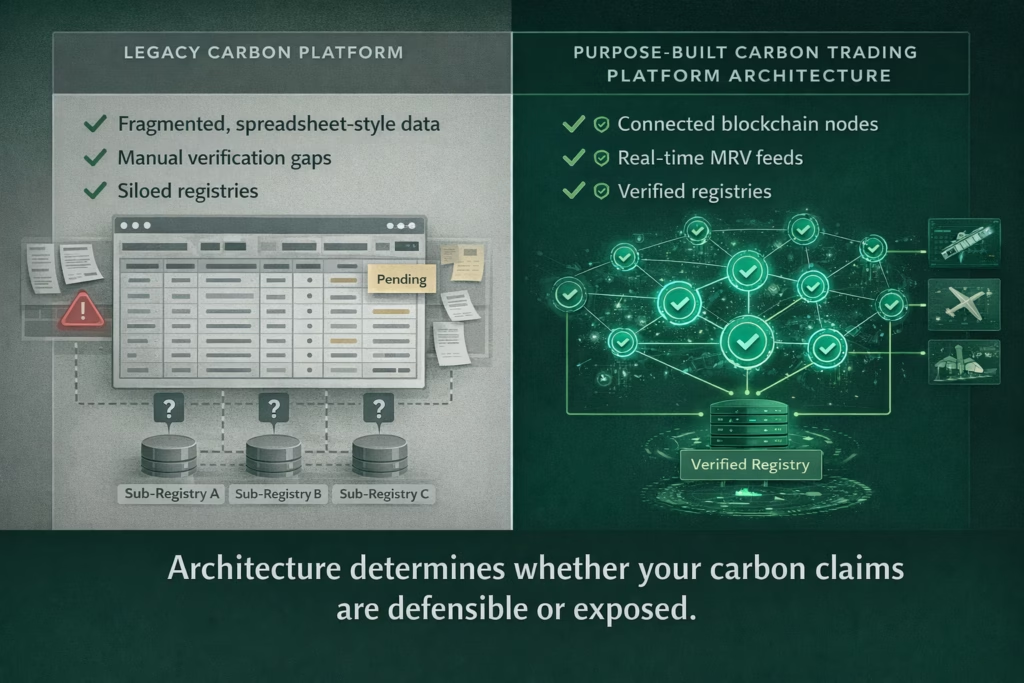
When regulators or NGOs challenge a company’s carbon-neutral claim, they are not auditing your marketing copy. They are auditing your data chain. The core question is: can you prove, at the transaction level, that every carbon credit you purchased was real, additional, non-duplicated, and properly retired?
Most organizations cannot. Not because they were negligent, but because their carbon trading platform architecture was never designed to answer that question.
According to Bloomberg BNEF’s 2024 Long-Term Carbon Offset Outlook, voluntary carbon credit prices are projected to reach $238 per tonne by 2050, implying an annual market value exceeding $1.1 trillion. As credit values climb, so does the financial incentive for fraud — and the regulatory scrutiny applied to buyers who cannot verify what they purchased.
The ISDA’s 2024 greenwashing risk report identifies two distinct failure modes in voluntary carbon markets: system-level risk, where a company’s overall net-zero claim is structurally misleading, and credit-level risk, where individual credits purchased are overstated or invalid. Both failures share a single root cause: inadequate carbon trading platform architecture.
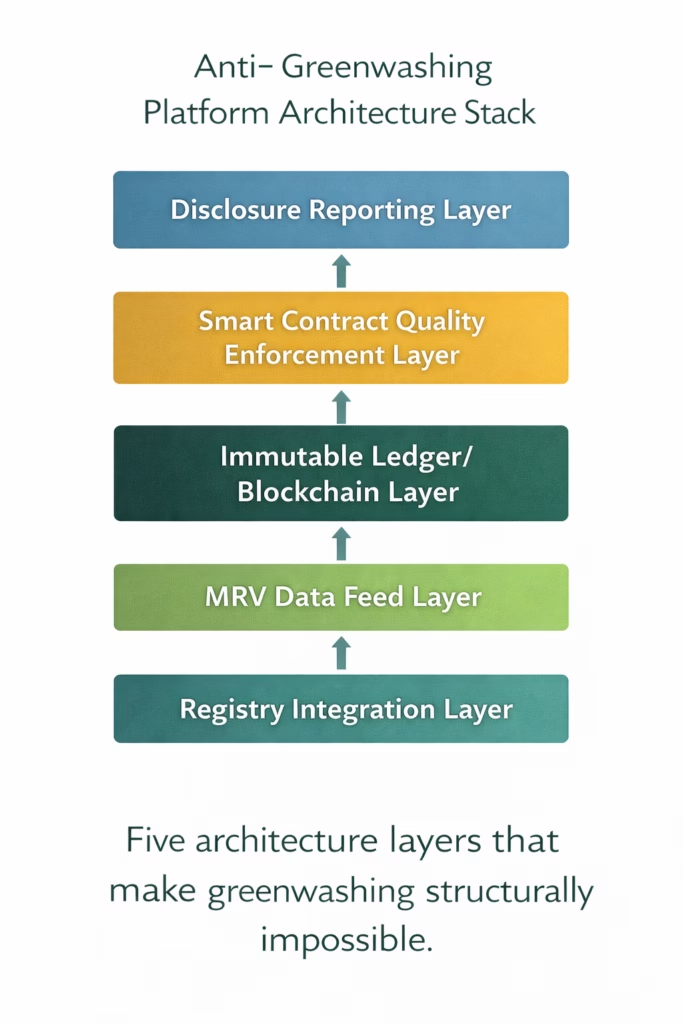
Anti-greenwashing carbon trading platform architecture is not a single feature. It is a set of interconnected design decisions that together make fraudulent or misleading claims structurally impossible. Here is what that looks like in practice across five critical architecture layers.
Every carbon credit must carry an unbroken, tamper-resistant audit trail from project issuance to retirement. In legacy platforms, provenance is tracked in spreadsheets or third-party registries that are queried manually. A purpose-built carbon trading platform architecture uses a distributed ledger or cryptographic hash-chain to record every ownership transfer, ensuring that a credit’s entire lifecycle — project origin, verification standard, registry record, buyer chain, and retirement event — is machine-readable and court-admissible.
This alone eliminates the double-counting problem that has invalidated billions of dollars in offsets across the voluntary carbon market. When the same credit cannot be sold twice because the ledger physically prevents it, your sustainability claims become cryptographically verifiable, not just assertible.
A carbon trading platform architecture built for compliance connects directly to registries such as Verra, Gold Standard, ACR, and national compliance registries via live API, not batch-sync. This means the moment a credit is retired on your behalf, that retirement is reflected in your platform records with a timestamp, registry transaction ID, and linked credit metadata.
When your sustainability report says “10,000 tonnes offset in Q3,” your platform can generate a retirement certificate bundle that references specific registry entries. That documentation is what separates a defensible ESG claim from a greenwashing liability.
Greenwashing often originates not from bad credits, but from bad baselines. A company claims to have offset 50,000 tonnes when its actual measured emissions were 80,000 tonnes — and the gap was never audited. A robust carbon trading platform architecture integrates MRV data feeds directly into the trading workflow.
This means your platform does not just track what you bought. It tracks what you emitted, compares it against what you offset, and flags discrepancies before they appear in your annual sustainability disclosure. The financial value here is significant: proactive discrepancy detection eliminates the regulatory correction costs, restatement expenses, and reputational damage that reactive compliance triggers.
Not all carbon credits are equal. Credits from projects with weak additionality, poor permanence controls, or questionable baselines represent significant greenwashing risk even when legitimately issued. A carbon trading platform architecture built on smart contracts can enforce quality floors programmatically.
This means your platform can be configured to reject credits that do not meet ICVCM Core Carbon Principles, automatically screen for vintage year constraints, flag credits from project types your legal team has identified as high-risk, and require third-party verification attestations before a credit clears for purchase. Quality control that previously required a team of analysts now runs at transaction speed, 24/7.
The CSRD in Europe, SEC climate disclosure rules in the United States, and India’s CCTS reporting requirements all demand granular, auditable records of carbon offset activity. A carbon trading platform architecture that generates disclosure-ready reports — pre-formatted for regulatory submission, with underlying registry references attached — transforms compliance from a quarterly scramble into a continuous automated output.
The ROI of a carbon trading platform architecture designed to prevent greenwashing is not speculative. It is quantifiable across four vectors.
First, regulatory penalty avoidance. The EU Green Claims Directive, enacted in early 2024, allows member states to impose fines of up to 4% of annual revenue for unsubstantiated environmental claims. For a company with €500 million in revenue, a single greenwashing finding costs €20 million. A purpose-built carbon trading platform architecture costs a fraction of that to implement and eliminates the liability entirely.
Second, credit procurement efficiency. Companies with direct registry connectivity and automated quality screening consistently achieve $1–3 per tonne procurement advantages over those relying on brokers and manual processes. For an organization purchasing 100,000 tonnes annually, that efficiency gap represents $100,000–$300,000 in annual savings — before any revenue-side benefits are counted.
Third, premium credit access. As the ICVCM’s new Core Carbon Principles disqualify low-integrity credits from the market, high-quality credits are becoming scarcer and more valuable. Organizations with platforms capable of sourcing, verifying, and retiring premium credits directly — rather than through intermediaries — gain access to inventory that competitors cannot reach.
Fourth, investor and customer trust compounding. ESG ratings agencies now factor carbon accounting transparency into sustainability scores. A platform that generates audit-ready retirement documentation reduces investor risk perception, which translates directly into lower cost of capital and higher ESG-linked revenue premiums over time.
Taken together, for a mid-market enterprise operating in any regulated sector, a carbon trading platform architecture investment that prevents a single material greenwashing finding pays for itself before the lawyers finish billing.
Regulatory frameworks around carbon market integrity are tightening in real time. The Article 6.4 mechanism under the Paris Agreement established globally agreed rules for credit issuance and transfer. The EU has banned green claims that cannot be substantiated. India’s CCTS is formalizing compliance obligations for 461 designated enterprises. CORSIA Phase 2 begins mandatory compliance for airlines in 2027.
Every one of these frameworks raises the evidentiary bar for carbon-neutral claims — and every one of them assumes that your carbon trading platform architecture is already capable of meeting that bar. If it is not, the correction will be more expensive under regulatory pressure than it is today.
The companies building defensible carbon trading platform architecture now are not just managing risk. They are building a competitive moat. When your carbon claims are cryptographically verifiable and your competitors’ are not, that difference shows up in procurement decisions, investor conversations, and customer relationships — not just compliance audits.
If your current carbon offset process relies on broker-sourced credits, manual retirement confirmation, or spreadsheet-based emissions tracking, your greenwashing exposure is structural. No amount of legal review or marketing restraint eliminates architecture-level risk.
The solution is a carbon trading platform architecture engineered from the ground up to make every claim you make not just true, but provable.
At Techaroha, we develop and implement carbon credit trading platforms with anti-greenwashing architecture built in from day one — registry integration, MRV connectivity, immutable ledger infrastructure, smart contract quality enforcement, and disclosure-ready reporting. We work with enterprises, financial institutions, and climate-tech founders across compliance and voluntary markets globally.
If your organization is evaluating what that looks like for your sector, transaction volume, and regulatory context, the architecture decisions made in the next 90 days will determine your liability exposure for the next decade.
Contact Techaroha for a carbon trading platform architecture assessment — and find out exactly what your current setup is and isn’t protecting you against.