

CORSIA Phase I closes out its compliance window between 2024 and 2026, and something quietly expensive has been happening on every desk trading Article 6-eligible inventory: CORSIA settlement lag. Not price risk. Not supply risk, although that exists too. A slower, more mechanical problem: the gap between when a trade is agreed and when it actually clears, and it is costing airlines, brokers, and exchanges real money every single week.
This post is for the people who feel that gap directly: exchange founders building compliance-grade trading infrastructure, CTOs responsible for uptime and settlement integrity, and ESG or carbon fund managers who need certainty that the credit they bought this morning will still be theirs, cleanly, by end of day.
CORSIA-eligible credits carry a specific compliance signature: a host-country Letter of Authorization (LoA) confirming that a Corresponding Adjustment (CA) has been or will be applied under Article 6 of the Paris Agreement. That signature is what separates a credit airlines can legally retire against their CORSIA obligation from a credit that looks identical on paper but carries none of that protection.
The problem is where that verification actually happens. On most platforms today, it happens manually, after the trade is agreed, not before. A compliance officer or broker pulls a PDF, checks a registry reference number by eye, maybe emails a national registry contact to confirm a host-country attestation, and only then releases funds or clears the trade. During CORSIA’s most active trading hours, that manual review queue backs up. What should be a same-day settlement becomes a multi-day wait, and that wait is CORSIA settlement lag in its purest form.
In numbers, the shape of the problem looks like this:
| Factor | Manual Verification Reality |
|---|---|
| LoA/PDF cross-check time | Hours to multiple days per trade |
| National registry API response variance | Inconsistent across host countries, no unified standard |
| Peak-hour trade backlog | Queued behind other manual reviews |
| Double-selling exposure | High, since sovereign registries do not talk to each other in real time |
| Counterparty risk during lag window | Rises with every hour price moves against either side |
None of this is a compliance failure in the legal sense. Every credit involved may be perfectly legitimate. The failure is architectural: verification sits in a slow, disconnected, human-mediated layer instead of inside the settlement pipeline itself.
Here is the part that gets missed in most CORSIA commentary, which tends to stay at the policy level. CORSIA settlement lag is not a regulatory problem waiting on ICAO or a host government. It is a systems design problem, and it sits squarely inside the exchange’s own technology stack.
Three specific failure modes show up again and again on platforms that have not solved this:
Each of these failure modes translates directly into either a lost trade, a compliance exception that has to be manually unwound, or a client who moves their volume to a competitor with faster clearing. CORSIA settlement lag is not an inconvenience. It is a line item.
Most exchanges built their compliance-checking logic the same way they built everything else in the voluntary carbon market era: as an overnight batch job or a manual queue, because volumes were low enough that nobody needed anything faster. CORSIA changes that math completely.
Phase I demand for CORSIA-eligible emissions units runs into the hundreds of millions of tonnes, against a supply of authorized inventory that has consistently lagged behind. That imbalance means every unit with a confirmed corresponding adjustment carries a real premium, and premium assets attract fast-moving, high-frequency trading behavior — exactly the environment where batch-style verification breaks down first.
Reduce CORSIA settlement lag using batch logic, and the fix is temporary at best. Volume simply outgrows the review queue again within a quarter. This is the same category of design mistake carbon market infrastructure keeps repeating: putting compliance-critical logic in the slowest layer of the system instead of the fastest.
The fix is not more people reviewing PDFs faster. It is a structural change to where and when verification happens. The pattern that actually resolves CORSIA settlement lag is a dedicated API Middleware and Verification Oracle — a service layer that sits between the order matching engine and every national Article 6 registry endpoint a platform touches.
Here is how that architecture actually functions in practice:
This is the architectural difference between a platform that treats CORSIA settlement lag as an unavoidable cost of doing business, and one that treats it as a solved engineering problem.
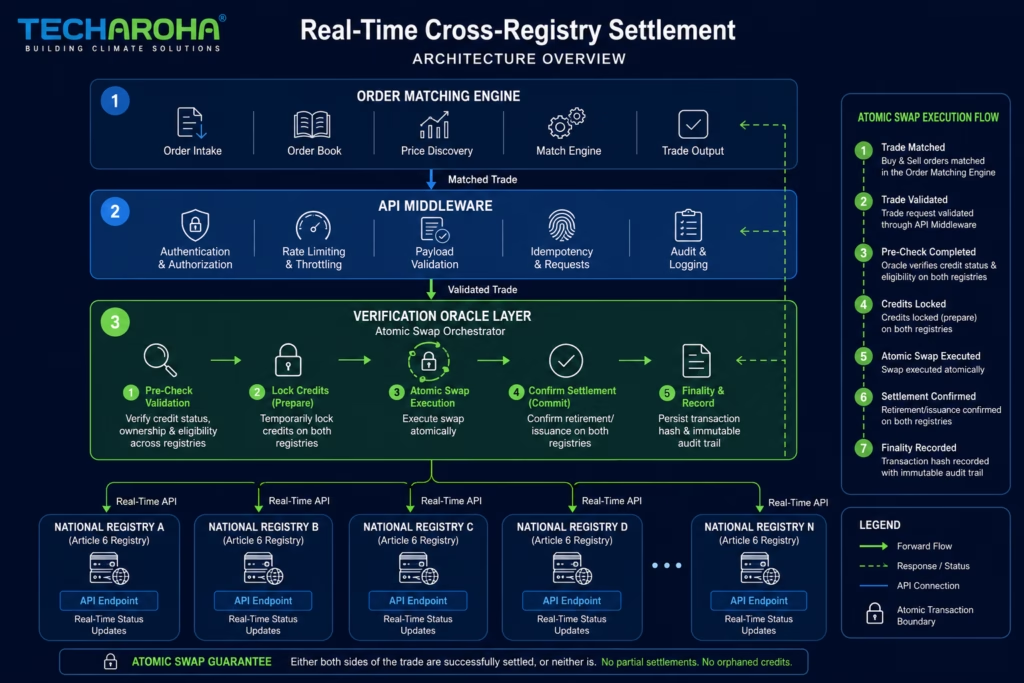
The people reading this closely — airline compliance managers, carbon brokers, institutional trading desks — are the ones who feel CORSIA settlement lag as risk exposure, not abstraction. Here is what an automated CA verification oracle actually changes for each of them:
| Dimension | Manual PDF/Batch Review | API Middleware and Verification Oracle |
|---|---|---|
| Verification timing | After trade agreement | Before order matches |
| Time to clear | Hours to multiple days | Seconds to minutes |
| Double-selling protection | Weak, relies on human cross-checking | Structural, enforced at the settlement layer |
| Scalability under Phase I volume | Breaks down under peak load | Scales with registry API throughput |
| Audit trail | Manually assembled, inconsistent | Cryptographically verifiable, automatic |
| Institutional buyer confidence | Erodes with each delayed trade | Reinforced by consistent, fast clearing |
A recurring mistake in carbon market software is treating compliance verification as something that can live in the interface layer, a checkbox a trader could, in theory, bypass through a direct API integration or an internal override. CORSIA settlement lag will not actually go away if the oracle only checks orders placed through a website UI while institutional desks connecting through a raw API skip the check entirely.
The verification oracle has to be enforced at the settlement layer itself, where funds and units actually change hands, not wherever is fastest to build. That is an architectural decision, not a feature toggle, and it is the difference between a platform that has genuinely solved CORSIA settlement lag and one that has only hidden it from the average user.
Read- The Post-Transition Purge: Why Every Carbon Exchange Needs a Carbon Credit Invalidation Protocol Now
To be direct about scope: this post describes an architectural pattern for eliminating CORSIA settlement lag through real-time corresponding adjustment verification and atomic settlement. It reflects the kind of engineering approach a purpose-built carbon exchange needs to handle Article 6-eligible inventory at CORSIA Phase I volumes. Specific implementation details for any given platform, including exact API integrations with individual national registries, should be scoped and verified against that platform’s actual production environment before going live.

CORSIA Phase I is compressing timelines across the board. Host countries are still working through LoA backlogs. Authorized supply remains tight relative to demand. In that environment, the exchanges and platforms that solve CORSIA settlement lag structurally, not with more manual staff, are the ones that will hold onto institutional trading volume as Phase II approaches.
Airlines, brokers, and fund managers evaluating carbon trading infrastructure right now should be asking a direct question: does this platform verify corresponding adjustments before the trade clears, or after? That single answer determines whether CORSIA settlement lag is a manageable footnote or a recurring source of failed trades, price exposure, and audit risk.
If your team is scoping a custom carbon credit trading platform, or auditing whether your current settlement architecture can actually absorb CORSIA Phase I volume without CORSIA settlement lag eating into your margins, that is exactly the kind of build Techaroha specs and architects for clients working at this intersection of software engineering and carbon market compliance.