

On June 30, 2026, a quiet administrative deadline reshaped the entire legacy carbon market. Only 415 of the more than 1,500 Clean Development Mechanism projects hoping to transition into the UN’s new Article 6.4 mechanism secured host-government approval in time. China and India, together home to two-thirds of all applicants, declined to back the bulk of their own project pipelines. The result: hundreds of millions of legacy CDM credits, some estimates put the total closer to a billion when combined with related CDM-era volumes, are now stranded outside the compliance perimeter of the Paris Agreement Crediting Mechanism.
Carbon desks are calling them “zombie credits.” That label is more than a headline. It describes a real, structural problem sitting inside every exchange, registry, and corporate carbon ledger that holds CDM-origin inventory: units that were tradable yesterday and are not tradable today, with no clean mechanism in most systems to say so.
This is not a policy story anymore. It is a software story. And it is exactly the kind of software story that separates exchanges running a real carbon credit invalidation protocol from exchanges that discover the hard way, mid-audit, that their data model was never built to handle one.
This post lays out why a dedicated carbon credit invalidation protocol has become non-negotiable infrastructure for any platform holding legacy carbon inventory, what breaks when exchanges try to bolt this logic onto existing systems instead, and what an actual carbon credit invalidation protocol engineering solution looks like.
Most exchanges and registries were architected around a simple assumption: once a credit is issued and verified, its eligibility status is stable. A credit might move from “available” to “retired” as it changes hands and gets used against a claim, but the underlying compliance backing rarely, if ever, changed after issuance.
Article 6.4’s rocky transition period has broken that assumption completely. A credit that was fully eligible for international compliance markets on June 29, 2026, could lose that eligibility overnight on June 30, depending entirely on a host government decision that had nothing to do with the credit’s project quality, vintage, or verification history. The credit itself did not change. Its regulatory backing did.
None of this is hypothetical. It is happening right now, in real portfolios, on real registries, because most legacy carbon software was never designed to absorb a regulatory event of this scale.

The deeper issue is architectural, not procedural. Most carbon registries and exchange back-ends inherited their data model from simple asset-tracking systems: an ID, a quantity, a vintage, and a binary status column. That model works fine when eligibility is decided once, at issuance, and never revisited.
It falls apart the moment eligibility becomes contingent on an external event a host government’s transition decision, a Supervisory Body ruling, a documentation deadline slipping past. A flat status field cannot represent “was valid, is now frozen pending review, may become valid again if the host country reverses course before the December 2026 documentation deadline.” It can only represent “valid” or “not valid,” and updating that field through a manual process is exactly how cross-clearing errors and audit gaps happen.
This is the same category of design failure we have flagged in other corners of carbon market infrastructure: compliance-relevant state that lives in the wrong layer of the system. If invalidation logic sits in a front-end filter, a UI toggle a compliance officer forgets to check, or a nightly batch script someone forgets to run, then any direct API integration, any institutional desk connecting outside the standard interface, will bypass it entirely. A carbon credit invalidation protocol has to be enforced at the data and settlement layer, where a trade actually clears, not wherever happens to be easiest to bolt on after the fact. Building a carbon credit invalidation protocol into that layer, rather than the interface layer, is what actually closes the gap.
The fix is not a bigger status column or a more frequent manual review cycle. It is a structural pattern: a carbon credit invalidation protocol built as an Asset Invalidation State Machine, sitting as its own service layer between the registry feed and the exchange’s core trading and settlement systems.
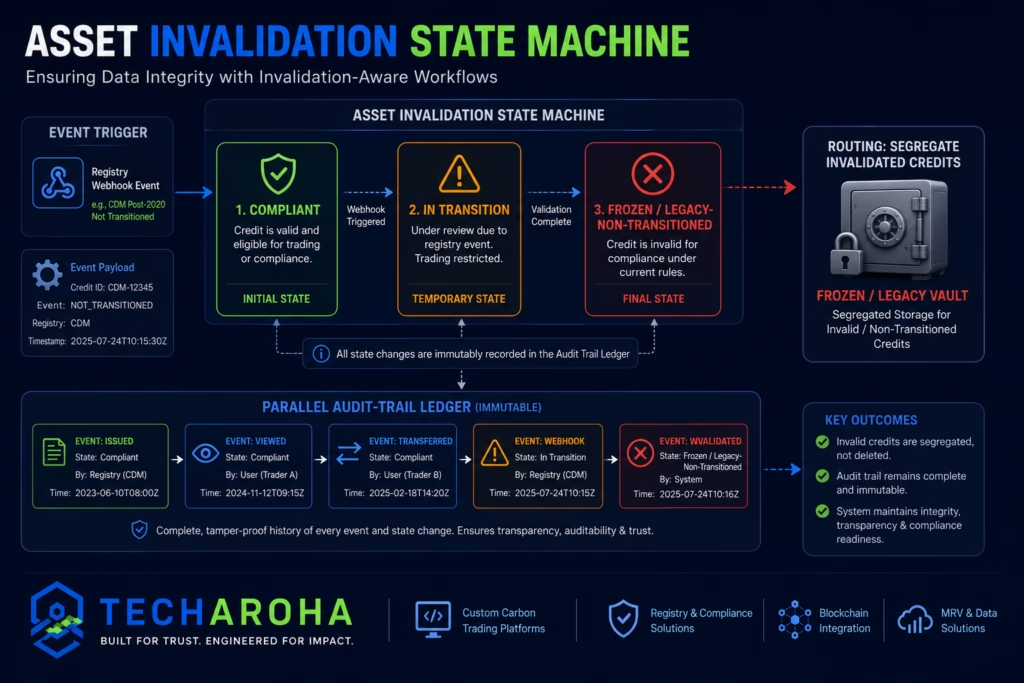
The approach outlined here reflects how Techaroha designs resilient carbon market infrastructure for evolving regulatory environments. It illustrates an architectural pattern rather than a description of a specific client implementation.
The consequences of skipping a carbon credit invalidation protocol are not abstract. Consider the operational reality facing any exchange or corporate carbon desk holding legacy CDM inventory right now:
The December 2026 documentation deadline is still ahead. More host-country decisions, more Supervisory Body rulings, and more shifts in legacy credit status are coming before this transition period closes. Exchanges that build invalidation logic into their core architecture now will absorb each of those events as a routine data update. Exchanges that don’t will be retrofitting under audit pressure, one manual correction at a time.
The zombie credit problem is the most visible example right now, but it is not a one-off. Carbon markets are entering a period where regulatory status is becoming a live, mutable property of an asset rather than a fixed one, set once at issuance and never revisited. The same pattern that governs CDM-to-PACM transition risk applies to any future regulatory shift that can strip eligibility from previously valid inventory: a change in registry recognition, a host country revoking a corresponding adjustment, or a standard-setting body tightening its rules retroactively.
Exchanges and registries that build a genuine carbon credit invalidation protocol into their core data architecture today are not just solving the immediate zombie credit problem. A carbon credit invalidation protocol built now is the only kind of system that can survive the next regulatory shock without a scramble.
This is precisely the layer of carbon market engineering Techaroha specializes in: understanding how international climate diplomacy, host-country politics, and UN Supervisory Body rulings translate directly into database schema, service architecture, and audit-trail design. We have spent years building credit-state logic for exchanges and registries that cannot afford to get this wrong, and the Article 6.4 transition fallout is a live demonstration of why that discipline matters.
If your exchange, registry, or corporate carbon ledger is currently holding CDM-legacy inventory and you are not confident your system can cleanly isolate frozen, non-transitioned credits from fully compliant ones, that is worth a conversation before the next transition deadline forces the issue.