
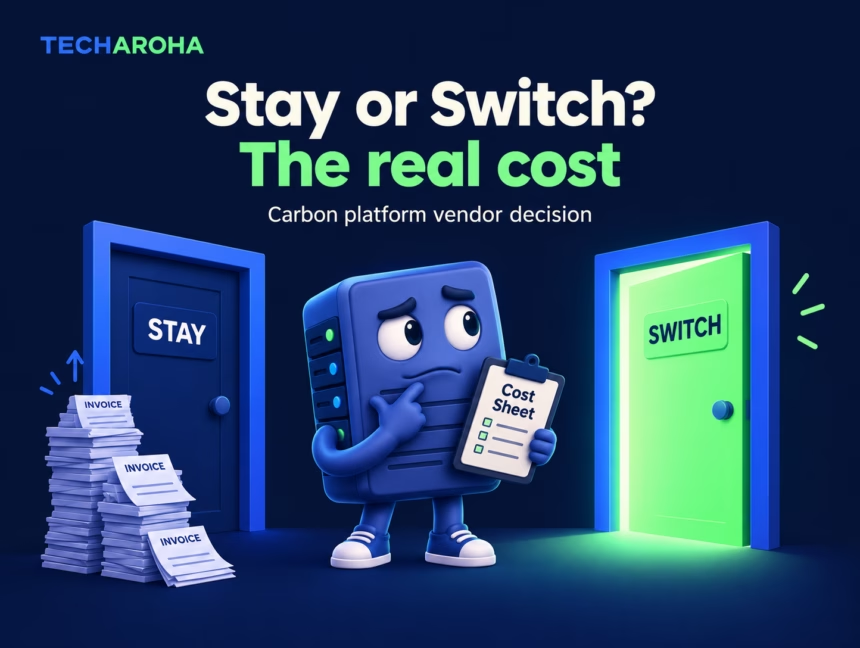
Read this if: you run a live carbon exchange or marketplace, your vendor quotes more for every change request, and you have started to wonder whether you should switch carbon trading software vendor before the next quarter’s invoice arrives. Most owners in that position do nothing. Migration looks risky, so the current vendor gets another year. The risk of leaving is visible and vivid. The cost of staying is spread across invoices, delayed launches and workarounds, so it never shows up as a single line anyone has to defend. This post puts both sides on the same sheet so you can decide with numbers instead of instinct. Why owners hesitate to switch carbon trading software vendor, and what it costs them If you own the exchange but not the roadmap, four costs are running quietly in the background. 1. The change-request premium. A new fee tier, a new registry, a new asset class. Each one is quoted as a project, and each quote tends to be higher than the last because the codebase gets harder to touch. The trend matters more than any single quote. 2. Delay cost. When a feature takes three months instead of three weeks, the revenue it would have earned in those ten weeks is gone. A buyer who wanted a forward contract product signed with a competitor instead. 3. Workaround labour. Every gap the platform cannot handle becomes a spreadsheet, a manual reconciliation or a late-night support task. Your ops team is paying the vendor’s technical debt in salary. 4. Control risk. If the vendor decides your feature is not on their roadmap, or gets acquired, or raises prices, you have no lever. You are a tenant in your own business. You can put a number on all four. The next section shows how, and the section after it does the same for leaving. Price the decision to switch carbon trading software vendor on one sheet A useful comparison has two columns, each covering the same 24-month window. Cost line Staying Leaving Licence or retainer fees Current annual fees, plus expected increases Fees on the new platform, if any Change requests Last 4 quarters of quotes, trended forward Build cost of the same changes on the new stack Delay cost Revenue lost per month of delay, times months delayed Lower after cutover, but count the migration months Workaround labour Ops hours per week, times loaded hourly cost Should fall; estimate honestly Migration project Zero Discovery, data mapping, build, testing, parallel run Dual-running period Zero Two platforms live for a period, typically several weeks Downtime and error risk Ongoing risk of incident Risk during cutover; price the mitigation, not the fear Exit and IP costs Hidden until you try to leave Data export, code ownership, contract notice Here is an illustrative example. These numbers are made up to show the method, not to predict yours. Run that forward 24 months and staying often costs more than a scoped migration. It does not always. That is why you build the sheet before making the call, and why the answer should sometimes be “stay and renegotiate.” Why migration feels riskier than it is The fear is legitimate, but it usually attaches to the wrong thing. When owners consider a decision to switch carbon trading software vendor, they worry about “the migration” as one giant event. It is actually three separate problems, and each has a known way to handle it. Treat them separately and the project stops being one frightening leap. How to migrate trade history without losing it Trade history is data you own, and it should leave the old platform in a form you control. The sequence that tends to work: If the old platform’s records and the registry disagree today, you want to know before migration, not after. That finding is worth having on its own. (Multi-registry platforms should also read our note on registry API integration deadlines, since registry changes land on the same calendar as your migration.) How to cut over without downtime Downtime is an engineering choice, not a law of nature. Exchanges that switch carbon trading software vendor without a trading halt generally follow the same pattern. Read your contract before you read proposals Some of the biggest costs of leaving sit in the agreement you already signed. Check these before you talk to any new vendor: If you do not own your code, the cost of leaving is partly a cost of rebuilding. That is worth knowing early because it changes the sheet. When you should stay Switching is not always the right answer. Stay, and renegotiate, when: A good second opinion will tell you this. If an advisor recommends leaving without seeing your numbers, be cautious about the advice. Decision guide Your situation Likely direction Quotes rising each quarter, features late, no code access Leave, after scoping the switch Quotes stable, delivery on time, roadmap shared Stay and renegotiate terms Platform works, but registry sync or reconciliation is fragile Fix or decouple that layer first Vendor acquired, sunsetting or unresponsive Leave, on a planned timeline Unsure Get an independent assessment before deciding How Techaroha approaches a decision to switch carbon trading software vendor When an owner is weighing whether to switch carbon trading software vendor, we start with an assessment, not a rebuild. Before we propose anything, we look at your current architecture, your registry connections, your change-request history and your contract position, then tell you whether leaving pays back. Sometimes the honest answer is to stay. Our carbon work is not theoretical. We built Carbon Plant, an FSA-registered NFT-based carbon credit exchange, and Planet First Registry, the registry infrastructure behind it. Both run on the same concerns this post covers: credit lifecycle, registry reconciliation and trade integrity. If you want the wider picture of what a carbon exchange platform involves, see our carbon credit exchange platform page. Get your numbers Download the Switch-or-Stay Cost Sheet. It is the two-column model from this post, ready to fill in

If your exchange, marketplace, or brokerage connects to Verra, part of 2026 went into the S&P Global migration remapped fields, new webhook formats, and a scramble to confirm nothing silently broke in reconciliation. That’s done. Treating it as a one-time event would be a mistake. Gold Standard has announced its own next-generation Impact Registry, built with climate technology firm Trovio on an API-first platform, scheduled to go live in Q4 2026. If your platform touches Gold Standard credits and most multi-registry exchanges do, this is your next carbon registry API integration deadline, and it’s already on the calendar. Keep reading if: What Gold Standard Is Actually Changing Gold Standard’s current Impact Registry works the way most registries have for years — a web interface built for manual lookups, with limited programmatic access. The new registry inverts that. Every core function, from issuance to transfer to retirement, will run through secure, standardized APIs built for direct connection from external systems: exchanges, brokers, marketplaces, and national registries. That’s a structural shift, not a cosmetic one. A registry built for humans clicking through a dashboard behaves differently from one built for machines calling an API. Field names change. Rate limits appear. Webhook payloads carry different metadata. Retirement and transfer events fire on different timing assumptions. Gold Standard has said existing accounts, credit holdings, and access permissions will carry over without disruption to ownership, and that a testing window will run before the Q4 2026 launch. That’s good news for continuity. It says nothing about whether your platform’s current carbon registry API integration is built to absorb the change without downtime. This Is a Pattern, Not a One-Off Here’s the part that should change how exchange CTOs think about registry integration generally. Verra didn’t upgrade its infrastructure in isolation. Its migration moved more than 5,900 projects, 10,500 account holders, and 1.4 billion credits onto S&P Global Energy’s platform, with further API and Article 6 connectivity phases still to come. Gold Standard’s move follows the same logic: modernize the plumbing so the registry can support the volume and speed regulators and institutional buyers now expect. Two of the largest voluntary registries in the market have committed to API-first architecture within the same twelve-month window. That’s not a coincidence. It’s a market signal. Verra → S&P Global (July 2026) Gold Standard → Trovio (Q4 2026) Migration status Complete Scheduled Architecture shift Consolidated platform, phased API rollout API-first from launch Scale migrated 5,900+ projects, 1.4B credits Full account and holdings base Article 6 relevance Planned future phase Built for national registry interoperability What it means for you Already tested your integration once Your next carbon registry API integration test If you’re wiring exchange or brokerage infrastructure to more than one registry, this table is your roadmap for the next twelve months — not just for Gold Standard. Where a Carbon Registry API Integration Actually Breaks Most exchange platforms weren’t built assuming a registry’s data model could change underneath them. They were built assuming stability, because for years that assumption held. It no longer does. A registry migration or API overhaul tends to expose the same weak points: None of these are Gold Standard problems specifically. They’re carbon registry API integration problems that surface every time a registry the market depends on modernizes its infrastructure — now a recurring event, not a rare one. A Short Diagnostic Before Q4 2026 If more than one answer makes you uneasy, that’s the diagnostic doing its job. Build Options: Patch, Rebuild, or Decouple Which fits depends on how many registries you’re integrated with today, how much technical debt sits in your matching engine, and how much runway remains before Q4 2026. Why This Matters More for Multi-Registry Platforms If your exchange only touches one registry, a migration is a contained project. If you’re running a multi-registry platform Verra, Gold Standard, American Carbon Registry, and increasingly national Article 6 registries every registry’s independent modernization schedule becomes your integration team’s calendar. That’s the operational reality carbon exchange CTOs face now: registry infrastructure is no longer static, and a carbon registry API integration built for today’s field structures is quietly accumulating risk with every announcement like this one. The platforms best positioned going into Q4 2026 already treat registry integration as ongoing infrastructure work, not a project that finished when the last migration did. Get Ahead of the Q4 2026 Deadline We build and audit carbon exchange infrastructure for platforms connecting to multiple registries, including the reconciliation and event-driven layers that keep matching and settlement accurate through a registry change. If you’re not confident your current integration would survive Gold Standard’s launch cleanly, that’s worth finding out before Q4 2026, not after. Audit Your Registry Integration – get a technical review of how your platform connects to Verra, Gold Standard, and any other registry in your stack, before the next migration decides it for you. The Bottom Line Gold Standard’s Q4 2026 launch is the second major registry modernization of the year, and it won’t be the last. A carbon registry API integration built to survive one migration by patching field mappings keeps failing the same way at the next one. Exchanges treating registry integration as standing infrastructure, not a one-time project, are the ones that won’t be scrambling next time.

Building a carbon exchange is not primarily a software decision. It is an ownership, liquidity, compliance, and time-to-market decision. Here is how founders and CTOs should actually choose between building, buying, or going white-label. You have the business model.You know who will supply the credits.You may already have project developers, corporate buyers, brokers, or investors interested.Then someone asks the uncomfortable question: “Are we building the exchange ourselves, buying existing software, or launching on a white-label platform?” That decision can determine how much control you have three years from now. Get it wrong, and you can end up with a platform that launches quickly but cannot support your compliance model, a custom system that consumes a year of capital before generating liquidity, or a white-label solution that looks like your exchange but behaves like someone else’s product. That is why the build vs buy carbon exchange decision should not be reduced to development cost. The real question is:Which implementation route gives your business the right combination of speed, control, compliance, economics and future ownership?There are three realistic routes: The right answer depends on what you are actually trying to own. Build vs Buy Carbon Exchange: Start With the Business Model, Not the Software A common mistake is starting with a feature checklist. “Does it have an order book?”“Does it support wallets?”“Does it have an admin dashboard?”“Can buyers purchase credits?” Those questions matter, but they come too late. A carbon exchange is not simply a website where tonnes are listed.Behind every transaction may be: The implementation route should therefore follow the business model and market structure. If your exchange is fundamentally different from existing platforms, customization becomes strategically important.If your model is conventional and speed is everything, buying may make sense.If you need your own brand and customer relationship without funding an entire exchange architecture from scratch, white-label can be the middle ground. The Three Carbon Exchange Routes Factor Custom Build Buy Existing Platform White-Label Initial speed Slowest Fast Fastest Upfront investment Highest Low–Medium Medium Customization Very High Limited Medium–High Brand ownership Full Depends on vendor Usually high IP ownership Negotiable/full Vendor-owned Usually vendor-owned core Registry integration Custom Depends on vendor Configurable Compliance logic Designed around your model Vendor constraints Depends on architecture Scalability Designed for your roadmap Product-dependent Depends on shared architecture Vendor dependency Lower High High Best for Strategic exchange operators Standard requirements Fast market entry But there is a more important distinction. You are not choosing between three software packages. You are choosing where your competitive advantage will live. Option 1: Build a Custom Carbon Exchange A custom build means the exchange is engineered around your requirements rather than forcing your requirements into somebody else’s product.This does not necessarily mean writing every component from zero.A competent development partner can use established engineering patterns, cloud infrastructure, security frameworks, payment infrastructure, and reusable components while custom-building the business-critical layers. Build makes sense when you need: The biggest advantage is control. You decide how credits are represented.You decide which attributes affect eligibility.You decide how orders are matched.You decide how settlement works.You decide which integrations become core infrastructure. That control becomes particularly valuable when the market evolves. A regulation changes.A registry changes its integration model.A new credit category becomes commercially important. Your buyer requires a new settlement mechanism. With a custom platform, those changes become engineering decisions rather than vendor negotiations. But a custom build has a serious disadvantage. Time. A serious exchange cannot be treated like a standard marketplace website. Architecture, security, testing, registry integrations, matching, settlement, and operational controls all take engineering effort. That means custom development is usually a poor choice for a company that simply wants to “test whether people will buy carbon credits.” It becomes much more attractive when the exchange itself is intended to become a long-term business asset. Option 2: Buy an Existing Carbon Exchange Platform Buying software is attractive because it appears to eliminate the hardest part of the problem. The vendor has already built: You configure it and launch. For a company with standard requirements, this can be perfectly reasonable. Buy when: But there is a question founders often forget to ask: What happens when your business becomes more successful than the software you bought? That is the real risk. A platform can be excellent today and still become restrictive tomorrow. Imagine that your exchange eventually needs: If the vendor cannot support those changes, your growth becomes constrained by someone else’s product roadmap. The hidden cost of buying The licence fee is only one part of the equation. You should evaluate: Licence + integration + customization + migration + vendor dependency + switching cost A cheap platform can become expensive if every meaningful change requires paid customization. Option 3: White-Label Carbon Exchange This is where the decision becomes more interesting. A white-label carbon exchange allows you to launch under your own brand while using an underlying platform infrastructure provided by another company. For a company that wants market presence quickly, this can be attractive.You can potentially get: without financing every component of the platform from scratch.The critical word, however, is architecture. Not every white-label solution is actually suitable for carbon markets. A generic crypto exchange with a new logo is not automatically a carbon exchange. Carbon credits have attributes that influence whether a transaction is valid. For example: A serious white-label architecture therefore needs more than a branded front end.It needs appropriate tenant isolation, configurable business rules, registry integrations, permissions, transaction controls, and compliance-aware workflows. Read our Article- What Does a Carbon Exchange Actually Cost to Build? A Module-by-Module Breakdown The Build vs Buy Carbon Exchange Decision Matrix Instead of asking which route is “best,” score each route against your actual requirements. Decision Factor Build Buy White-Label Budget sensitivity ★★ ★★★★★ ★★★★ Speed to launch ★★ ★★★★ ★★★★★ Product differentiation ★★★★★ ★★ ★★★ Platform control ★★★★★ ★★ ★★★ Compliance customization ★★★★★ ★★ ★★★★ Registry flexibility ★★★★★ ★★–★★★ ★★★ Long-term ownership ★★★★★ ★★ ★★★ Engineering independence ★★★★★ ★★ ★★★ MVP validation ★★★ ★★★★★ ★★★★★
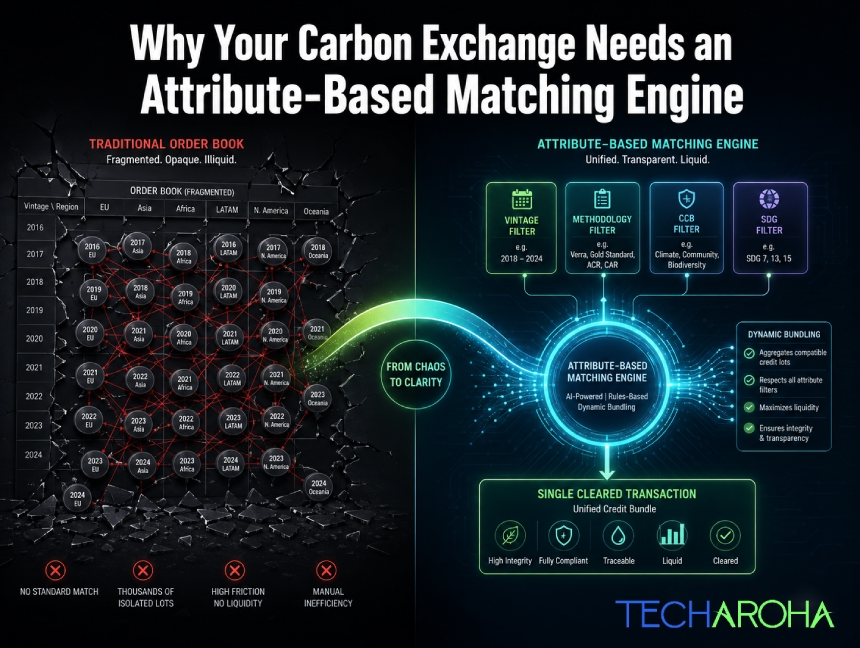
The trading infrastructure built for stocks and Bitcoin will systematically destroy liquidity in any carbon exchange. Here is the architectural fix and the exact engineering logic behind it. Carbon markets are at an inflection point. Voluntary carbon credit issuances have grown into a multi-hundred-billion-dollar projected market, institutional buyers are entering at scale, and Article 6.4 is formalizing cross-border credit flows in ways that would have seemed theoretical five years ago. Exchange founders are raising capital. Trading desks are staffing up. And almost every single one of them is about to make the same catastrophic infrastructure mistake. They are going to build a Central Limit Order Book (CLOB). The CLOB is the gold standard of financial exchange architecture. It powers the NYSE. It underpins every top-tier crypto exchange. It is fast, transparent, price-time priority-driven, and battle-tested. For carbon credits, it is the wrong tool in precisely the way that a pneumatic drill is the wrong tool for a surgical procedure. Not ineffective in general. Lethally ineffective here. This article is a precise technical and economic explanation of why, and a blueprint for the architecture that actually works: the carbon credit trading platform matching engine built on attribute-indexed, parameter-based order resolution. If you are building or operating a carbon exchange, a carbon trading desk, or evaluating infrastructure for a voluntary carbon market platform, this is the engineering decision that will determine whether your liquidity pool deepens or evaporates. Part 1: Why the CLOB Destroys Carbon Liquidity – The Structural Problem A Central Limit Order Book works on one foundational assumption: The asset is fungible. One share of AAPL is identical to every other share of AAPL. One Bitcoin is identical to every other Bitcoin. The order book can aggregate all bids and all asks into a single depth ladder because every unit on both sides of the book represents the same underlying thing. Carbon credits are not the same underlying thing. A 2021 cookstove credit from a Gold Standard-certified project in rural Kenya and a 2025 direct-air-capture credit from a Climeworks facility in Iceland are both “one tonne of CO₂ equivalent.” That is where the similarity ends.They have different: And, critically, they clear at prices that can differ by a factor of 10 or more. Institutional buyers do not treat them as interchangeable. Compliance frameworks do not treat them as interchangeable. Even voluntary corporate buyers with qualitative net-zero targets frequently cannot treat them as interchangeable without triggering greenwashing liability. What Happens When You Force Carbon Credits Into a CLOB? The matching engine identifies the asset by symbol. To maintain the fiction of fungibility across radically different credits, you have only two options: In a mature carbon market with: …you end up with thousands of discrete order books. Each one is individually empty. A liquidity pool that should be $50 million deep becomes: The consequences are predictable: The platform appears broken because, functionally, it is. This is not hypothetical. It is exactly why the voluntary carbon market spent years operating primarily as an OTC market conducted through brokers and phone calls. The asset’s heterogeneity made exchange-style infrastructure practically non-functional for real trading.A carbon credit trading platform matching engine that copies traditional financial exchange architecture without accounting for this reality will simply recreate that illiquidity problem at scale. Part 2: The Right Architecture – Attribute-Based Matching Over an Indexed Credit Graph The correct mental model for a carbon exchange is not a stock exchange. It is closer to a parametric procurement engine. The kind of system that allows a large corporate buyer to issue a single tender specification (“supply 10,000 units of this type of component, meeting these tolerances, at under this price”) and have the system dynamically identify, aggregate, and clear supply from multiple disparate sources to fulfill the single order. Applied to carbon, the architecture has three layers. Layer 1: The Credit Attribute Graph (Transactional Database) Every credit lot is stored as a structured object with a rich attribute schema not merely a quantity and price.A credit record contains: This is a normalized relational schema in your primary transactional database. PostgreSQL is an appropriate choice for ACID compliance on settlements. But the transactional database alone cannot power real-time matching at query complexity levels that carbon requires. Write about our blog that explains- The Ghost Credit Trap: What No One Tells You About Carbon Registry API Integration Layer 2: The Attribute Index (Elasticsearch or Redis Search) This is the layer many platforms either skip or implement incorrectly. The carbon credit trading platform matching engine requires a secondary search index optimized for: Elasticsearch Advantages Redis Search Advantages For institutional-scale exchanges, a hybrid architecture makes sense: Example Redis Search Schema With this index in place, the matching engine can execute parametric queries in real time. A buyer placing an order like “Buy 10,000 tonnes of any Nature-Based Removal, vintage 2023 or later, CCB certified, under $18 per tonne” translates directly to an indexed query: Example Buyer Query Buyer requests: Buy 10,000 tonnes of any Nature-Based Removal, vintage 2023+, CCB certified, under $18/tonne. This query executes against the in-memory index in under 5 milliseconds and returns every matching available lot ranked by price, regardless of which project, geography, or vintage within the buyer’s specification each lot originates from. Layer 3: The Dynamic Bundling and Clearing Algorithm The search query returns a ranked list of available lots. The matching engine’s clearing algorithm then executes a greedy fulfillment sweep: The buyer receives a single trade confirmation -10,000 tonnes cleared at a volume-weighted average price of $16.43/tonne across 7 credit lots, not 7 individual trade notifications across 7 empty order books. The seller-side experience is equally clean: individual lot holders have their available inventory consumed by the engine, with settlement proceeds routed per standard clearing logic. This is the structural breakthrough. The carbon credit trading platform matching engine does not require both sides to agree on a specific lot. It requires only that a buyer’s parameter specification encompasses the seller’s lot attributes. The parameter space is the order