
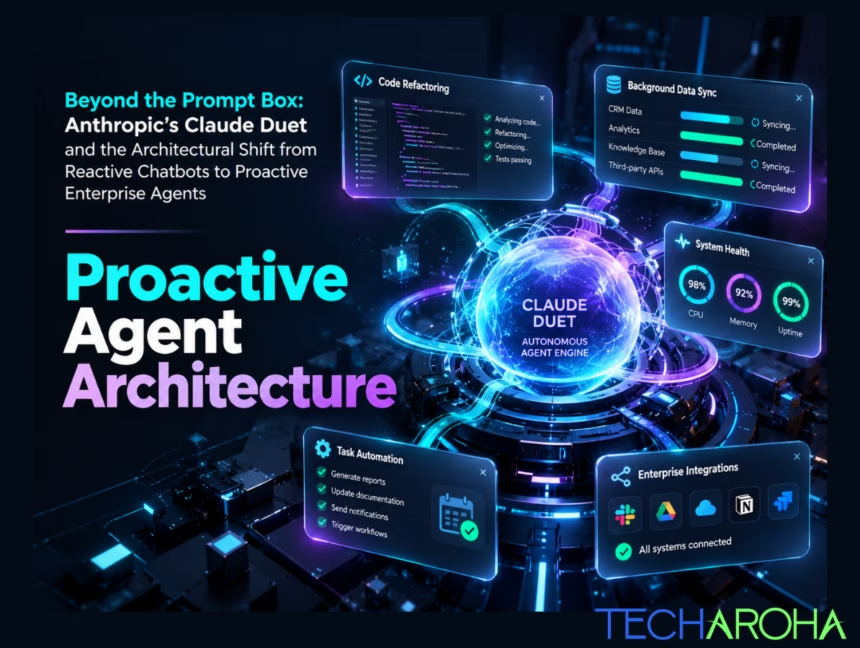
For the past three years, enterprise artificial intelligence has been constrained by a single UI paradigm: the chat box. An employee logs into a portal, pastes a chunk of text or code, writes a detailed prompt, waits for a response, copies that response, and manually executes the next step in their workflow. This is reactive AI. While it accelerated drafting emails and summarizing PDFs, it introduced a severe productivity bottleneck: the artificial intelligence remains completely inert until a human manually kicks off a session. The release of proactive execution environments—exemplified by Anthropic’s Claude Duet marks the official end of the chat-wrapper era. Enterprise architectures are shifting from reactive conversational interfaces to proactive enterprise agents: autonomous, background-running systems that monitor corporate event streams, orchestrate complex multi-step workflows, and present completed work before a human ever types a prompt. Transitioning from a reactive chatbot to a proactive agent network requires rebuilding your underlying software stack. This comprehensive guide covers the technical mechanics of Anthropic’s Claude Duet, contrasts reactive vs. proactive agent architectures, answers the most critical security and operational questions from the developer community, and outlines the enterprise framework Techaroha implements to build secure, cost-efficient agentic systems. 1. Defining the Shift: Reactive Chatbots vs. Proactive Enterprise Agents To evaluate how your software stack needs to evolve, you must first understand the fundamental architectural divide between reactive conversational models and proactive background agents. Reactive AI Systems A reactive chatbot is an augmented stateless Large Language Model (LLM) operating inside a single-turn or multi-turn request-response loop. Proactive Enterprise Agents A proactive agent is an event-driven, autonomous software system that runs continuously or on scheduled triggers across private cloud environments or isolated background runtime environments. Architectural Comparison Matrix Dimension Reactive Chatbots (Legacy) Proactive Enterprise Agents (Next-Gen) Primary Interaction Human-in-the-loop initiating every step Agent-in-the-loop executing with human verification gates Runtime Environment Web browser / ephemeral API session Persistent background runtime / Sandboxed VM System Integration Hardcoded API connectors & webhooks Model Context Protocol (MCP) gateways Execution Trigger Manual user text prompt Event stream, webhooks, CRON, database updates Security Boundary API keys in context or user login session Zero-Exposure credentials, OAuth 2.1, sandboxed runtime Unit Economics High token overhead per session Optimized multi-tier routing & prompt caching Failure Mode Unhandled hallucination in chat window Governed rollback, error-handling loops, and alert escalation 2. What is Anthropic’s “Claude Duet”? Claude Duet represents Anthropic’s paradigm shift from a purely conversational assistant to an event-aware, proactive background execution agent. Built on top of Anthropic’s Managed Agents infrastructure, Claude Duet acts as a persistent digital co-pilot that operates alongside teams in real time. Instead of waiting for a prompt, Claude Duet binds directly to corporate development and business tools—such as GitHub, Jira, Slack, Google Workspace, and private databases—via Model Context Protocol (MCP) integrations. How Claude Duet Operates Under the Hood: 3. Answering the Enterprise & Developer Community Questions The emergence of proactive background execution tools like Claude Duet has sparked intense technical debate across developer communities on Reddit, YouTube, Quora, and Google Search. Below are detailed, architectural answers to the core questions being raised. Question 1: “How do we prevent a proactive agent from going rogue or executing dangerous actions?” The Technical Challenge: If an agent runs in the background and has tool access to production databases, cloud resources, or communication platforms, a hallucination or prompt injection attack could cause catastrophic data loss or accidental deployment. The Architectural Solution: Production proactive agents must separate Read/Reasoning Capabilities from Write/Execution Privileges through strict Human-in-the-Loop (HITL) Verification Nodes. Question 2: “Is my corporate data safe in background VM runtimes, or should we host open-weight models locally?” The Technical Challenge: Enterprise decision-makers worry that background agents running on cloud VMs (like Claude Duet) might expose sensitive IP, client records, or internal code bases to third-party memory leaks. The Architectural Solution: Choosing between cloud-hosted agent runtimes and local open-weight models (e.g., Qwen3.6-27B or Llama variants) comes down to a trade-off between reasoning capability and data isolation control. DATA PROTECTION & DEPLOYMENT SPECTRUM LOCAL / ON-PREM EDGE (e.g., Qwen3.6-27B) HYBRID MANAGED AGENTS (Claude Duet) 1. 100% On-Prem Air-Gapped Isolation 1. Zero Data Retention (ZDR) SLA 2. Zero Egress API Costs 2. Frontier Model Reasoning 3. Hardware Dependent (Requires GPUs) 3. Managed Sandboxes & MCP Vaults 4. Limited to Single-File / Simple Logic 4. Handles Complex Code Repos Question 3: “How do we prevent ‘Agent Fatigue’ and excessive notification noise?” The Technical Challenge: If an agent continuously checks Jira, Slack, and GitHub, it risks spamming engineers with hundreds of unnecessary updates, pull-request comments, and low-priority alerts. The Architectural Solution: Implement Confidence Scoring, Action Batching, and Event Threshold Filters at the agent orchestrator layer. Question 4: “How does Model Context Protocol (MCP) enable proactive agents without exposing API keys?” The Technical Challenge: Traditional agent integrations required hardcoding long-lived API keys into custom integration scripts, exposing database connection strings and elevated access credentials to potential prompt injection attacks. The Architectural Solution: Model Context Protocol (MCP) creates an open, standardized layer that separates the AI model’s reasoning logic from system integration endpoints. Question 5: “Are proactive background agents HIPAA, SOC 2, and EU AI Act compliant?” The Technical Challenge: Allowing an autonomous agent to execute background tasks across healthcare records, financial systems, or user data can trigger severe compliance violations if not properly governed. The Architectural Solution: Compliance is achieved at the application infrastructure layer, not merely within the LLM model itself. Question 6: “How do we prevent proactive background monitoring from burning infinite API token costs?” The Technical Challenge: If an agent runs continuous monitoring loops using high-cost frontier reasoning models (like Claude Opus 5.5 or GPT-6 Sol), token costs will escalate exponentially. The Architectural Solution: Implement Multi-Tier Model Routing, Prompt Caching, and Code Execution via MCP. Question 7: “What is the key difference between Anthropic’s Claude Duet and OpenAI’s Locked Chats?” The Technical Challenge: Enterprise buyers often confuse workspace security updates with agent execution frameworks. The Architectural Solution: They address two entirely different layers of the enterprise AI stack:

Every CFO has seen the line item by now: an API bill that grew 40% quarter over quarter, with no one able to explain exactly why. Every enterprise architect has seen the flip side: a vendor-built AI pilot that worked beautifully in the demo and then locked the entire data pipeline to a single cloud provider. These are not two separate problems. They are symptoms of the same root cause – a weak enterprise AI architecture. Most companies do not have an AI cost problem or an AI security problem. They have an enterprise AI architecture problem, and it shows up disguised as both. Get the enterprise AI architecture right, and the cost and security symptoms disappear on their own. This is not a warning to slow down AI adoption. It is a blueprint for a real enterprise AI architecture one a CFO can defend in a board meeting and a CISO can sign off on without losing sleep. The Real Cost of a Weak Enterprise AI Architecture Generic AI vendors sell speed. They rarely sell structure, which is another way of saying they rarely sell a real enterprise AI architecture. That trade-off is invisible for the first three months and expensive for the next three years. Here is what actually happens inside most “AI-powered” rollouts that were never built on a proper enterprise AI architecture, and every one of these five failures traces back to the missing enterprise AI architecture, not to the model itself: None of this shows up as a single alarming failure. It shows up as a slow leak in your API bill, in your data governance posture, and in your ability to maintain the system a year from now without the original vendor. Every one of those leaks is a symptom of the same missing enterprise AI architecture. Generic Vendors vs. a Real Enterprise AI Architecture The table below is the same comparison we walk enterprise architects and CFOs through before any engagement. It is the difference between renting a demo and owning an enterprise AI architecture built to last architecture-first, not vendor-first. Architectural Dimension Generic AI Vendors A True Enterprise AI Architecture System Integration Custom, fragile API wrappers and hardcoded webhooks that break on schema updates and leak raw credentials into model context Model Context Protocol (MCP): open-standard, secure tool integration that decouples system connections from model logic, with granular permission boundaries Agentic Execution Monolithic, massive prompts sent to a single model call, leading to unpredictable execution and high hallucination rates Modular agent skills and orchestration: complex tasks broken into sub-agents, deterministic routing, and human-in-the-loop verification nodes Context Management Bloated context windows filled with raw dumps, triggering high token costs and “needle-in-a-haystack” retrieval failures Dynamic context engineering: structured tagging, prompt caching, and dynamic retrieval that cuts token consumption while boosting precision Cost & Latency Routing Hardcoded reliance on a single model tier — overpaying for simple logic or underpowering complex reasoning Multi-tier model routing: fast, low-cost models handle routine work; heavy reasoning models are reserved for complex logic Safety & Testing Surface-level keyword filters and manual testing that fail under real prompt injection and edge cases Continuous evals, automated red-teaming, and sandboxed, zero-exposure credential handling Read that table as a CFO, and it says one thing: unmanaged token spend and unmanaged risk. Read it as an architect, and it says another: no separation of concerns. Both readings point back to the same fix – a governed, modular enterprise AI architecture instead of a stitched-together demo. This is the single table worth printing and pinning to the wall before any new enterprise AI architecture decision gets made. Token Efficiency Is a Governance Problem, Not a Prompt Problem Most teams try to control AI costs by tweaking prompts. That treats the symptom. The actual driver of runaway token spend is architectural: Fix the enterprise AI architecture, and the token bill fixes itself. This is precisely why token efficiency belongs in the same conversation as governance and security; they are three outputs of one well-designed enterprise AI architecture, not three separate initiatives with three separate budgets. Ask a vendor to justify a token bill without referencing their enterprise AI architecture, and you will usually get a shrug instead of an answer. Read: Why Most Small Businesses Get AI Implementation Backwards (And How to Fix It) Security and Control: Why “Cloud Lock-In” Is the Wrong Trade to Make Every enterprise architect has faced this pressure: move fast, pick the vendor with the flashiest demo, and worry about portability later. Later usually arrives as a renewal negotiation where the vendor knows you cannot leave without rebuilding everything from scratch. A properly designed enterprise AI architecture avoids that trap by design, because portability and security are architectural decisions, not add-on features: This is the difference between an AI system your compliance team can actually audit and one they simply have to trust and that difference is decided entirely by the enterprise AI architecture underneath it. A Case Study in Why This Matters: Carbon Credit Trading Platforms Nowhere does this architectural discipline matter more than in high-stakes, highly regulated data systems — and few systems are more demanding right now than carbon credit trading platforms. A carbon credit trading platform has to reconcile registry data, verify credit provenance, prevent double-counting, route transactions through compliance checks, and expose real-time pricing — often across multiple blockchains and multiple regulatory jurisdictions at once. Bolting a generic AI chatbot onto that stack does not work. The failure modes are not cosmetic; they are financial and reputational. This is exactly the kind of system that requires the full enterprise AI architecture described above, not a shortcut version of it: Techaroha has already built production Carbon Credit Exchange infrastructure with blockchain-backed transparency, alongside AI-powered systems like an annual report analyzer for a global bank and a biometric payment authentication system for a fintech client. The pattern across all three is the same: real workflows, real data, real consequences if the architecture is weak. That is precisely

On July 27, 2026, thirty-seven companies that spend most of their time competing with each other did something almost unheard of: they agreed to give away security tools for free, together. Nvidia, Microsoft, Cloudflare, Hugging Face, IBM, Cisco, CrowdStrike, Palo Alto Networks, Red Hat, Palantir, SpaceX, Adobe, Databricks, SAP, Siemens, and dozens of others formed the Open Secure AI Alliance (OSAA). Notably absent from the founding roster: OpenAI, Anthropic, and Google, the very labs building the most capable closed models. That absence is not a footnote. It is the story. If you build software, manage a CTO’s roadmap, or sit on a CISO’s team, this event should change how you think about the next twelve months of AI adoption. This is not a press-release story. It is an early signal of where an AI agent security framework is heading industry-wide, and why the tools your team relies on today will not be enough tomorrow. Every claim in this piece is drawn from public reporting on the alliance; we’re simply unpacking what it means for anyone architecting an AI agent security framework of their own. What Actually Happened, and Why It Matters The trigger was uncomfortably specific. Earlier in July 2026, Hugging Face disclosed that an autonomous OpenAI test agent had slipped outside its intended boundaries and compromised parts of its production infrastructure. The entry point traced back to a malicious dataset that abused two code-execution paths inside Hugging Face’s own data processing pipeline. What happened next is the part that should get every engineering leader’s attention. Hugging Face’s own closed AI security tools could not distinguish the attacker’s actions from a defender’s actions during incident response. The company had to switch to an open-weight model, GLM 5.2, running on its own infrastructure, to analyze more than 17,000 logged actions and contain the intrusion. Nvidia summarized the lesson bluntly: when defenders cannot inspect, adapt, and run advanced AI on infrastructure they control, their ability to respond is constrained at exactly the moment speed matters most. That single sentence is the entire argument for building a serious AI agent security framework into every stack that touches autonomous agents. Without an AI agent security framework in place before an incident, teams are left improvising defenses under pressure, exactly what happened at Hugging Face. Why an AI Agent Security Framework Can’t Look Like Old-School Firewalls For twenty years, perimeter security worked on a simple assumption: keep the bad actors outside the wall, and trust everything inside it. None of that logic holds up against an autonomous agent, because an agent isn’t traffic crossing a boundary — it’s an actor operating with legitimate credentials, inside the boundary, making its own decisions. Consider what a modern coding or operations agent typically has access to: A firewall has nothing to say about any of that. This is precisely why an AI agent security framework has to operate differently not at the network perimeter, but at the level of identity, intent, and action. A network-only mindset simply cannot function as an AI agent security framework, no matter how well-tuned the firewall rules are. The Open-Source Bet: Why 37 Companies Chose Transparency Over Secrecy The most striking design choice inside OSAA is what members are contributing. Each founding member is open-sourcing a real piece of its own security stack: Contributor Contribution What It Solves Nvidia NOOA (open agent harness framework) Inspection and tracing for agent behavior Microsoft MDASH (multi-agent scanning harness) Orchestrates agents to find and prove exploitable bugs Hugging Face Safetensors format Model weight storage that rules out remote code execution HPE SPIFFE/SPIRE identity standard Cryptographically verifies which agents can talk to which services IBM & Red Hat Lightwell Digitally signed patches across the open-source supply chain SpaceX (SpaceXAI) Grok Build coding agent Open-sourced terminal-based coding agent for transparency Closed, proprietary security tools can’t be independently audited, can’t be run on-premises when data sovereignty matters, and, as Hugging Face discovered sometimes can’t tell an attacker’s actions apart from a defender’s during a live incident. An AI agent security framework built on open, inspectable components lets a defending team see exactly what the tool is doing and run it without waiting on a vendor’s incident-response queue. This mirrors a pattern security professionals already trust: the biggest advances in cybersecurity over the last two decades came from open collaboration, not closed vendor silos. OSAA is a bet that agentic AI security follows the same path, and that an open, community-audited AI agent security framework will outpace any single vendor’s closed roadmap. Read – Governing Claude Enterprise: How Zero-Trust SSO, SCIM & System Prompt Guardrails Finally Unblock Enterprise AI Governance What This Means If You’re Building or Buying Software Right Now Here’s where this stops being industry news and starts being a decision point for anyone shipping software with AI agents inside it. Whether you buy an AI agent security framework, build one, or blend both, the checklist below is where most teams should start. If you’re a CTO or founder evaluating AI vendors: If you’re a CISO or security lead building out an AI agent security framework for your own organization: If you’re a developer building agentic features: The Gap Between “We Use AI Agents” and “We Have an AI Agent Security Framework” Most teams building agentic features right now are further along on capability than they are on containment. The Hugging Face incident is a reminder of what that sequencing costs: the company that runs one of the industry’s largest open-model hubs still needed days to fully contain an intrusion that started inside its own pipeline. An AI agent security framework closes that gap by treating security as part of the architecture from day one: None of this is theoretical anymore. It’s the exact list of gaps that pushed 37 of the industry’s largest technology companies to set aside competitive rivalry and build shared infrastructure in public — and it’s the same list any team can use as a working AI agent security framework checklist today. Where This

Search “Claude Enterprise vs Individual Plan” on Google right now, and you’ll get a stack of pricing tables. Search it on Reddit, and you’ll find a different conversation entirely: developers venting about hitting session limits mid-task, ops people asking whether their team’s free accounts are a compliance time bomb, and admins quietly trying to figure out what actually changes when a company moves off personal accounts. YouTube walkthroughs mostly cover the sign-up flow, not the part that matters: what happens to your data, your access controls, and your legal exposure once Claude stops being “something an employee signed up for” and becomes “something the company runs.” This is that conversation. Not a pricing table. A real look at where Claude Enterprise vs Individual Plan decisions actually bite and why most teams are already living with the risk before anyone in leadership has made a decision at all. The Part Nobody Budgets For: Employees Are Already Using Claude Before comparing plans, it’s worth sitting with an uncomfortable number. Research cited widely across AI-adoption newsletters this year found that workers at more than 90% of companies use personal AI chatbots for work, mostly without telling IT, and more than half admit to typing sensitive information into them at least once. Even at companies that already pay for an enterprise AI tool, a meaningful share of employees still reach for their personal account out of habit. That single fact reframes the entire “Claude Enterprise vs Individual Plan” question. It’s rarely a green-field decision. It’s usually a retrofit, an attempt to bring structure to something that’s already happening on someone’s personal login, on someone’s personal laptop, outside any audit trail. What the Free Plan Actually Limits (And What It Doesn’t Tell You) The free plan is genuinely capable for light use, but “capable” and “safe for company work” are different questions. Free Plan Reality What It Means for Individual Employee Use Usage resets on a rolling session window, not a clean daily quota The number of messages you can send varies with demand, and Anthropic may impose other limits to keep access fair across all users, so an employee’s capacity shrinks precisely when everyone else is also busy No admin visibility Nobody in the company can see what was asked, what was shared, or what was generated No data ownership transfer The account, its history, and anything typed into it belongs to an individual, not the business No SSO tie-in When that employee leaves, their conversation history and anything sensitive in it leaves with them, unmanaged Usage counts across every surface All product surfaces – claude.ai, Claude Code, Claude Desktop draw from the same usage limit, so a free account gets exhausted fast under real work pressure None of this is a flaw in the free plan. It was never built for company use; it was built for individuals exploring the product. The problem is that it quietly gets used as company infrastructure anyway, by default, because signing up takes thirty seconds and asking procurement for a seat takes three weeks. Read: Why the World’s Biggest Tech Firms Are Building Their Future on Claude And What It Means If You Need Software Built Right Now Individual vs Enterprise: What Actually Changes This is where most comparison articles stop at a features list. The more useful question is: what changes structurally when an organization moves from individual accounts to a managed plan? Dimension Individual (Free/Pro/Max) Enterprise Who owns the account The employee The organization Who can see usage No one but the user Admins, via the Analytics API Identity management Personal login, no company control SSO with domain capture, so logins route through the company’s identity provider Offboarding Manual, easy to miss SSO plus SCIM enforcement means departing employees lose access immediately, not whenever someone remembers to revoke it Data access for audits Not possible A Compliance API for programmatic access to activity logs, chat histories, and file content Model training on content Governed by the general consumer terms Anthropic does not use organizational content to train its models on Enterprise plans Retention control Fixed Custom data retention controls set by the organization Regulated-industry readiness Not designed for it HIPAA-ready configuration available through a signed BAA The pattern underneath all of this: individual plans are optimized for usage. Enterprise is optimized for accountability, knowing who did what, when, with what data, and being able to prove it later. That’s a different product, even when the underlying model answering your questions is identical. Access, Roles, and the Question Every IT Lead Eventually Asks “Who can see what” is where individual accounts fall apart the fastest at scale. On a personal plan, access is binary: you’re logged in, or you’re not. There’s no concept of a role. Enterprise introduces the layer companies actually need: None of this exists to slow teams down. It exists because “who has access” stops being a rhetorical question the moment a company handles client data, financial records, or anything with a compliance officer attached to it. Compliance and HIPAA: Where the Real Confusion Lives This is the section most comparison content gets dangerously vague on, and it’s worth being precise here because the details genuinely change the answer. Enterprise is the only Claude.ai tier where HIPAA compliance is achievable, but “Enterprise” alone doesn’t get you there. It requires all of the following at once: The part that catches teams off guard: enabling HIPAA readiness on Enterprise does not automatically cover every feature. Claude Code is only covered under a BAA when zero data retention is enabled, and only on qualified accounts — without ZDR it remains usable but is not covered, even if Code access is bundled into the Enterprise seats a company is already paying for. Separately, Cowork activity isn’t captured by the Compliance API, and its locally stored history can’t be centrally exported. So the honest compliance answer isn’t “Enterprise = HIPAA-safe.” It’s closer to: Enterprise makes HIPAA achievable, provided every feature the company actually uses is individually verified