Every founder has heard the pitch: “We’ll have your MVP ready in six months.” And every founder has lived the reality that follows: six months quietly becoming eight, budgets doubling, and a competitor launching first.
At Techaroha, we got tired of watching good ideas die in development purgatory. So we rebuilt our entire delivery process around one core discipline: AI MVP development. Not “AI-assisted coding” as a buzzword, but a genuinely different operating system for building software, one where business requirements become machine-executable specifications, and AI agents do the heavy lifting while human engineers focus on judgment, architecture, and quality.
This is the story of how that shift let us compress a traditional 6-month MVP timeline into 6 weeks and why we’re now applying the same approach to build something far more complex.
If you’re a founder, CTO, or product lead evaluating how to actually ship fast without cutting corners, this one’s for you.
Before we get to the “how,” it’s worth understanding why the old model fails so predictably.
A typical MVP build follows a familiar rhythm: discovery workshops, requirement documents that get reinterpreted by three different people, a design phase that runs long, a development phase where developers guess at intent because the spec was never precise enough, and a testing phase where all those guesses surface as bugs. By the time you reach launch, you’ve spent six months building something that only loosely resembles what the business actually needed.
The problem isn’t the developers. It’s the translation layer between “what the business wants” and “what gets built.” Every handoff from founder to product manager to designer to engineer introduces ambiguity. Ambiguity is expensive. It’s the single biggest hidden cost in software development, and it’s exactly what AI MVP development is designed to eliminate.
Spec-Driven Development is the methodology that makes true AI MVP development possible. In plain terms: instead of writing loose requirement documents and hoping engineers interpret them correctly, we write hyper-precise specifications and acceptance criteria so detailed and unambiguous that an AI coding agent can execute them correctly on the first pass.
Think of it as the difference between telling a contractor “build me a nice kitchen” versus handing them an architectural blueprint with exact measurements, materials, and load calculations. One invites interpretation and rework. The other produces a predictable, high-quality outcome.
In practice, spec-driven development for AI MVP development means:
This is the foundation of every AI MVP development engagement we run at Techaroha. Before a single line of code is written, we’ve already defined success in terms precise enough for a machine to understand – which means when the AI agents start generating code, they’re not guessing. They’re executing.

Here’s the comparison that matters most to founders evaluating build partners. This isn’t theoretical — it’s the actual phase-by-phase breakdown from a recent engagement.
| Phase | Traditional Timeline | Techaroha AI MVP Development Timeline |
|---|---|---|
| Boilerplate & Setup | 2 Weeks | 2 Hours (Automated Agents) |
| Feature Implementation | 2 Months | 10 Days (Parallel AI Generation) |
| Testing & QA / Bug Fixes | 3 Weeks | 2 Days (AI-Assisted TDD) |
| Total | ~6 Months | ~6 Weeks |
Let’s unpack what’s actually happening in each row, because the “3x faster” headline only means something once you understand the mechanics behind it.
In a traditional build, the first two weeks disappear into scaffolding – setting up authentication, database schemas, CI/CD pipelines, environment configs, and folder structures. It’s necessary work, but it’s also entirely repeatable and low-judgment.
In our AI MVP development workflow, this is where automated agents shine. Once the spec defines the tech stack and data models, agents generate the entire boilerplate – auth flows, API scaffolding, deployment pipelines in a couple of hours. Engineers review and approve it rather than typing it from scratch. Two weeks of grunt work becomes an afternoon.
This is the phase where the compounding value of spec-driven development really shows. Because every feature has already been broken into atomic, testable specifications, AI agents can work on multiple features in parallel rather than a single engineering team working sequentially through a backlog.
A traditional team builds feature A, then feature B, then feature C, each waiting on the last, each subject to a single developer’s bandwidth and context-switching fatigue. Our AI MVP development approach runs feature generation in parallel streams, with engineers acting as reviewers and integrators rather than line-by-line authors. Two months of sequential feature work compresses into roughly ten days.
Because acceptance criteria were written as testable conditions from day one, test suites are generated alongside the code, not bolted on afterward. This is AI-assisted Test-Driven Development (TDD): the AI agent writes the feature and the corresponding tests simultaneously, referencing the same spec. Bugs that would normally surface three weeks into a QA cycle get caught in hours, because the test criteria were baked into the build from the start.
The result: a 3-week bug-hunting marathon becomes a 2-day validation pass.
It’s tempting to read this as simply “AI makes things faster.” That’s true, but it undersells the real shift. What AI MVP development actually changes is risk.
A 6-month MVP timeline isn’t just slow – it’s risky. Markets shift. Competitors launch. Budgets run out before validation happens. Founders spend six months building based on assumptions that were true in month one but stale by month six.
Compressing that into six weeks means you’re testing your product hypothesis against a live market almost immediately. You’re not betting six months of runway on an untested idea; you’re validating in weeks and adjusting based on real user behavior, not committee guesswork.
This is precisely why AI MVP development has become the default approach we recommend to early-stage founders: it doesn’t just save time, it de-risks the entire venture.
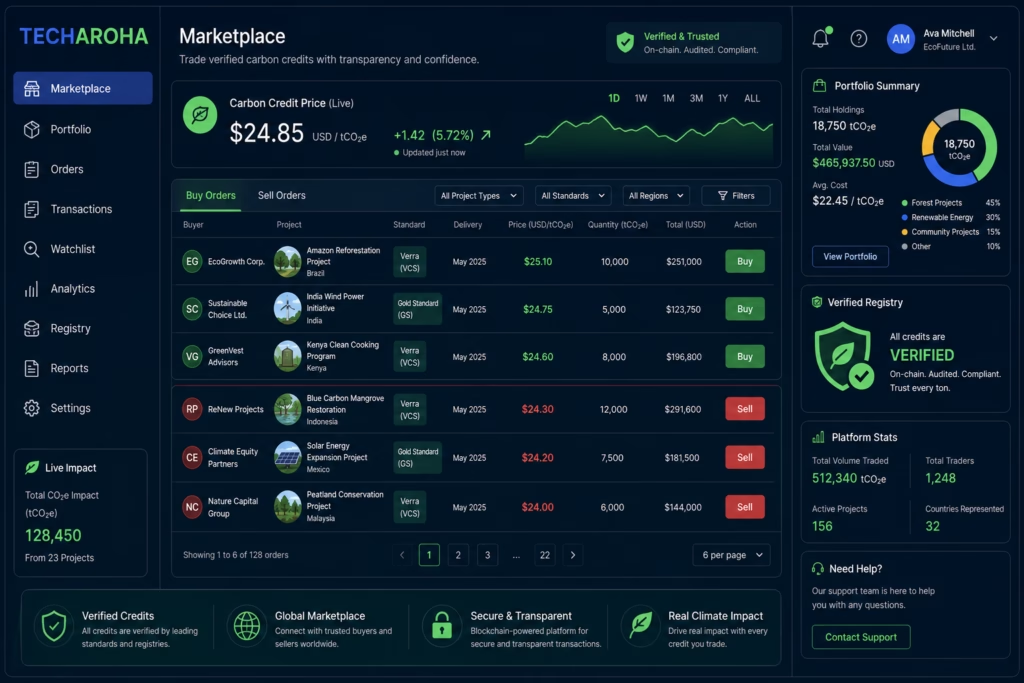
Let’s make this concrete with the kind of build where speed and precision both matter enormously: a carbon credit trading platform.
Climate-tech is one of the most time-sensitive spaces in software right now. Regulatory frameworks are shifting, verification standards are evolving, and the window for a new entrant to establish market position is narrow. A founder building a carbon credit trading platform doesn’t have the luxury of a 6-month build followed by a 3-month iteration cycle; by the time that’s done, the registry integrations they planned around may have changed, and two competitors may already have first-mover advantage.
Here’s where spec-driven AI MVP development becomes not just useful, but essential. A carbon credit trading platform has a specific set of components that are perfect candidates for this methodology:
When we approach a build like this, the same phase breakdown applies: boilerplate and infrastructure in hours instead of weeks, core marketplace and trading features generated in parallel over roughly ten days, and a rigorous AI-assisted QA pass that stress-tests the transaction logic critical in any platform handling financial trades in days rather than weeks.
For a founder in the carbon credit space, that’s the difference between launching in Q1 and launching in Q3. In a market this regulatory-sensitive and competitively fluid, that gap is existential.
AI MVP development isn’t the right fit for every project, and we’d rather tell you that upfront than oversell it. It’s built for a specific kind of ambition:
If any of that sounds like where you are right now, this is the conversation worth having.
To be transparent: this model works because of what happens before the AI agents start generating anything. The compression in the timeline comes from the precision of the spec, which means the discovery and requirements phase still requires real collaboration between your team and ours.
The difference is that this investment happens once, upfront, in a tight and structured sprint, not scattered across months of shifting requirements and Slack threads. A few days of rigorous specification work is what buys you six weeks instead of six months. It’s front-loaded precision in exchange for back-loaded speed.
This is also why AI MVP development produces fewer post-launch surprises than traditional builds. When acceptance criteria are this explicit, “scope creep” and “that’s not what I meant” become far rarer conversations.
Six months was never a law of physics; it was a byproduct of ambiguity, sequential workflows, and testing bolted on at the end. Spec-driven AI MVP development removes each of those bottlenecks individually: automated agents handle boilerplate in hours, parallel AI generation compresses feature implementation from months to days, and AI-assisted TDD turns weeks of bug-hunting into a two-day validation pass.
For a standard SaaS MVP, that’s a 6-week build instead of 6 months. For something as complex and time-sensitive as a carbon credit trading platform, it’s the difference between leading a nascent market and watching from the sidelines.
If you’re a founder weighing whether to spend the next six months building or the next six weeks, that’s the conversation we’re here to have. For more information, visit our site, Techaroha,