

Somewhere right now, a project developer’s sustainability team is quietly telling their CFO that a specific batch of credits reduced the company’s Scope 1 footprint by 4,000 tonnes. At the same moment, three floors away or three time zones away, that exact same batch is sitting live in an order book on the exchange the company also happens to sell through. Nobody lied. Nobody hacked anything. Two systems that don’t talk to each other just did their jobs, and now two entities are standing on the same tonne of carbon. That’s the carbon credit dual-claiming risk, and it’s not a bug. It’s what happens when regulation moves faster than architecture. Why This Risk Didn’t Exist Two Years Ago And Why It’s Everywhere Now Dual-claiming used to be a slow-moving compliance concept people wrote papers about. Today it’s a live-fire operational hazard, and the reason is structural: carbon credits no longer sit in one place. A single credit can exist in a corporate ESG database as a claimed offset, in a project registry as an issued asset, and in an exchange’s matching engine as tradable inventory – all at once, all update-able by different teams, on different schedules, with no shared source of truth. The carbon credit dual-claiming risk is the direct byproduct of that fragmentation. It’s not caused by bad actors. It’s caused by systems that were never designed to know what each other is doing. Add anti-greenwashing enforcement to that mix – the SEC’s climate disclosure scrutiny, the EU’s Green Claims Directive, the CSRD’s assurance requirements and the stakes flip from “reputational awkwardness” to “securities-level liability.” Regulators aren’t asking whether your platform could prevent a dual claim. They’re asking whether your architecture makes one possible in the first place. If the answer is yes, that’s not a disclosure footnote. That’s an exposure line item. The Anatomy of a Dual Claim: How It Actually Happens Picture the sequence, because it’s almost boringly simple, and that’s what makes it dangerous. A project developer generates verified credits. Their internal ESG or sustainability reporting system pulls credit data via a feed – often a flat file, a manual CSV export, or a quarterly sync and marks a batch as “retired against our 2026 target.” Separately, the same developer (or an authorized broker acting for them) lists a portion of that same batch on an exchange for sale. The exchange’s matching engine sees available inventory and lets a buyer clear an order against it. Now the exact same emission reduction has been claimed twice: once internally against a corporate net-zero target, once externally as a sold, tradable asset transferred to a new owner. Nobody in this sequence acted maliciously. Nobody even necessarily acted carelessly by the standards of their own department. The ESG team saw a credit in “claimed” status in their spreadsheet. The exchange saw a credit in “available” status in its order book. Both were right, from where they were sitting. That’s the core carbon credit dual-claiming risk: it’s a state synchronization failure dressed up as a fraud scenario, and most compliance teams are still investigating it like the latter. The Real Architectural Problem: Credits Live in Two Worlds at Once Here’s the part most platform teams underestimate. A carbon credit today typically exists in a hybrid state – part on-chain or on-registry, part off-chain in corporate systems that were never built for real-time state propagation. On one side you have an escrow account, a smart contract, or a registry serial number: fast, atomic, and auditable. On the other side you have a corporate sustainability database, often a spreadsheet-adjacent SaaS tool updated by a human on a monthly reporting cycle. These two worlds have fundamentally different clocks. That mismatch is the entire engineering problem. An exchange order book needs to know, to the millisecond, whether a credit is claimable. A corporate ESG system needs to know, potentially weeks later, whether a credit it already booked against a target has since been sold out from under it. Neither system currently has a reliable channel to tell the other “this credit’s status just changed.” Bridging that gap not adding more disclosure language, not adding more manual reconciliation, but actually closing the technical gap is what separates a defensible exchange from a lawsuit waiting to be filed. The Engineering Fix: State Locks, Not More Paperwork The instinct across the industry has been to solve dual-claiming with process – attestations, audit trails, quarterly reconciliation reports. Those things matter, but they’re all reactive. They tell you a dual claim happened after it already happened. What actually prevents the carbon credit dual-claiming risk is a transactional state lock: an architectural pattern where a credit’s claimable metadata is frozen the instant it enters an active order book or matching engine, and that freeze is enforced at the data layer, not the policy layer. Here’s the mechanism, stripped down to its engineering bones. Why “Just Add a Compliance Checkbox” Doesn’t Work There’s a tempting shortcut here, and it’s worth naming because a lot of platforms take it: add a manual attestation step where the seller checks a box confirming the credit hasn’t been claimed elsewhere. This does almost nothing. It shifts liability onto a human’s honesty in a moment (order placement) that has no visibility into what a separate ESG team is doing in a separate system on a separate continent. A checkbox doesn’t close a technical gap. It just adds a line to a legal document that regulators will read as “the platform knew this was possible and didn’t fix it.” The same logic applies to end-of-day reconciliation jobs. Running a nightly batch process that cross-checks exchange transactions against ESG claim records catches dual claims after they’ve already happened: after the trade cleared, after the buyer paid, after the ESG report already went to the board. At that point, you’re not preventing the carbon credit dual-claiming risk. You’re documenting your own incident report. Regulators evaluating anti-greenwashing controls are increasingly asking not “do you detect this,” but “can this

On June 17, 2026, Verra sent out a notice that reads, on the surface, like routine infrastructure news. Underneath it is a deadline that should be sitting at the top of every exchange operator’s sprint board right now. Verra, working with S&P Global Energy, confirmed that its next-generation registry platform officially goes live on Monday, July 27, 2026. No soft launch. No parallel-run grace period mentioned. A hard cutover date, three and a half weeks out from the moment most platform teams even noticed the announcement. If you operate a carbon exchange, a fund settlement desk, or any product that touches Verra credit statuses, this is the moment your carbon registry middleware either proves itself or quietly breaks your order book. And the unsettling part is that most teams won’t know which outcome they’re heading toward until settlement day, when it’s already too late to fix. The Quiet Panic Spreading Through Exchange Engineering Teams Talk to anyone running platform infrastructure on top of Verra credits this week, and you’ll hear the same nervous undertone. Their carbon registry middleware was built for a registry that, as of July 27, no longer exists in its current form. The legacy Verra Registry interface that most integrations were written against is being replaced wholesale, folded into a new architecture built around the Verra Project Hub and S&P Global’s Environmental Registry software. The official documentation confirms the new system introduces transaction-ready application programming interfaces that allow for automated transfers and retirements, replacing manual processes and enabling frictionless, high-volume trading across brokers, exchanges, and marketplaces. That single sentence is doing a lot of quiet work. “Replacing manual processes” means the old polling-based integration pattern most platforms rely on is being structurally deprecated, not just cosmetically updated. And “frictionless, high-volume trading” only holds true if your carbon registry middleware is built to consume the new schema correctly from day one. Here’s why this matters more than a typical vendor API version bump. Verra isn’t tweaking field names. It’s merging two previously separate systems, the Project Hub and the new Environmental Registry layer, into a single system for traceability, centralised documentation, and automated transactions, with direct connectivity into the Meta Registry to prevent cross-registry double counting. That’s a fundamentally different data topology than what most exchange middleware was coded against eighteen months ago. The Problem: Polling Was Always a Time Bomb, Verra Just Set the Timer Let’s be honest about how most carbon exchange middleware works today. A scheduled job hits Verra’s registry API every few minutes, pulls credit status, diffs it against the local order book, and updates inventory. It’s not elegant, but it’s worked well enough for years because Verra’s legacy interface was relatively static and predictable. That assumption dies on July 27. Carbon registry middleware built on interval polling has three structural weaknesses that the new architecture is about to expose all at once. First, polling intervals create a sync lag window, and during that window your order book is lying to you. A credit can be retired on the registry side while your platform still shows it as available, and if a second buyer clears an order against that phantom inventory before the next poll cycle, you have just sold a credit that no longer exists. That’s not a hypothetical edge case. It’s the exact mechanism behind double-selling incidents that have already damaged trust in exchange-grade carbon infrastructure. Second, the new registry’s two-way data exchange model with the Project Hub means status changes can now originate from multiple touchpoints in the credit lifecycle, not just a single settlement endpoint. Integration with Verra’s Project Hub will enable project proponents to prepare project documents and move through the full lifecycle, registration, monitoring, issuance, with less duplication and greater efficiency. Every one of those lifecycle stages can now fire an event your middleware needs to catch. A polling job checking one endpoint every five minutes simply cannot keep pace with a multi-stage, multi-source event stream. Third, and this is the part most teams haven’t internalized yet, the new registry connects directly into the Meta Registry, preventing double-counting across systems. That’s good news for market integrity, but it means your carbon registry middleware now has to reconcile state not just against Verra, but against a cross-registry verification layer that can override a status your platform thought was final. If your architecture treats Verra as the single source of truth without accounting for Meta Registry reconciliation events, you’ll see credits flip status in ways your current code has no handler for. Why “Just Update the API Calls” Is the Wrong Fix The instinct on most engineering teams right now is to treat this as a routine integration update. Swap out the old endpoint URLs, adjust the request format, ship it before July 27, move on. That instinct is the exact reason so many platforms are going to have a bad settlement week. The new registry isn’t a faster version of the old one. It’s an event-native system, and bolting event-native data onto a polling-based middleware architecture doesn’t fix the underlying problem; it just changes which part of the stack absorbs the latency. You need carbon registry middleware that’s architecturally decoupled from your order-matching engine, capable of ingesting asynchronous events as they happen rather than reconstructing state from periodic snapshots. This is where the real engineering work lives, and it’s the work most generalist development shops have never had to do, because most generalist development shops have never built carbon registry middleware that has to reconcile real-time settlement events against a live order book without ever pausing trading. The Architecture Solution: Event-Driven Middleware, Not Smarter Polling The fix isn’t a smarter polling interval. It’s a different category of system. Decoupled, event-driven carbon registry middleware built around a message broker, Apache Kafka or AWS EventBridge are the two most production-proven choices, sits between your registry connection and your trading engine, and it changes the entire failure profile of the platform. Here’s the shape of it. Instead of your matching engine

The 2026 Signal You Cannot Ignore The first half of 2026 handed the voluntary carbon market a statistic that reframes everything: credit retirements — actual, verified demand from corporate buyers — hit an all-time record high, while global issuances dropped by 44% compared to the same period in 2025, according to AlliedOffsets data. Read that twice. Demand is at its peak. Supply is collapsing. This is not a temporary correction. High-integrity spot credits take years to develop, verify, and issue. The pipeline that produces them is structurally constrained, and no amount of buyer appetite can compress that timeline. What buyers — and the platforms serving them — are doing instead is moving aggressively into forward offtake agreements: locking in future vintage deliveries today, often before a project has issued a single credit, in exchange for upfront or milestone-linked capital. For platform builders and exchange operators, this shift carries a hard technical consequence. The infrastructure required to operate a carbon forward contract platform is fundamentally different from a spot trading engine. The two are not just different in scale. They are different in kind. Spot Infrastructure Is the Wrong Foundation A spot trade engine is conceptually straightforward. A buyer submits a purchase order, the system matches it against available inventory, the registry API confirms the serial transfer, and the credit is retired. Settlement is near-instantaneous. Risk is bounded at the transaction level. The engine does not need to care about what happens in three years. A carbon forward contract platform cannot inherit that architecture. Every assumption changes. Delivery is deferred — sometimes by five to ten years. The project that will produce the credits may not yet have completed its first verification cycle. Pricing may be fixed at signing but subject to quality adjustment clauses tied to co-benefit outcomes. Capital may flow in tranches, not as a lump sum. Default scenarios — what happens if the project underperforms, misses a verification window, or suffers a reversal event — must be encoded, not handled manually. Any development team that attempts to build forward contract infrastructure on top of a spot matching engine will hit structural limits within the first contract cycle. The data model, the state machine, and the risk management layer all need to be purpose-built. What a Carbon Forward Contract Platform Actually Needs to Do Before writing a line of code, it is worth being precise about the functional envelope a carbon forward contract platform must cover. These are not nice-to-have features. They are the baseline required to make a forward offtake agreement enforceable and auditable on a digital platform. Engineering the Milestone Escrow Module The technical core of a carbon forward contract platform is the milestone escrow module. This is where structured finance meets programmable infrastructure. The design pattern works as follows. At contract execution, the buyer’s capital commitment is moved into a permissioned escrow state — either via a smart contract on a compatible ledger (EVM-compatible chains, Hyperledger Fabric, or permissioned Hedera environments have all been used in production carbon infrastructure) or via a custodied fiat escrow account managed by the platform’s treasury layer, depending on regulatory context. The capital does not move again until a milestone condition is satisfied. Each milestone is defined in the contract as a structured data object containing three fields: the event type (e.g., “initial biomass verification”), the verification source (e.g., a named third-party auditor or a specific satellite data feed), and the release amount (the capital tranche to be unlocked on confirmation). The platform’s milestone engine polls the verification source, receives a signed confirmation event, cross-references it against the contract’s milestone schedule, and if the condition is met, initiates the capital release to the project developer’s account. The critical design decision here is the oracle architecture. dMRV data does not arrive in a form that a contract engine can consume directly. Satellite imagery needs to be parsed into standardized biomass delta signals. IoT sensor aggregates need to be normalized and signed by a trusted verification node before they can trigger a financial event. A well-built carbon forward contract platform includes a dMRV oracle layer that transforms raw monitoring data into signed, timestamped attestation events that the escrow engine can resolve against. For nature-based projects, the milestone sequence typically runs: independent validation → first monitoring report → initial credit issuance confirmation. For engineered removals — biochar, enhanced rock weathering, direct air capture — the milestone triggers are more granular: feedstock tonnage confirmation, operational capacity certification, and then periodic tonne-verified issuance against the contracted volume. Default Buffers and Non-Delivery Risk A carbon forward contract platform that does not encode default handling is not a platform. It is a promissory note management system. Default scenarios are not edge cases in forward carbon markets — project timelines slip, verification bodies discover discrepancies, and force majeure events affect land-based projects routinely. The engineering solution is a two-layer default architecture. The first layer is the delivery buffer. At contract inception, the platform locks a percentage of the project’s expected issuance volume — typically 10 to 20 percent — into a buffer account. This buffer is denominated in anticipated credits, not capital, and is managed via a registry subaccount or an on-chain token reserve, depending on the platform’s issuance model. If the project delivers short in any given vintage year, the platform automatically draws from the buffer to fulfill the buyer’s contract position. The second layer is the capital clawback mechanism. If the buffer is exhausted and the project remains in default — delivery shortfall exceeds the buffer reserve within a defined cure period — the platform enforces a partial or full capital recovery against the remaining escrow balance. This requires the contract to define a clear priority waterfall: what portion of the undeployed escrow reverts to the buyer, what portion is forfeited, and under what conditions the developer retains any remainder. The state machine for this layer needs to be auditable. Every state transition — from active to in-default, from buffer-drawn to clawback-initiated — must produce a
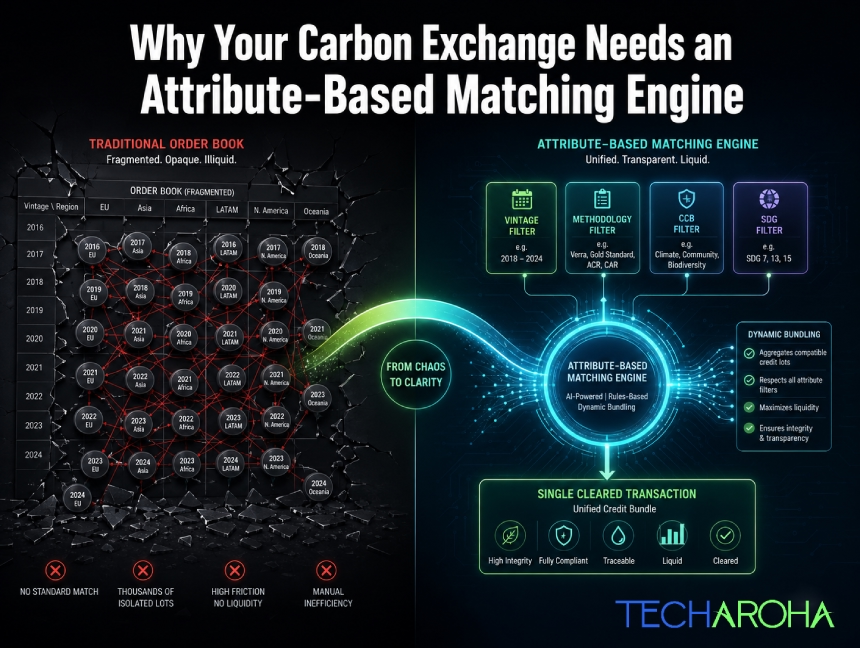
The trading infrastructure built for stocks and Bitcoin will systematically destroy liquidity in any carbon exchange. Here is the architectural fix and the exact engineering logic behind it. Carbon markets are at an inflection point. Voluntary carbon credit issuances have grown into a multi-hundred-billion-dollar projected market, institutional buyers are entering at scale, and Article 6.4 is formalizing cross-border credit flows in ways that would have seemed theoretical five years ago. Exchange founders are raising capital. Trading desks are staffing up. And almost every single one of them is about to make the same catastrophic infrastructure mistake. They are going to build a Central Limit Order Book (CLOB). The CLOB is the gold standard of financial exchange architecture. It powers the NYSE. It underpins every top-tier crypto exchange. It is fast, transparent, price-time priority-driven, and battle-tested. For carbon credits, it is the wrong tool in precisely the way that a pneumatic drill is the wrong tool for a surgical procedure. Not ineffective in general. Lethally ineffective here. This article is a precise technical and economic explanation of why, and a blueprint for the architecture that actually works: the carbon credit trading platform matching engine built on attribute-indexed, parameter-based order resolution. If you are building or operating a carbon exchange, a carbon trading desk, or evaluating infrastructure for a voluntary carbon market platform, this is the engineering decision that will determine whether your liquidity pool deepens or evaporates. Part 1: Why the CLOB Destroys Carbon Liquidity – The Structural Problem A Central Limit Order Book works on one foundational assumption: The asset is fungible. One share of AAPL is identical to every other share of AAPL. One Bitcoin is identical to every other Bitcoin. The order book can aggregate all bids and all asks into a single depth ladder because every unit on both sides of the book represents the same underlying thing. Carbon credits are not the same underlying thing. A 2021 cookstove credit from a Gold Standard-certified project in rural Kenya and a 2025 direct-air-capture credit from a Climeworks facility in Iceland are both “one tonne of CO₂ equivalent.” That is where the similarity ends.They have different: And, critically, they clear at prices that can differ by a factor of 10 or more. Institutional buyers do not treat them as interchangeable. Compliance frameworks do not treat them as interchangeable. Even voluntary corporate buyers with qualitative net-zero targets frequently cannot treat them as interchangeable without triggering greenwashing liability. What Happens When You Force Carbon Credits Into a CLOB? The matching engine identifies the asset by symbol. To maintain the fiction of fungibility across radically different credits, you have only two options: In a mature carbon market with: …you end up with thousands of discrete order books. Each one is individually empty. A liquidity pool that should be $50 million deep becomes: The consequences are predictable: The platform appears broken because, functionally, it is. This is not hypothetical. It is exactly why the voluntary carbon market spent years operating primarily as an OTC market conducted through brokers and phone calls. The asset’s heterogeneity made exchange-style infrastructure practically non-functional for real trading.A carbon credit trading platform matching engine that copies traditional financial exchange architecture without accounting for this reality will simply recreate that illiquidity problem at scale. Part 2: The Right Architecture – Attribute-Based Matching Over an Indexed Credit Graph The correct mental model for a carbon exchange is not a stock exchange. It is closer to a parametric procurement engine. The kind of system that allows a large corporate buyer to issue a single tender specification (“supply 10,000 units of this type of component, meeting these tolerances, at under this price”) and have the system dynamically identify, aggregate, and clear supply from multiple disparate sources to fulfill the single order. Applied to carbon, the architecture has three layers. Layer 1: The Credit Attribute Graph (Transactional Database) Every credit lot is stored as a structured object with a rich attribute schema not merely a quantity and price.A credit record contains: This is a normalized relational schema in your primary transactional database. PostgreSQL is an appropriate choice for ACID compliance on settlements. But the transactional database alone cannot power real-time matching at query complexity levels that carbon requires. Write about our blog that explains- The Ghost Credit Trap: What No One Tells You About Carbon Registry API Integration Layer 2: The Attribute Index (Elasticsearch or Redis Search) This is the layer many platforms either skip or implement incorrectly. The carbon credit trading platform matching engine requires a secondary search index optimized for: Elasticsearch Advantages Redis Search Advantages For institutional-scale exchanges, a hybrid architecture makes sense: Example Redis Search Schema With this index in place, the matching engine can execute parametric queries in real time. A buyer placing an order like “Buy 10,000 tonnes of any Nature-Based Removal, vintage 2023 or later, CCB certified, under $18 per tonne” translates directly to an indexed query: Example Buyer Query Buyer requests: Buy 10,000 tonnes of any Nature-Based Removal, vintage 2023+, CCB certified, under $18/tonne. This query executes against the in-memory index in under 5 milliseconds and returns every matching available lot ranked by price, regardless of which project, geography, or vintage within the buyer’s specification each lot originates from. Layer 3: The Dynamic Bundling and Clearing Algorithm The search query returns a ranked list of available lots. The matching engine’s clearing algorithm then executes a greedy fulfillment sweep: The buyer receives a single trade confirmation -10,000 tonnes cleared at a volume-weighted average price of $16.43/tonne across 7 credit lots, not 7 individual trade notifications across 7 empty order books. The seller-side experience is equally clean: individual lot holders have their available inventory consumed by the engine, with settlement proceeds routed per standard clearing logic. This is the structural breakthrough. The carbon credit trading platform matching engine does not require both sides to agree on a specific lot. It requires only that a buyer’s parameter specification encompasses the seller’s lot attributes. The parameter space is the order