
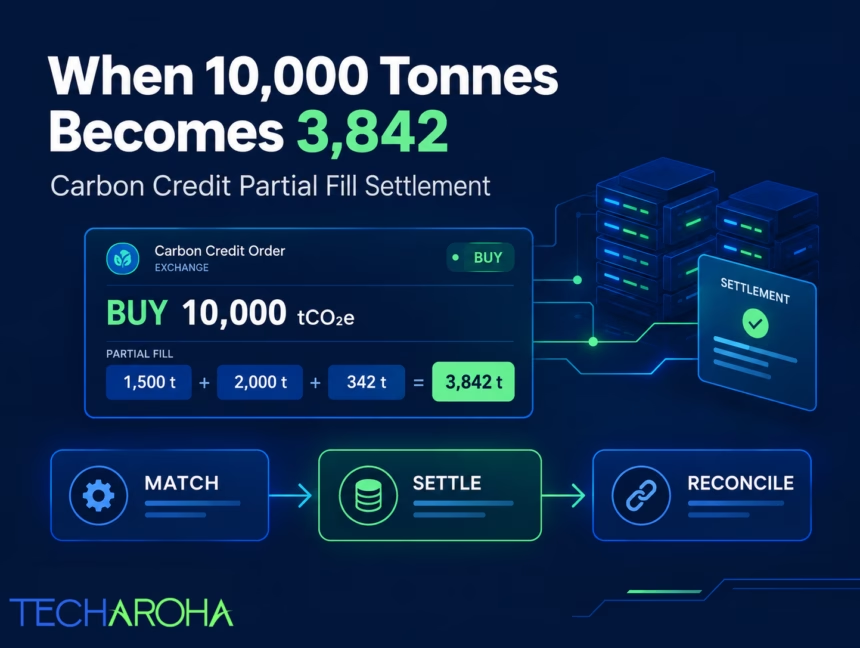
A carbon exchange can display a beautiful order book and still have fundamentally broken trading infrastructure. The real test begins when a buyer submits an order for 10,000 tonnes, but the matching engine can only execute 3,842 tonnes across multiple eligible sellers. What happens to the remaining 6,158 tonnes? More importantly: This is where carbon credit partial fill settlement becomes an architecture problem rather than a UI feature. Traditional exchange infrastructure already understands partial fills. Carbon markets make the problem harder because the underlying asset isn’t simply “10,000 units.” A carbon order can depend on vintage, methodology, geography, project, registry, authorization status, corresponding adjustment, removal/reduction classification, co-benefits, eligibility rules and available inventory.That means the matching engine cannot simply ask: “Does price match?” It needs to ask: “Does price match and does this exact inventory satisfy the buyer’s eligibility constraints at execution time?” And settlement has to preserve that decision. Why Partial Fills Are More Complicated in Carbon Markets Consider this order: Order Parameter Buyer Requirement Quantity 10,000 tCO₂e Maximum price $18/t Registry Approved registry Vintage 2022–2025 Methodology Removal Geography Eligible jurisdictions Eligibility Corporate procurement criteria Time-in-force IOC The order enters the exchange. The engine finds: But Seller D’s inventory subsequently fails an eligibility check. The executable quantity is therefore 3,840 tonnes, not 8,340. That single change creates several state transitions. Order state NEW → PARTIALLY_FILLED → CANCELLED/EXPIRED Inventory state AVAILABLE → RESERVED → TRADED → SETTLED Settlement state PENDING → PARTIALLY_SETTLED → SETTLED Registry state TRANSFER_REQUESTED → CONFIRMED / FAILED A production platform must maintain these states independently without allowing them to contradict one another. That is the core challenge behind carbon credit partial fill settlement. 1. Start With the Matching Engine, Not Settlement Settlement problems are frequently symptoms of weak execution architecture. A robust carbon exchange should separate at least these logical layers: The important architectural principle is that matching creates an execution commitment; settlement fulfils that commitment.Settlement should not independently decide what was traded. If the settlement service recalculates eligibility or price independently from the matching engine, the platform can create discrepancies between: That is precisely what an exchange operator wants to avoid. Read: The Authorization Wall: How Custom Carbon Exchanges Must Architect for Article 6 Corresponding Adjustments 2. Eligibility Must Be Part of Matching A common architecture mistake is to treat eligibility as a front-end filter. For example: “Show the buyer only CORSIA-eligible credits.” That is not enough. The eligibility decision needs to survive all the way into execution. Suppose a buyer wants 5,000 tonnes of eligible inventory. The matching engine finds three lots: Seller Available Price Eligibility Executable A 1,200 $14.80 Yes 1,200 B 2,000 $15.10 Yes 2,000 C 3,000 $15.40 No 0 The engine should not match 5,000 tonnes and “sort out eligibility later.” The correct result is: 3,200 tonnes executable + 1,800 tonnes residual. This distinction becomes especially important when eligibility can change because of: For institutional trading, eligibility should therefore be represented as a versioned execution condition, not simply a UI attribute. 3. Order Types Determine Partial-Fill Behaviour Not every order should behave the same way. A carbon exchange may support several order instructions depending on its market design. Order Type Partial Fill? Typical Behaviour Limit Yes Execute available eligible quantity and leave residual Market Usually yes Execute against eligible liquidity subject to protection rules IOC Yes Fill available quantity immediately; cancel residual FOK No Execute only if entire eligible quantity can be filled GTC Yes Leave residual active until filled/cancelled/expired GTD Yes Remain active until specified expiry Smart Order Yes Route across eligible liquidity sources For carbon credit partial fill settlement, this distinction matters because the residual order is not necessarily another settlement. The platform must clearly separate: Executed quantity from Remaining quantity For example: The settlement engine must never accidentally treat the original 10,000 tonnes as the settled amount. 4. Partial Fill Is an Execution Event, Not an Order Event This is a subtle but critical architecture decision. One order can generate multiple executions. For example: The order has therefore executed: 3,842 tonnes But the exchange has three separate execution records. Each execution should have its own immutable identifiers and economic details. At minimum: This event-level structure is what makes downstream reconciliation possible. 5. The Smart Order Router Has a Different Job A smart order router should not simply find the cheapest credit. It should find the best executable eligible liquidity according to the exchange’s routing policy. Imagine: The router can evaluate: This becomes particularly valuable when the exchange operates as an aggregation layer rather than a single order book. The router should also preserve execution provenance. If 10,000 tonnes are sourced through four venues, the platform needs to know exactly where every tonne originated. 6. The Hard Part: Carbon Credit Partial Fill Settlement This is where many marketplace architectures become fragile. Suppose: Buyer order = 10,000 tonnes The engine executes: Total: 3,842 tonnes Settlement should operate on the 3,842-tonne execution set, not the original order. A simplified flow looks like: The settlement orchestrator should maintain a state machine rather than a single Boolean such as: settled = true A more useful model is: That distinction becomes essential when registry APIs are asynchronous or unreliable. 7. Registry Confirmation Should Not Be Treated as a Synchronous Assumption Carbon exchanges often depend on external registry infrastructure. The exchange might successfully execute a trade, but the registry transfer could: Therefore: Trade execution ≠ registry settlement. The platform needs a durable settlement workflow. For example: The exact ordering can vary depending on custody and counterparty-risk design, but the state transitions must be explicit. 8. Idempotency Is Mandatory Imagine the registry confirms a transfer. Your webhook receives the confirmation. The service processes it. Then the same webhook arrives again. If the system simply says: “Transfer confirmed → add 1,500 tonnes” you have a serious accounting problem. Instead, settlement events need unique evidence identifiers. For example: The settlement processor should verify whether that evidence has already been consumed. Conceptually: This is one of the most important

Building a carbon exchange is not primarily a software decision. It is an ownership, liquidity, compliance, and time-to-market decision. Here is how founders and CTOs should actually choose between building, buying, or going white-label. You have the business model.You know who will supply the credits.You may already have project developers, corporate buyers, brokers, or investors interested.Then someone asks the uncomfortable question: “Are we building the exchange ourselves, buying existing software, or launching on a white-label platform?” That decision can determine how much control you have three years from now. Get it wrong, and you can end up with a platform that launches quickly but cannot support your compliance model, a custom system that consumes a year of capital before generating liquidity, or a white-label solution that looks like your exchange but behaves like someone else’s product. That is why the build vs buy carbon exchange decision should not be reduced to development cost. The real question is:Which implementation route gives your business the right combination of speed, control, compliance, economics and future ownership?There are three realistic routes: The right answer depends on what you are actually trying to own. Build vs Buy Carbon Exchange: Start With the Business Model, Not the Software A common mistake is starting with a feature checklist. “Does it have an order book?”“Does it support wallets?”“Does it have an admin dashboard?”“Can buyers purchase credits?” Those questions matter, but they come too late. A carbon exchange is not simply a website where tonnes are listed.Behind every transaction may be: The implementation route should therefore follow the business model and market structure. If your exchange is fundamentally different from existing platforms, customization becomes strategically important.If your model is conventional and speed is everything, buying may make sense.If you need your own brand and customer relationship without funding an entire exchange architecture from scratch, white-label can be the middle ground. The Three Carbon Exchange Routes Factor Custom Build Buy Existing Platform White-Label Initial speed Slowest Fast Fastest Upfront investment Highest Low–Medium Medium Customization Very High Limited Medium–High Brand ownership Full Depends on vendor Usually high IP ownership Negotiable/full Vendor-owned Usually vendor-owned core Registry integration Custom Depends on vendor Configurable Compliance logic Designed around your model Vendor constraints Depends on architecture Scalability Designed for your roadmap Product-dependent Depends on shared architecture Vendor dependency Lower High High Best for Strategic exchange operators Standard requirements Fast market entry But there is a more important distinction. You are not choosing between three software packages. You are choosing where your competitive advantage will live. Option 1: Build a Custom Carbon Exchange A custom build means the exchange is engineered around your requirements rather than forcing your requirements into somebody else’s product.This does not necessarily mean writing every component from zero.A competent development partner can use established engineering patterns, cloud infrastructure, security frameworks, payment infrastructure, and reusable components while custom-building the business-critical layers. Build makes sense when you need: The biggest advantage is control. You decide how credits are represented.You decide which attributes affect eligibility.You decide how orders are matched.You decide how settlement works.You decide which integrations become core infrastructure. That control becomes particularly valuable when the market evolves. A regulation changes.A registry changes its integration model.A new credit category becomes commercially important. Your buyer requires a new settlement mechanism. With a custom platform, those changes become engineering decisions rather than vendor negotiations. But a custom build has a serious disadvantage. Time. A serious exchange cannot be treated like a standard marketplace website. Architecture, security, testing, registry integrations, matching, settlement, and operational controls all take engineering effort. That means custom development is usually a poor choice for a company that simply wants to “test whether people will buy carbon credits.” It becomes much more attractive when the exchange itself is intended to become a long-term business asset. Option 2: Buy an Existing Carbon Exchange Platform Buying software is attractive because it appears to eliminate the hardest part of the problem. The vendor has already built: You configure it and launch. For a company with standard requirements, this can be perfectly reasonable. Buy when: But there is a question founders often forget to ask: What happens when your business becomes more successful than the software you bought? That is the real risk. A platform can be excellent today and still become restrictive tomorrow. Imagine that your exchange eventually needs: If the vendor cannot support those changes, your growth becomes constrained by someone else’s product roadmap. The hidden cost of buying The licence fee is only one part of the equation. You should evaluate: Licence + integration + customization + migration + vendor dependency + switching cost A cheap platform can become expensive if every meaningful change requires paid customization. Option 3: White-Label Carbon Exchange This is where the decision becomes more interesting. A white-label carbon exchange allows you to launch under your own brand while using an underlying platform infrastructure provided by another company. For a company that wants market presence quickly, this can be attractive.You can potentially get: without financing every component of the platform from scratch.The critical word, however, is architecture. Not every white-label solution is actually suitable for carbon markets. A generic crypto exchange with a new logo is not automatically a carbon exchange. Carbon credits have attributes that influence whether a transaction is valid. For example: A serious white-label architecture therefore needs more than a branded front end.It needs appropriate tenant isolation, configurable business rules, registry integrations, permissions, transaction controls, and compliance-aware workflows. Read our Article- What Does a Carbon Exchange Actually Cost to Build? A Module-by-Module Breakdown The Build vs Buy Carbon Exchange Decision Matrix Instead of asking which route is “best,” score each route against your actual requirements. Decision Factor Build Buy White-Label Budget sensitivity ★★ ★★★★★ ★★★★ Speed to launch ★★ ★★★★ ★★★★★ Product differentiation ★★★★★ ★★ ★★★ Platform control ★★★★★ ★★ ★★★ Compliance customization ★★★★★ ★★ ★★★★ Registry flexibility ★★★★★ ★★–★★★ ★★★ Long-term ownership ★★★★★ ★★ ★★★ Engineering independence ★★★★★ ★★ ★★★ MVP validation ★★★ ★★★★★ ★★★★★

A mid-size manufacturing company’s ESG director logs into a carbon exchange. She selects 5,000 tonnes of nature-based removal credits, clicks purchase, and receives a settlement certificate. The transaction took four minutes. The audit fails six weeks later. Not because the credits were fraudulent. Not because the registry was wrong. Because her company – a Category A firm under the newly enacted SBTi Corporate Net-Zero Standard V2.0 – purchased credits that weren’t routed to the correct Ongoing Emissions Responsibility tier, weren’t mapped to any internal carbon price floor, and can’t be traced back to her Scope 3 accounting data. The platform she used treated a compliance-critical procurement event the same way Amazon treats a household purchase. This is the failure mode that makes carbon procurement portal development the most consequential engineering conversation in climate finance right now. The Compliance Landscape Has Just Fundamentally Shifted On June 11, 2026, the Science Based Targets initiative released Corporate Net-Zero Standard V2.0 — the most significant overhaul of corporate climate target-setting since the original standard launched in 2021. For carbon market platform operators, the headline isn’t the emissions reduction trajectories or the scope target changes. It’s the Ongoing Emissions Responsibility (OER) framework. OER formalizes, for the first time, a structured route for carbon credits within a corporate net-zero strategy. It replaces the vague “Beyond Value Chain Mitigation” label with a tiered recognition programme that has hard price-floor requirements: What this means operationally: a corporate buyer making a voluntary carbon credit purchase under V2.0 cannot simply buy credits at market rate and retire them. They must know at the moment of purchase which OER pathway they’re qualifying for, whether the credits meet Core Carbon Principle (CCP) eligibility for that pathway, what internal price floor that transaction is being booked against, and how the purchase maps to their Scope 1, 2, and 3 accounting data. A standard B2B carbon marketplace cannot perform any of these functions. This is what makes purpose-built carbon procurement portal development a non-negotiable infrastructure priority for any operator serving institutional buyers. Why Your Current Platform Architecture Fails This Test Most carbon exchanges and marketplace platforms were architected for one purpose: match willing buyers with willing sellers at a price both parties accept. The order management system (OMS) records the trade, triggers a registry retirement call, and issues a settlement certificate. Full stop. Under SBTi V2.0’s OER framework, that architecture has exactly three critical gaps. Gap 1: No Scope-Aware Order Context A carbon credit purchase by a Category A corporate buyer is not an isolated transaction. It’s a claim against their existing Scope 1, 2, and 3 emissions inventory. The platform has no way of knowing whether the buyer is purchasing credits to address Scope 1 direct emissions (hard-to-abate industrial processes), Scope 2 purchased electricity residuals, or Scope 3 supply chain emissions — and these distinctions matter for audit defensibility. Any serious carbon procurement portal development program must solve for Scope-linked order context before writing a single OMS line. Gap 2: No OER Tier-Matching Engine When a buyer places an order, the platform needs to programmatically determine: Is this buyer pursuing the $20/tCO₂e pathway (Recognised) or the $80/tCO₂e pathway (Leadership)? Are the credits in the requested lot CCP-eligible for that specific pathway? Does the order value, applied against the buyer’s total ongoing emissions footprint, satisfy the percentage threshold for their target recognition tier? Standard exchange matching engines are built for price-time priority, not parameter-based compliance routing. They cannot answer any of these questions. Gap 3: No Internal Price Floor Enforcement V2.0’s OER framework requires that the internal carbon price applied to a purchase be defensible in a third-party audit. If a corporate buyer’s finance team books a credit purchase at a market clearing price of $14/tonne while claiming Recognised pathway status (minimum $20/tCO₂e threshold), the claim is invalid — even if the credits themselves are CCP-eligible. The platform’s OMS must either enforce a minimum transaction price floor dynamically or surface an explicit attestation workflow that allows the buyer to document supplementary internal carbon pricing above the market price. Carbon procurement portal development that skips this layer will produce audit failures for every corporate buyer on the Recognised or Leadership pathway. The Architecture That Actually Works Building a carbon procurement portal development infrastructure that handles SBTi V2.0’s OER requirements is not a configuration problem. It’s a data model and routing engine problem. Here’s what the correct architecture looks like. Layer 1: The Carbon Accounting API Integration Layer Before a buyer can place a compliant OER order, the platform needs to know their emissions baseline. That data doesn’t live in your carbon exchange — it lives in the buyer’s GHG accounting system (Normative, Greenly, Watershed, or a custom internal system). The portal’s integration layer must expose a structured API that pulls: This data populates a buyer-specific compliance dashboard. Every order a corporate buyer places is evaluated against this live context, not processed in isolation. This is the foundational capability that separates enterprise-grade carbon procurement portal development from a retail marketplace with a compliance-sounding landing page. Layer 2: The OER Tier-Matching Engine Once the buyer’s emissions context is loaded, every incoming order request passes through a tier-matching engine that operates as a pre-routing validation layer before the order ever reaches the matching engine. The tier-matching engine performs three checks: Pathway eligibility check: Does the buyer’s declared internal carbon price meet the floor for their target OER tier? ($20/t for Recognised, $80/t for Leadership.) If the market-clearing price for the requested credit lot falls below the floor, the engine either triggers a price attestation workflow or routes the order to a supplementary carbon pricing ledger entry. CCP pool routing: Under V2.0, not all voluntary carbon credits qualify equally. Credits must meet Core Carbon Principle standards for OER use. The tier-matching engine queries the credit’s CCP eligibility flag – a structured attribute set during credit ingestion from the registry and routes the order to the appropriate CCP-eligible sub-ledger. Engaged pathway orders route to a broader set of eligible