

A mid-size manufacturing company’s ESG director logs into a carbon exchange. She selects 5,000 tonnes of nature-based removal credits, clicks purchase, and receives a settlement certificate. The transaction took four minutes.
The audit fails six weeks later.
Not because the credits were fraudulent. Not because the registry was wrong. Because her company – a Category A firm under the newly enacted SBTi Corporate Net-Zero Standard V2.0 – purchased credits that weren’t routed to the correct Ongoing Emissions Responsibility tier, weren’t mapped to any internal carbon price floor, and can’t be traced back to her Scope 3 accounting data. The platform she used treated a compliance-critical procurement event the same way Amazon treats a household purchase.
This is the failure mode that makes carbon procurement portal development the most consequential engineering conversation in climate finance right now.
On June 11, 2026, the Science Based Targets initiative released Corporate Net-Zero Standard V2.0 — the most significant overhaul of corporate climate target-setting since the original standard launched in 2021. For carbon market platform operators, the headline isn’t the emissions reduction trajectories or the scope target changes. It’s the Ongoing Emissions Responsibility (OER) framework.
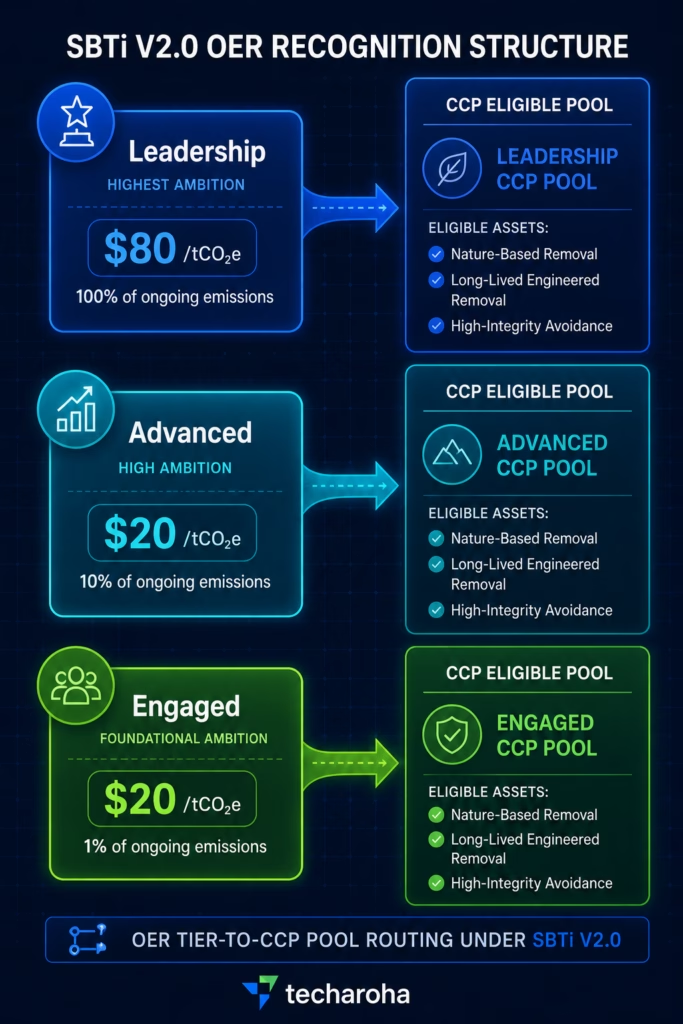
OER formalizes, for the first time, a structured route for carbon credits within a corporate net-zero strategy. It replaces the vague “Beyond Value Chain Mitigation” label with a tiered recognition programme that has hard price-floor requirements:
What this means operationally: a corporate buyer making a voluntary carbon credit purchase under V2.0 cannot simply buy credits at market rate and retire them. They must know at the moment of purchase which OER pathway they’re qualifying for, whether the credits meet Core Carbon Principle (CCP) eligibility for that pathway, what internal price floor that transaction is being booked against, and how the purchase maps to their Scope 1, 2, and 3 accounting data.
A standard B2B carbon marketplace cannot perform any of these functions. This is what makes purpose-built carbon procurement portal development a non-negotiable infrastructure priority for any operator serving institutional buyers.
Most carbon exchanges and marketplace platforms were architected for one purpose: match willing buyers with willing sellers at a price both parties accept. The order management system (OMS) records the trade, triggers a registry retirement call, and issues a settlement certificate. Full stop.
Under SBTi V2.0’s OER framework, that architecture has exactly three critical gaps.
Gap 1: No Scope-Aware Order Context
A carbon credit purchase by a Category A corporate buyer is not an isolated transaction. It’s a claim against their existing Scope 1, 2, and 3 emissions inventory. The platform has no way of knowing whether the buyer is purchasing credits to address Scope 1 direct emissions (hard-to-abate industrial processes), Scope 2 purchased electricity residuals, or Scope 3 supply chain emissions — and these distinctions matter for audit defensibility. Any serious carbon procurement portal development program must solve for Scope-linked order context before writing a single OMS line.
Gap 2: No OER Tier-Matching Engine
When a buyer places an order, the platform needs to programmatically determine: Is this buyer pursuing the $20/tCO₂e pathway (Recognised) or the $80/tCO₂e pathway (Leadership)? Are the credits in the requested lot CCP-eligible for that specific pathway? Does the order value, applied against the buyer’s total ongoing emissions footprint, satisfy the percentage threshold for their target recognition tier? Standard exchange matching engines are built for price-time priority, not parameter-based compliance routing. They cannot answer any of these questions.
Gap 3: No Internal Price Floor Enforcement
V2.0’s OER framework requires that the internal carbon price applied to a purchase be defensible in a third-party audit. If a corporate buyer’s finance team books a credit purchase at a market clearing price of $14/tonne while claiming Recognised pathway status (minimum $20/tCO₂e threshold), the claim is invalid — even if the credits themselves are CCP-eligible. The platform’s OMS must either enforce a minimum transaction price floor dynamically or surface an explicit attestation workflow that allows the buyer to document supplementary internal carbon pricing above the market price. Carbon procurement portal development that skips this layer will produce audit failures for every corporate buyer on the Recognised or Leadership pathway.
Building a carbon procurement portal development infrastructure that handles SBTi V2.0’s OER requirements is not a configuration problem. It’s a data model and routing engine problem. Here’s what the correct architecture looks like.
Layer 1: The Carbon Accounting API Integration Layer
Before a buyer can place a compliant OER order, the platform needs to know their emissions baseline. That data doesn’t live in your carbon exchange — it lives in the buyer’s GHG accounting system (Normative, Greenly, Watershed, or a custom internal system). The portal’s integration layer must expose a structured API that pulls:
This data populates a buyer-specific compliance dashboard. Every order a corporate buyer places is evaluated against this live context, not processed in isolation. This is the foundational capability that separates enterprise-grade carbon procurement portal development from a retail marketplace with a compliance-sounding landing page.
Layer 2: The OER Tier-Matching Engine
Once the buyer’s emissions context is loaded, every incoming order request passes through a tier-matching engine that operates as a pre-routing validation layer before the order ever reaches the matching engine.
The tier-matching engine performs three checks:
Pathway eligibility check: Does the buyer’s declared internal carbon price meet the floor for their target OER tier? ($20/t for Recognised, $80/t for Leadership.) If the market-clearing price for the requested credit lot falls below the floor, the engine either triggers a price attestation workflow or routes the order to a supplementary carbon pricing ledger entry.
CCP pool routing: Under V2.0, not all voluntary carbon credits qualify equally. Credits must meet Core Carbon Principle standards for OER use. The tier-matching engine queries the credit’s CCP eligibility flag – a structured attribute set during credit ingestion from the registry and routes the order to the appropriate CCP-eligible sub-ledger. Engaged pathway orders route to a broader set of eligible credits, including high-integrity avoidance. Leadership pathway orders, carrying the $80/t floor, route to a narrower CCP pool requiring a higher proportion of long-lived removal credits.
Scope mapping: The engine records which scope the credit purchase is being applied against, generating an immutable order record that links the transaction ID, credit serial number, OER tier, internal price floor, and emissions scope. This record is the audit trail.
Layer 3: The Programmatic Budget Router
For institutional buyers — corporate treasury teams managing annual OER budgets – the portal needs a programmatic budget routing module that converts the OER compliance framework into an automated spending instruction.
A corporate treasury team configures: total OER budget for the year ($X million at $20/t for Recognised pathway, or $Y million at $80/t for Leadership pathway). The portal’s budget router then executes purchases against this budget on a scheduled or triggered basis, routing capital into the appropriate CCP-eligible credit pools, maintaining scope attribution for each tranche, and generating quarterly compliance reports that map every purchase to the OER framework’s recognition tier requirements.
This is fundamentally different from a “recurring purchase” feature in a retail carbon marketplace. It’s a structured procurement automation engine — and it’s the reason why serious carbon procurement portal development can’t be accomplished by adapting an off-the-shelf e-commerce platform or a generic trading desk build.

The companies that will feel this problem most acutely are not small buyers. They are Category A companies, large and medium-sized enterprises in high-income countries, facing mandatory OER requirements from 2035, that are building voluntary OER programs now to secure public recognition and audit credibility ahead of the mandatory deadline.
These companies are currently evaluating carbon trading platforms. Their procurement teams are asking questions their current vendors cannot answer: Can your platform generate an OER compliance report that matches each credit purchase to our Scope 3 supplier emissions data? Can it enforce the $80/t internal price floor automatically for our Leadership pathway commitment? Can it route budget separately into Recognised and Leadership pathway pools when we’re managing two OER tiers across different business units?
Every platform that answers “no” to these questions is watching a potential multi-year institutional contract walk out the door. Every carbon procurement portal development project that embeds these capabilities at the architecture level rather than treating compliance as a reporting feature bolted on afterward, is building what those institutional buyers actually need.
It’s tempting to assume that existing carbon marketplace vendors will add OER compliance modules to their platforms. Some will. But the fundamental challenge is that OER tier-matching requires the platform’s core data model to be built around emissions context, scope attribution, and dynamic price-floor routing from day one — not adapted to support these requirements after the fact.
A platform whose core data model treats carbon credits as generic inventory items and orders as price-matching events cannot be refactored into an OER-aware compliance engine without rebuilding the order management system from scratch. The Scope integration layer, the tier-matching engine, and the programmatic budget router are not features. They are architectural primitives.
This is why the institutional buyers now evaluating platforms for post-V2.0 procurement infrastructure are not looking at generic marketplace vendors. They’re looking for a carbon procurement portal development partner that understands the V2.0 compliance architecture well enough to have already made the right engineering decisions — before the first line of code was written.
If you’re building or operating a carbon exchange that serves institutional buyers, the compliance upgrade required by SBTi V2.0 is not optional, and it’s not far away. Target validations under V2.0 begin in Q1 2027. Corporate buyers who want OER recognition in their first V2.0 reporting cycle need procurement infrastructure that supports compliant purchasing before that window opens.
The platforms that move first on carbon procurement portal development with genuine OER architecture — not a compliance overlay on a retail marketplace, but a purpose-built enterprise portal with Scope API integration, CCP pool routing, and programmatic budget automation — will control the institutional buyer relationships that define the voluntary carbon market’s next decade.
The platforms that don’t will find that their institutional clients have migrated to the ones that did.
Building an enterprise carbon procurement portal for SBTi V2.0 compliance?
Techaroha has architected custom carbon trading platforms, NFT-based environmental exchanges, and compliance infrastructure for institutional clients across climate finance. If you need a platform that routes OER budgets, enforces price floors, and generates audit-ready Scope attribution reports, let’s talk about what the right architecture looks like for your use case.