

There is a specific kind of dread that hits a CTO around year eight of running the same PHP or Java monolith. The application still works. Revenue still flows through it. But every new feature takes three sprints instead of three days, every senior engineer who understood the checkout module has left the company, and the last attempt at a “full rewrite” burned eleven months and $1.2 million before being quietly shelved.
This is the reality of legacy code modernization in 2026: it is no longer a question of whether to modernize, but of how to do it without repeating the failed big-bang rewrites of the last decade. And the answer that is finally working for enterprise teams is not a bigger rewrite team. It is a smaller team armed with extended-context AI models, code dependency graphs, and parallelized agent workflows.
At Techaroha, we’ve spent the last two years pulling apart monoliths for fintech and SaaS clients, and the pattern is consistent: teams that treat legacy code modernization as a context problem, not a headcount problem, cut their migration timelines by more than half.
Before talking about what works, it’s worth being honest about why most modernization projects stall. Three failure modes show up again and again:
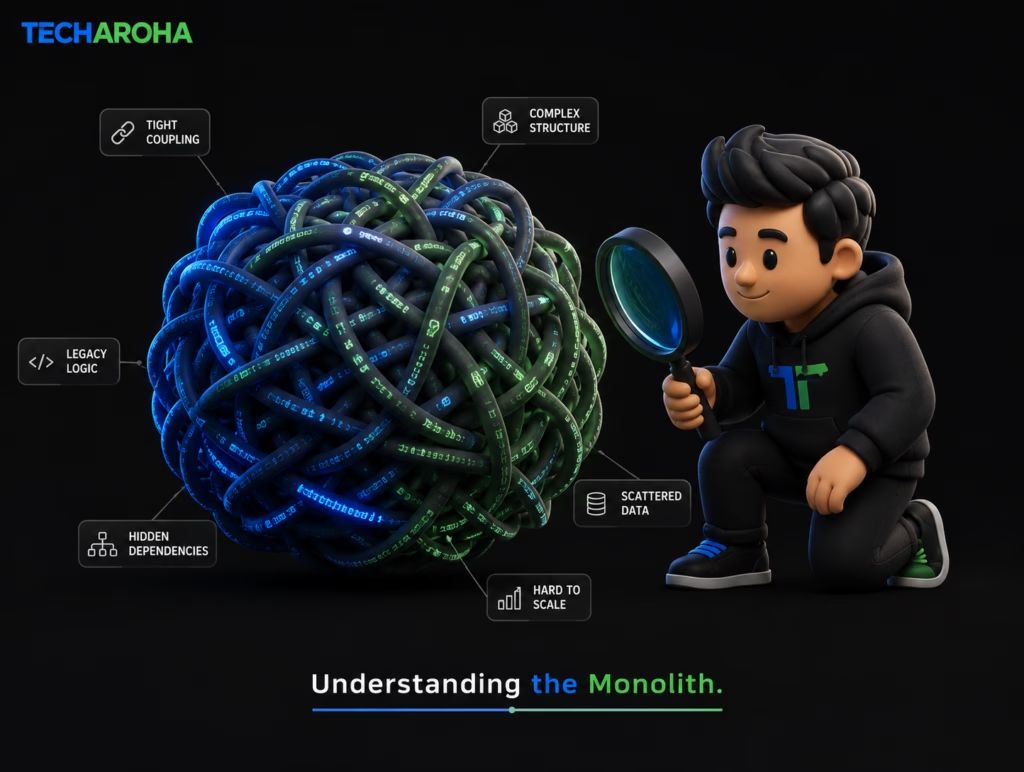
Each of these is fundamentally a context problem. Engineers can’t hold a 200,000-line codebase in their head, and neither could older AI coding tools with 8K or 32K token context windows; they’d lose track of how a change in one repository rippled through six others.
That’s changed. Extended-context models can now ingest hundreds of thousands of tokens – Claude Enterprise, for instance, offers a 500K-token context window in chat, enough to reason across roughly 200,000 lines of code in a single pass. That single capability shift is what turns “understand this monolith” from a six-month archaeology project into a days-long automated mapping exercise.
Read: Why 37 Tech Giants Just Declared War on the Old-School Firewall
A production-grade legacy code modernization initiative at scale rests on three pillars working together, not in isolation:
| Pillar | What It Solves | Core Tooling |
|---|---|---|
| Cross-repository dependency mapping | “Nobody understands this” | Code graph tools + extended-context LLM analysis |
| Parallel agent refactoring | Slow, sequential migration | Git worktrees + isolated agent sessions |
| Automated test generation | The test-coverage cliff | AI-generated unit/integration test suites |
Let’s break each one down.
You cannot safely decompose a monolith you don’t fully understand. The first and most underrated step in any serious legacy code modernization engagement is building a complete dependency graph not just within a single repository, but across every service, shared library, and database schema the monolith touches.
Modern tooling combines two techniques:
The output isn’t a diagram for a slide deck. It’s a machine-readable map that tells the engineering team exactly which modules can be safely extracted first, usually the ones with the fewest inbound dependencies and the clearest domain boundaries (classic candidates: notifications, billing, authentication, reporting).
Practical tip: Start dependency mapping on the module with the highest business pain and the lowest coupling score. This is where teams see the fastest ROI and build internal confidence for the rest of the migration.
Here’s where most modernization projects lose weeks they don’t need to lose: sequential refactoring. One engineer (or one AI session) working through the codebase module by module, one at a time.

Git worktrees change this. Instead of a single checkout, a worktree lets a team run multiple isolated working directories off the same repository, each on its own branch, without the overhead of cloning the repo repeatedly or juggling stash conflicts. This matters enormously for legacy code modernization because it means multiple AI coding agent sessions can work on independent modules simultaneously, without stepping on each other’s changes:
worktree/billing-extractionworktree/notifications-extractionworktree/iac-updatesEach session runs in full isolation, informed by the same underlying dependency graph, so agents don’t propose conflicting boundary decisions. When a session finishes, its branch merges back through standard code review; nothing bypasses human sign-off.
The result: a modernization roadmap that used to take 18 months of one team working sequentially can realistically compress into 6–8 months of coordinated, parallel extraction without adding headcount.
This is the step teams most often skip, and it’s the one that causes production incidents six weeks after a “successful” migration.
When a module is extracted from a monolith into a standalone microservice, its behavior needs to be provably identical to the legacy version, especially for edge cases nobody remembers writing. Manually writing that test suite is slow and often incomplete. AI-assisted test generation, guided by the same extended-context model that mapped the dependencies, can:
For legacy code modernization projects with zero or near-zero existing test coverage, common in older PHP applications, this step alone often determines whether the migration succeeds or gets rolled back under pressure.
Here’s what a phased legacy code modernization roadmap typically looks like for a mid-to-large enterprise monolith (250K–500K lines of code):
This is not a theoretical timeline – it’s the structure we’ve used with clients moving fintech transaction-processing monoliths and enterprise SaaS platforms off aging PHP and Java bases, without a single unplanned outage during cutover.
It’s worth putting numbers on the status quo, because “we’ll modernize eventually” is rarely a neutral decision.
Multiply any of these across a two-to-three-year delay, and the “safe” choice to keep deferring legacy code modernization quietly becomes the more expensive one.
The teams that succeed at legacy code modernization don’t start with a company-wide mandate to “modernize everything.” They start narrow:
This is the difference between a modernization initiative that dies in a steering committee and one that quietly, methodically turns a decade-old monolith into a maintainable, cloud-native platform over two to three quarters.
Considering a legacy code modernization roadmap for your own PHP, Java, or monolithic platform? Techaroha’s engineering team combines extended-context AI models, cross-repository code graphs, and parallel refactoring workflows to de-risk enterprise modernization projects without the 18-month timeline or the big-bang rewrite gamble. Talk to our team about a free dependency-mapping assessment of your codebase.