
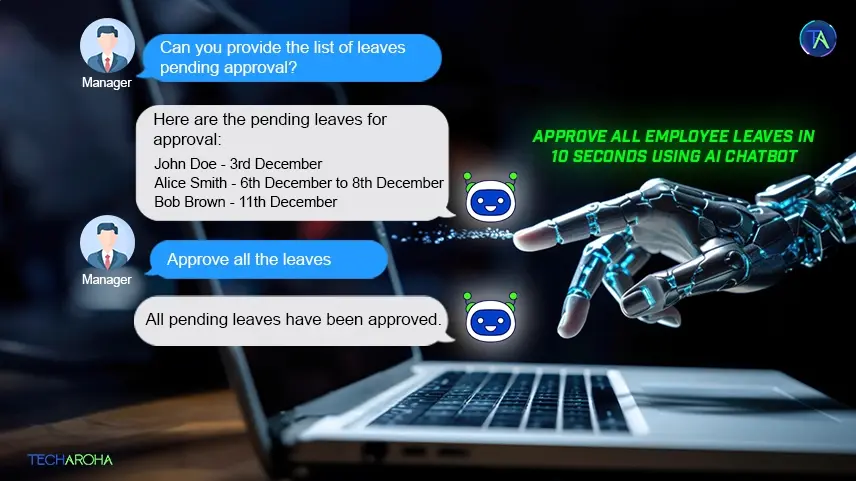
Managers often struggle with the time-consuming process of manually reviewing and approving employee leave requests. Techaroha’s AI Chatbot Integrated HRMS offers a solution that automates and streamlines this process. With our solution, managers can approve all employee leaves within seconds, enhancing productivity. Discover how AI chatbots can revolutionize leave management and save valuable time. What is HRMS (Human Resource Management System)? HRMS (Human Resource Management System) is a software solution designed to streamline and automate various HR functions in organizations. It centralizes employee data, payroll management, attendance tracking, leave requests, and performance evaluations. HRMS helps HR teams efficiently manage employee records, streamline administrative tasks, and improve communication across the company. By automating routine HR processes, HRMS ensures better accuracy, reduces manual effort, and enhances overall operational efficiency. This system is crucial in modern organizations, allowing HR professionals to focus on strategic tasks and improve employee experience while reducing the risk of errors. Challenges in Traditional Leave Management Systems These challenges not only reduce the overall efficiency of HR departments but also affect employee satisfaction and organizational productivity. How do AI chatbots transform HRMS for end users? AI Chatbot Integrated HRMS enhance efficiency, reduce human error, and streamline communication, making HRMS more user-friendly and effective for everyone involved. Key Benefits of AI Chatbot-Integrated HRMS for HRMS Creators and Providers AI chatbot integration can significantly boost profitability by enhancing product value, reducing costs, and attracting more clients to HRMS providers. Real-Life Example of AI Chatbot Leave Management Background: ABC HRMS, a leading HR management software provider used by over 100+ companies globally, faced challenges with the manual and time-consuming leave approval process. Managers had to process multiple leave requests daily, which slowed down decision-making and distracted them from more strategic tasks. The company wanted to improve operational efficiency and enhance the user experience for HR managers and employees. Solution: Techaroha integrated its AI-powered chatbot into ABC HRMS to automate the leave management process. The chatbot was designed to handle employee leave requests, process approvals, and provide real-time updates, streamlining the entire workflow. How AI Chatbot Integrated HRMS Made Things Easier: Outcomes: Techaroha’s AI chatbot integration helped ABC HRMS reduce time spent on leave management, improve communication, and streamline processes for both employees and managers. The solution enhanced productivity, reduced errors, and led to higher satisfaction, making the HRMS more attractive to other companies looking for efficient and modern HR solutions. In Conclusion Techaroha’s AI chatbot integration in HRMS revolutionizes leave management by making it faster, more efficient, and hassle-free for managers. This solution not only saves time but also improves productivity and employee satisfaction. Explore AI-powered HRMS solutions today to streamline your processes. For more information or a demo, visit Techaroha’s services.
Generative AI is revolutionizing business by creating content, designs, and solutions through advanced algorithms. Its significance in today’s business landscape lies in its ability to enhance creativity, efficiency, and personalization. This blog explores what Generative AI is, how it works, its business applications, benefits, challenges, and future trends. What is Generative AI? Definition of Generative AIGenerative AI refers to a class of artificial intelligence that can create new content, such as text, images, audio, and video, by learning patterns from existing data. Differences between Generative AI and Traditional AITraditional AI operates based on analyzing data and making predictions or decisions. It excels in classification tasks, such as identifying objects in images or translating languages. Generative AI, on the other hand, goes a step further by generating new data that resembles the training data. While traditional AI can tell you what is in an image, generative AI can create entirely new images from scratch. Examples of Generative AI Applications How Generative AI Works? Generative AI operates on basic principles of pattern recognition and creation using advanced algorithms. At its core, it relies on neural networks and deep learning techniques to learn from vast amounts of data and generate new content that mimics this data. Neural Networks and Deep LearningNeural networks, inspired by the human brain, consist of interconnected layers of nodes (neurons) that process input data. Deep learning, a subset of machine learning, involves training these neural networks on multiple layers to capture intricate patterns and representations in the data. Training Process for Generative Models Types of Generative AI Models Key Business Applications of Generative AI Generative AI revolutionizes several key business functions: These applications illustrate how generative AI augments creativity, efficiency, and customer-centricity, driving competitive advantage and fostering innovation across industries. Benefits of Generative AI for Businesses Generative AI offers substantial benefits to businesses: Efficiency and Cost Savings: Automates repetitive tasks like content creation and data analysis, reducing human resource costs and operational inefficiencies. Enhanced Creativity and Innovation: Generates novel solutions and designs, fostering innovation in product development and marketing strategies. Improved Customer Experience and Personalization: Creates personalized interactions through chatbots and tailored content, enhancing customer satisfaction and loyalty. Scalability of Operations: Scales operations seamlessly by handling increasing volumes of data and tasks without proportional increases in resources, supporting business growth and agility. Challenges and Considerations of Generative AI Generative AI presents significant challenges and considerations for businesses: Case Studies and Success Stories: Generative AI in Action Generative AI is no longer science fiction. Companies across industries are embracing this technology to drive innovation and achieve impressive results. Here are a few examples: 1. Personalized Marketing with Adobe: 2. Drug Discovery with Generative AI by Insilico Medicine: 3. Automating Fashion Design with Zalando: 4. Generating Realistic Product Mockups with Autodesk: 5. Content Creation for Social Media with Buzzfeed: Future Trends in Generative AI Emerging Technologies and Advancements: Generative AI is rapidly advancing with breakthroughs in reinforcement learning, transformer models, and multimodal AI that processes and generates text, images, and audio simultaneously. Quantum computing is set to enhance AI efficiency and capabilities, enabling faster training and more complex generative tasks. Predictions for Future Impact on Business: Generative AI will revolutionize industries by automating creative processes like product design and marketing, allowing businesses to create hyper-personalized customer experiences and streamline operations. Enhanced AI-driven decision-making tools will offer deeper insights and predictive analytics, transforming strategic planning. As AI integration deepens, ethical AI development and deployment will become critical, influencing regulatory landscapes and corporate governance. These trends suggest a future where generative AI not only boosts human creativity and productivity but also drives significant economic and societal changes, requiring businesses to adapt proactively. Getting Started with Generative AI in Your Business Steps to Integrate Generative AI: Generative AI holds immense potential to transform business operations, enhance creativity, and drive innovation. By automating content creation, optimizing marketing, and personalizing customer experiences, it offers significant competitive advantages. We encourage you to explore and adopt generative AI technologies to stay ahead in the evolving digital landscape. Embrace these advancements to unlock new opportunities and propel your business forward with Techaroha’s expertise.
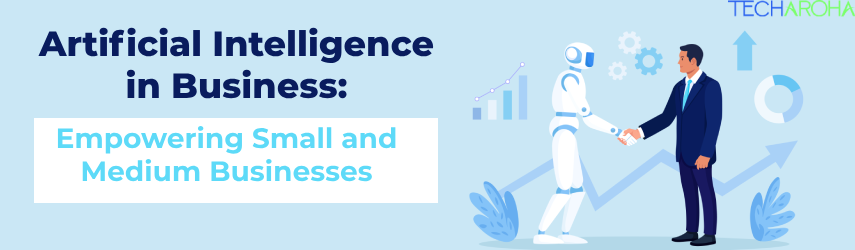
Artificial Intelligence (AI) has rapidly transformed industries with its immense potential, driving innovation and efficiency. Historically seen as a complex, costly technology suited for large corporations, AI’s perception as an exclusive tool is changing. This blog will explore how Artificial Intelligence in Business is becoming increasingly accessible and affordable for Small and Medium Businesses (SMBs), enabling them to harness its power for enhanced productivity, customer experiences, and data-driven decision-making. Challenges for SMBs in the AI Arena Adopting Artificial Intelligence in Business poses several challenges for Small and Medium Businesses (SMBs): Cost- The most significant hurdle is the cost. AI solutions often require substantial initial investments in technology, infrastructure, and software, followed by ongoing maintenance and updates. For many SMBs, these expenses can be prohibitive, especially when balancing tight budgets and limited financial resources. Technical expertise – Implementing and managing AI systems requires specialized knowledge in areas such as machine learning, data science, and software engineering. Many SMBs do not have the in-house talent to handle these complexities, making it difficult to deploy Artificial Intelligence in Business solutions effectively. Hiring or training staff with the necessary skills can be costly and time-consuming, further complicating AI adoption. Data limitations- Effective AI training relies on vast amounts of high-quality data to develop accurate models and predictions. Unlike large corporations, SMBs often lack extensive datasets, making it challenging to train AI systems effectively. Without sufficient data, AI applications may underperform or provide inaccurate insights, reducing their overall value. Fear of job displacement- The introduction of Artificial Intelligence in Business can lead to concerns about automation replacing human workers, potentially leading to job losses. This fear can create resistance to AI adoption within the organization, as employees may feel threatened by the technology. Addressing these challenges requires careful planning, investment in affordable and scalable AI solutions, upskilling employees, and fostering a culture of innovation that embraces technological advancements while addressing workforce concerns. How to Make AI Accessible for SMBs Gone are the days of AI being solely for tech giants! Here’s how SMBs can embrace this powerful tool: With these strategies, AI is no longer an out-of-reach dream; it’s a powerful tool waiting to revolutionize your SMB. Benefits of AI for SMBs AI isn’t just for big players; it’s a game-changer for SMBs too! Let’s take a look at the benefits of Artificial Intelligence in Business for Small and Medium Businesses: Real Case Studies of AI Implementation in Indian SMBs Here are some inspiring examples of how Small and Medium Businesses (SMBs) across India are leveraging Artificial Intelligence in Business to address challenges and achieve impressive results: 1. Vernacular AI for Seamless Customer Service: Lokal Baniya (Retail) 2. AI-Powered Inventory Management for Growth: Fabcurate (Fashion) 3. AI-Driven Farming for Sustainable Yields: Krishi Star (Agriculture) 4. AI for Fraud Detection and Financial Security: Razorpay (Fintech) These Indian SMBs showcase the diverse applications of Artificial Intelligence in Business and its potential to transform businesses of all sizes. The era of AI being solely for large corporations is over. Affordable, user-friendly Artificial Intelligence in Business solutions are empowering Small and Medium Businesses (SMBs) to embrace this transformative technology. From automating tasks to gaining data-driven insights, AI offers a competitive edge in today’s dynamic market. Don’t be left behind! Explore how Techaroha’s AI solutions can tailor AI to your specific needs and unlock the full potential of your SMB. Contact us today for a free consultation and see how AI can revolutionize your business!