
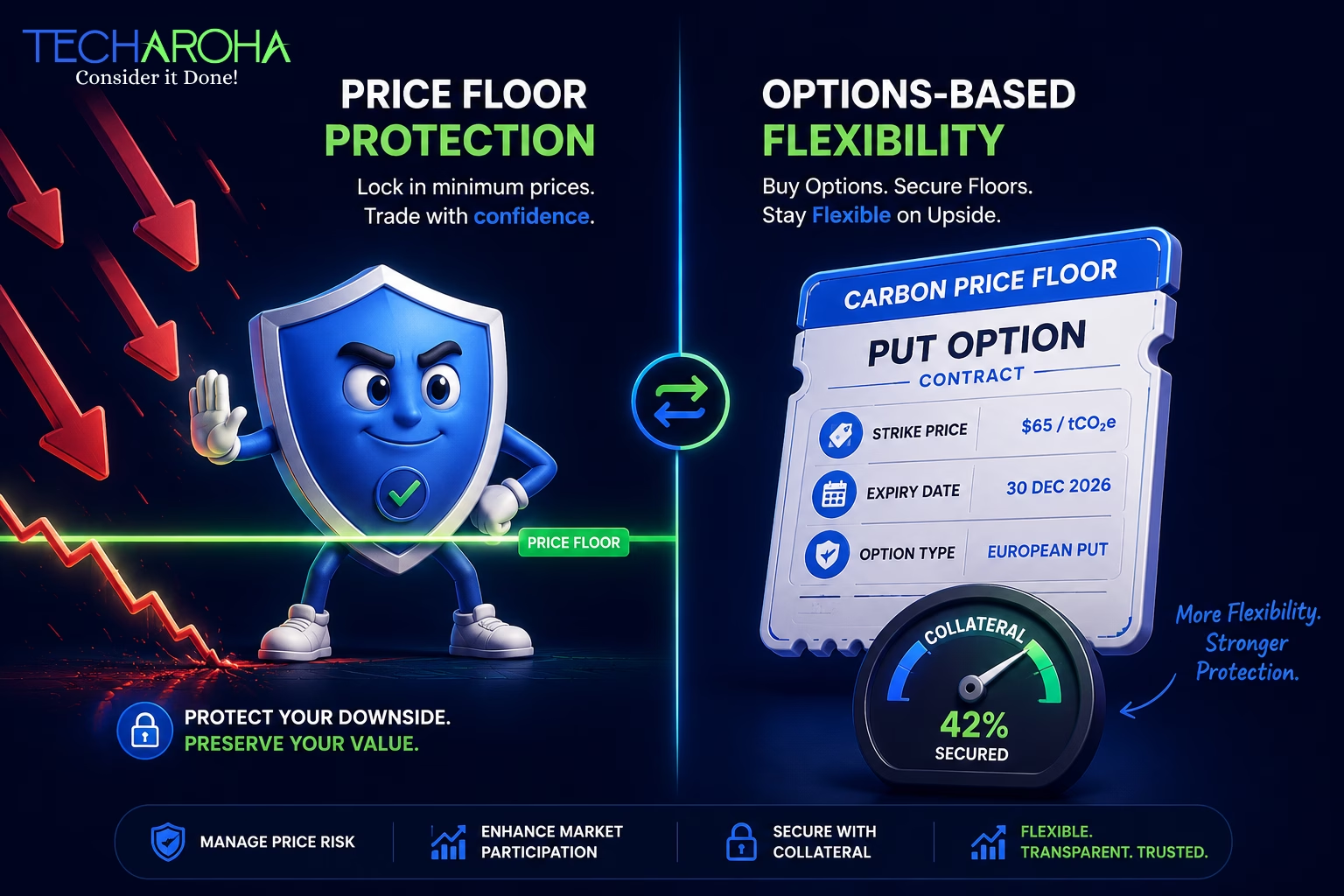
Ask a compliance manager at an airline or a steel manufacturer how they buy carbon credits, and “spot market” is rarely the honest answer. Compliance obligations under EU ETS, CORSIA, or India’s CCTS don’t arrive as a single, predictable invoice. They arrive as a moving liability tied to a price that can swing 15% in a quarter because of a Market Stability Reserve adjustment, a sector expansion, or a court ruling nobody priced in. A procurement head who buys 100,000 tonnes on the spot market today has no protection if the compliance deadline price spikes before their next purchase window. That’s not a trading inconvenience; it’s a budgeting crisis waiting to happen, and it’s exactly why a carbon credit derivatives platform has become the missing layer in nearly every exchange built in the last three years.
This post is for the people who feel that gap directly: commodity trading desk heads evaluating whether to add carbon to their book, green fintech founders whose spot exchange keeps losing institutional clients to “real” hedging venues, and CTOs told to “add options” without anyone explaining what that actually requires under the hood. We’re not pitching a finished product here we’re walking through how a serious engineering team architects a carbon credit derivatives platform, so you have a benchmark for whatever build or vendor conversation comes next.
Corporate compliance buyers airlines under CORSIA, cement and steel majors under EU ETS, and increasingly Indian obligated entities under CCTS rarely trade only spot credits, for one simple reason: spot exposure is unhedged exposure. A treasury team managing a multi-million-dollar annual compliance liability needs tools that look far more like a commodities desk than a retail offsetting app.
Here’s what that demand actually looks like in practice:
A spot-only exchange simply has no vocabulary for any of this. And the buyers who need it most commodity trading desks, ESG-focused institutional funds, and large compliance obligors will not migrate to a platform that can’t speak their language. This is the single biggest reason exchange founders lose institutional deal flow to legacy commodities infrastructure repurposed for carbon: their own software never grew past spot.
A carbon credit derivatives platform is what closes that gap. It doesn’t replace the spot order book it sits alongside it, giving the same exchange the ability to serve a hedge fund’s quant desk and a mid-sized manufacturer’s compliance officer with equally serious tooling.
Strip away the trading-floor jargon, and a carbon credit derivatives platform is solving three linked engineering problems, and any team evaluating a build in-house or outsourced should be judging the architecture against exactly these three:
Get those three right, and a carbon credit derivatives platform stops being a “nice to have” feature bolted onto a spot exchange. It becomes the reason a commodity trading desk chooses one venue over another because structured risk tooling, not credit availability, is usually the deciding factor for institutional flow.
The architectural core of any credible carbon credit derivatives platform is what we’d call an Options & Automated Collateral Management Microservice: a dedicated engine that sits apart from the spot matching engine, handling pricing, margin, and liquidation logic for every structured position on the exchange.

Here’s the conceptual flow for a single options trade, from order entry to settlement:
| Step | What Happens | Who Sees It |
|---|---|---|
| 1. Order intake | Buyer submits a call or put option order with strike price, expiry, and premium bid | Trader sees a standard options ticket |
| 2. Real-time pricing | The engine prices the contract using implied volatility derived from historical carbon price data and live order book depth | Invisible; happens in milliseconds |
| 3. Collateral haircut check | The system pulls the counterparty’s credit-quality signal and applies a dynamic haircut to posted collateral | Risk desk sees the adjusted margin requirement |
| 4. Position opening | Once margin clears, the contract is opened and logged against both counterparties | Both parties see an active position in their dashboard |
| 5. Continuous margin monitoring | The engine re-evaluates collateral value against the position’s mark-to-market exposure on every price tick | Risk team sees live margin utilization |
| 6. Automated liquidation (if triggered) | If collateral value breaches the maintenance threshold, the system unwinds the position per pre-agreed rules | Counterparty receives an immediate liquidation notice |
Each of those six steps depends on engineering that a generic exchange codebase does not include out of the box. Building a carbon credit derivatives platform means designing three distinct subsystems, and each one deserves its own architectural decision.
This is the buyer-facing surface of a carbon credit derivatives platform: an order book that handles calls, puts, and forward contracts alongside spot orders, without forcing every asset type through the same matching logic. Options pricing on carbon credits can’t simply borrow Black-Scholes wholesale; carbon markets have thinner liquidity, regulatory event risk (an MSR adjustment or a CORSIA phase change can move price more than any equity earnings call), and correlation patterns between compliance and voluntary credit tiers that a generic options engine has never seen. A serious matching layer blends standard options mathematics with carbon-specific volatility inputs pulled from historical price behavior around known regulatory events.
This is the layer that makes a carbon credit derivatives platform trustworthy to an institutional desk, and it’s also the piece most generic exchange builds skip entirely. Rather than treating every counterparty’s collateral the same way, the engine pulls independent credit-quality signals — the kind of ratings work done by firms like Sylvera and BeZero and applies a dynamic haircut to posted collateral based on that score.
In practice, that means:
This is the exact mechanism institutional trading desks expect from any serious derivatives venue, carbon or otherwise: collateral value that reflects independent, third-party risk assessment rather than a flat percentage applied to everyone equally.
Margin on a carbon credit derivatives platform can’t be a number set once at contract origination and left alone. It has to float continuously with two moving parts: the mark-to-market value of the open position, and the current value of posted collateral after its independent-rating haircut is applied.
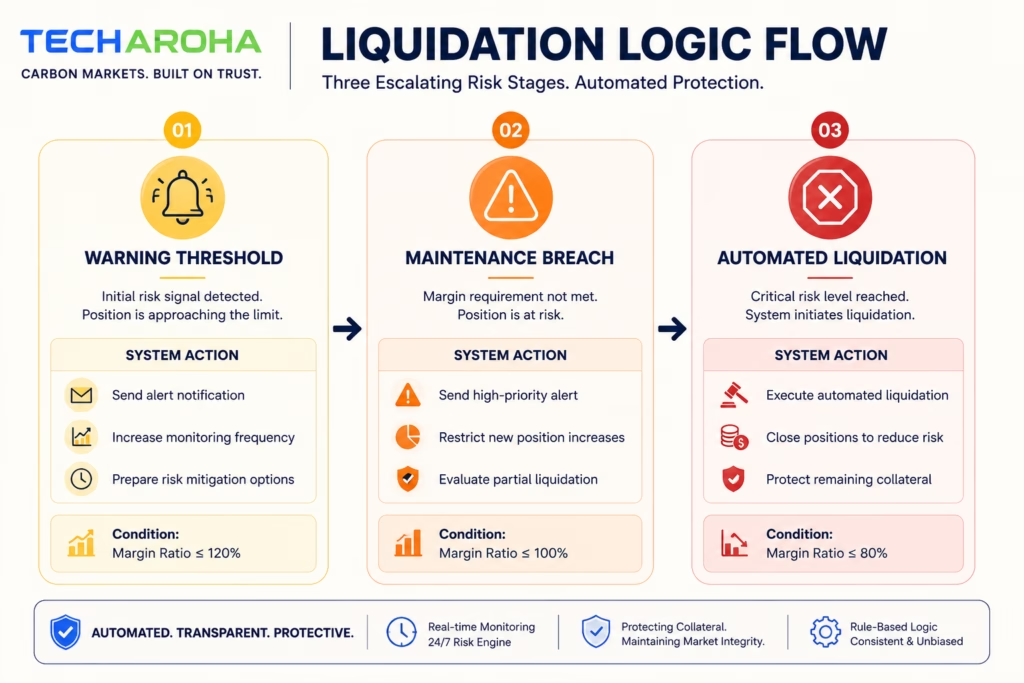
The liquidation logic itself has to be deterministic and rule-bound, not discretionary:
Production note: automated liquidation logic and haircut formulas described here represent the architecture pattern for a compliance-grade derivatives build. Exact thresholds, rating-provider integrations, and liquidation sequencing should be reviewed against shipped functionality before any client-facing claim is finalized.
Here’s the uncomfortable truth for most carbon exchange builds on the market today: the vast majority were designed for spot trading and had a basic forward contract feature added later, almost as an afterthought. That’s a fundamentally different engineering problem than building a carbon credit derivatives platform from the ground up with collateral management, floating margin, and automated liquidation as first-class citizens of the architecture, not bolt-ons.
Institutional buyers evaluating exchange partners increasingly ask, upfront, whether a platform’s risk logic actually understands independent credit ratings, dynamic haircuts, and automated liquidation sequencing. That question has become a qualifying filter for serious capital, in the same way “do you have FIX protocol support” once filtered legacy commodities venues.
A quick comparison of what separates a genuine carbon credit derivatives platform from a spot exchange with a forward-contract feature bolted on:
| Capability | Spot Exchange + Basic Forwards | True Carbon Credit Derivatives Platform |
|---|---|---|
| Options pricing | Not supported, or generic equity-style formula | Carbon-specific volatility modeling tied to regulatory event history |
| Collateral haircuts | Flat percentage or manual review | Dynamic, tied to independent ratings (Sylvera, BeZero-style scoring) |
| Margin monitoring | Periodic, often manual | Continuous, re-evaluated on every price tick |
| Liquidation | Discretionary, human-triggered | Automated, rule-bound, deterministic |
| Institutional readiness | Limited to buyers comfortable with spot-only exposure | Built for commodity desks, funds, and compliance treasuries |
A blog post about options pricing doesn’t usually read like a lead magnet, but this architecture is precisely the conversation that turns a browsing visitor into a qualified engineering discovery call. Commodity trading desks and green financial institutions don’t evaluate carbon platforms on marketing copy — they evaluate them on whether the underlying logic would survive scrutiny from their own quant and risk teams. A platform that can articulate independent-rating-based haircuts, floating margin, and automated liquidation in the same terms a Wall Street financial technology provider would use is signaling something specific: this vendor understands structured risk, not just token minting.
That’s the audience a carbon credit derivatives platform architecture is built to attract — exchange founders who’ve outgrown their MVP, CTOs benchmarking a build-versus-buy decision, and fund managers who need to know their counterparty risk is actually being managed, not just logged.
Building a carbon credit derivatives platform isn’t a weekend sprint or a plugin you bolt onto an existing spot exchange. It’s a genuine engineering discipline: real-time pricing, independent-rating-driven collateral haircuts, floating margin, and automated liquidation, all working together without introducing the kind of systemic risk that undermines trust in the entire market.
If you’re an exchange founder, a commodity trading desk head, or a CTO weighing whether your platform needs this layer, the conversation worth having isn’t “can you add options,” it’s “how does your collateral engine actually price counterparty risk.” That’s the conversation we have with every client building a carbon credit derivatives platform from the architecture up.
Book a technical discovery call with our engineering team to walk through your derivatives architecture requirements in detail.