
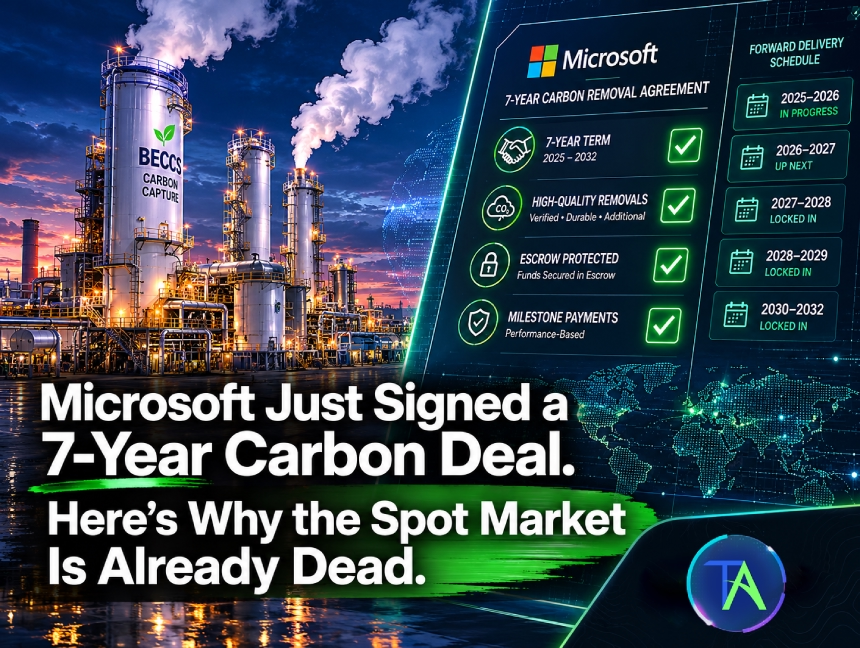
When Microsoft announced it had signed a 7-year forward contract with Stockholm Exergi for engineered carbon removals via Bioenergy with Carbon Capture and Storage (BECCS), most observers focused on the headline tonnage – 10,000 tonnes of CO₂ per year, drawn from one of the world’s first commercial BECCS facilities.
But the real story wasn’t the volume.
It was the structure.
Microsoft didn’t go to a spot market and buy carbon credits off the shelf. They signed an offtake agreement, a legally binding, milestone-linked, forward-delivery contract stretching seven years into the future. That is not a purchase. That is an infrastructure investment. And it signals something the carbon market has been slowly building toward for a decade: carbon forward contracts for engineered removals are becoming the gold standard for serious corporate climate buyers.
If you’re a corporate sustainability officer, a carbon project developer, or a fintech firm building the next generation of climate finance infrastructure, this is the moment that changes your roadmap.
For years, the voluntary carbon market (VCM) ran almost entirely on spot transactions. A company with a net-zero target in a press release would log onto a marketplace, browse available credits like a digital supermarket, retire some tonnes, and call it done. Fast, cheap, frictionless.
The problem? That model was optimized for avoidance credits — forestry protection, cookstove distribution, methane flaring. These credits are abundant, relatively cheap to issue, and can be minted quickly. Spot markets are well-suited to that inventory.
Engineered removals are the opposite of that.
Carbon forward contracts for engineered removals exist precisely because BECCS, Direct Air Capture (DAC), and Enhanced Rock Weathering projects require enormous upfront capital — construction of specialized infrastructure, procurement of specialized equipment, regulatory permitting, and years of operational setup — before a single verified tonne is captured. No developer can raise that capital on a promise to sell spot credits someday. The numbers simply don’t work.
This is exactly what Microsoft understood when it signed with Stockholm Exergi. The offtake agreement is the financing mechanism. The forward contract provides the revenue certainty that makes the project bankable. Without buyers willing to commit to carbon forward contracts for engineered removals years before delivery, most of these projects wouldn’t get financed at all.

Seven years is not an arbitrary contract length. It maps to something specific: the capital recovery cycle of a first-of-kind engineered removal facility.
Stockholm Exergi’s BECCS plant required substantial investment in carbon capture retrofits on top of an existing biomass heat and power plant. Investors underwriting that capital need visibility into future revenue over a period long enough to model a return. Seven years of contracted forward delivery at a known price (or price formula) is what makes the project investable.
This is how oil and gas infrastructure has been financed for decades — through long-term offtake agreements that give producers revenue certainty and give buyers supply certainty. Carbon forward contracts for engineered removals are simply applying the same mature financial logic to a new asset class.
And here’s the implication that most carbon market observers haven’t fully processed yet: if engineered removals are going to scale to the gigatonne level that climate models require, they need a financial infrastructure that makes long-term offtake agreements the default transaction model, not the exception.
That infrastructure doesn’t exist yet — at least not at scale. Most carbon trading platforms were built for the spot market. They handle credit issuance, registry synchronization, and retirement. They were not designed to manage the complex financial risk architecture that carbon forward contracts for engineered removals actually require.
Let’s be specific about the technical and financial complexity involved. A carbon forward contract for engineered removals is not a futures contract you can trade on an exchange. It is a bespoke bilateral agreement that typically includes:
This is where Carbon Plant’s architecture becomes directly relevant — and why we designed it the way we did.
When the Carbon Plant platform was conceived, the team made a foundational architectural decision: we would not build a spot market with forward contract features bolted on. We would build a forward contract engine with spot capability as a downstream feature.
That decision shapes everything about how Carbon Plant handles carbon forward contracts for engineered removals.

Here is what we believe the Microsoft-Stockholm Exergi deal actually reveals about where the carbon market is heading — and where the technology opportunity lies.
The market for engineered carbon removals is growing fast. Microsoft alone has committed to becoming carbon negative by 2030 and removing all historical emissions by 2050. Similar commitments have been made by Apple, Google, Stripe, and dozens of other large corporates. The Science Based Targets initiative (SBTi) is increasingly requiring that net-zero commitments include durable removals, not just avoidance credits.
All of that demand will flow through carbon forward contracts for engineered removals, because that is the only procurement structure that makes high-quality engineered removals financially viable. And all of those forward contracts will need platform infrastructure that doesn’t exist yet at scale.
That is the market Techaroha builds into.
If you are a carbon project developer who needs a platform to manage investor relations, forward contract documentation, milestone tracking, and credit delivery logistics — we build that.
If you are a corporate sustainability team that wants to move beyond spot credit retirement and into a structured forward procurement program with proper financial controls — we build the buyer-side interface for that.
If you are a financial institution, exchange operator, or climate fund that wants to create a marketplace for carbon forward contracts for engineered removals — we build the white-label infrastructure for that.
There is a lesson in Microsoft’s deal that applies directly to carbon market infrastructure.
Microsoft didn’t just sign a contract with Stockholm Exergi. They signed a contract that required Stockholm Exergi to meet a very specific set of technical, financial, and verification standards — standards that very few BECCS projects in the world could meet in 2024. The rigor of the contract is what makes the credit valuable.
The same logic applies to carbon trading platforms. The rigor of the infrastructure — the quality of the escrow logic, the robustness of the milestone tracking, the integrity of the verification integrations — is what makes the platform worth building on.
Carbon forward contracts for engineered removals are not a niche product for climate enthusiasts. They are the foundational financial instrument for a market that is projected to reach hundreds of billions of dollars in transaction volume by 2040. The platforms that handle those contracts need to be built to the standards of financial infrastructure, not marketplace software.
Carbon Plant was built to those standards. And we build custom versions of that infrastructure for clients who need it under their own brand and within their own regulatory context.
If that describes what you’re building — reach out. The window to establish infrastructure positions in the engineered removals market is open right now. It won’t be open indefinitely.
Techaroha builds custom carbon credit trading platforms, registries, and forward contract management infrastructure for exchanges, corporates, and project developers. Our Carbon Plant architecture is the foundation — your brand, your market, your rules.