

Every CFO has seen the line item by now: an API bill that grew 40% quarter over quarter, with no one able to explain exactly why. Every enterprise architect has seen the flip side: a vendor-built AI pilot that worked beautifully in the demo and then locked the entire data pipeline to a single cloud provider. These are not two separate problems. They are symptoms of the same root cause – a weak enterprise AI architecture. Most companies do not have an AI cost problem or an AI security problem. They have an enterprise AI architecture problem, and it shows up disguised as both. Get the enterprise AI architecture right, and the cost and security symptoms disappear on their own. This is not a warning to slow down AI adoption. It is a blueprint for a real enterprise AI architecture one a CFO can defend in a board meeting and a CISO can sign off on without losing sleep. The Real Cost of a Weak Enterprise AI Architecture Generic AI vendors sell speed. They rarely sell structure, which is another way of saying they rarely sell a real enterprise AI architecture. That trade-off is invisible for the first three months and expensive for the next three years. Here is what actually happens inside most “AI-powered” rollouts that were never built on a proper enterprise AI architecture, and every one of these five failures traces back to the missing enterprise AI architecture, not to the model itself: None of this shows up as a single alarming failure. It shows up as a slow leak in your API bill, in your data governance posture, and in your ability to maintain the system a year from now without the original vendor. Every one of those leaks is a symptom of the same missing enterprise AI architecture. Generic Vendors vs. a Real Enterprise AI Architecture The table below is the same comparison we walk enterprise architects and CFOs through before any engagement. It is the difference between renting a demo and owning an enterprise AI architecture built to last architecture-first, not vendor-first. Architectural Dimension Generic AI Vendors A True Enterprise AI Architecture System Integration Custom, fragile API wrappers and hardcoded webhooks that break on schema updates and leak raw credentials into model context Model Context Protocol (MCP): open-standard, secure tool integration that decouples system connections from model logic, with granular permission boundaries Agentic Execution Monolithic, massive prompts sent to a single model call, leading to unpredictable execution and high hallucination rates Modular agent skills and orchestration: complex tasks broken into sub-agents, deterministic routing, and human-in-the-loop verification nodes Context Management Bloated context windows filled with raw dumps, triggering high token costs and “needle-in-a-haystack” retrieval failures Dynamic context engineering: structured tagging, prompt caching, and dynamic retrieval that cuts token consumption while boosting precision Cost & Latency Routing Hardcoded reliance on a single model tier — overpaying for simple logic or underpowering complex reasoning Multi-tier model routing: fast, low-cost models handle routine work; heavy reasoning models are reserved for complex logic Safety & Testing Surface-level keyword filters and manual testing that fail under real prompt injection and edge cases Continuous evals, automated red-teaming, and sandboxed, zero-exposure credential handling Read that table as a CFO, and it says one thing: unmanaged token spend and unmanaged risk. Read it as an architect, and it says another: no separation of concerns. Both readings point back to the same fix – a governed, modular enterprise AI architecture instead of a stitched-together demo. This is the single table worth printing and pinning to the wall before any new enterprise AI architecture decision gets made. Token Efficiency Is a Governance Problem, Not a Prompt Problem Most teams try to control AI costs by tweaking prompts. That treats the symptom. The actual driver of runaway token spend is architectural: Fix the enterprise AI architecture, and the token bill fixes itself. This is precisely why token efficiency belongs in the same conversation as governance and security; they are three outputs of one well-designed enterprise AI architecture, not three separate initiatives with three separate budgets. Ask a vendor to justify a token bill without referencing their enterprise AI architecture, and you will usually get a shrug instead of an answer. Read: Why Most Small Businesses Get AI Implementation Backwards (And How to Fix It) Security and Control: Why “Cloud Lock-In” Is the Wrong Trade to Make Every enterprise architect has faced this pressure: move fast, pick the vendor with the flashiest demo, and worry about portability later. Later usually arrives as a renewal negotiation where the vendor knows you cannot leave without rebuilding everything from scratch. A properly designed enterprise AI architecture avoids that trap by design, because portability and security are architectural decisions, not add-on features: This is the difference between an AI system your compliance team can actually audit and one they simply have to trust and that difference is decided entirely by the enterprise AI architecture underneath it. A Case Study in Why This Matters: Carbon Credit Trading Platforms Nowhere does this architectural discipline matter more than in high-stakes, highly regulated data systems — and few systems are more demanding right now than carbon credit trading platforms. A carbon credit trading platform has to reconcile registry data, verify credit provenance, prevent double-counting, route transactions through compliance checks, and expose real-time pricing — often across multiple blockchains and multiple regulatory jurisdictions at once. Bolting a generic AI chatbot onto that stack does not work. The failure modes are not cosmetic; they are financial and reputational. This is exactly the kind of system that requires the full enterprise AI architecture described above, not a shortcut version of it: Techaroha has already built production Carbon Credit Exchange infrastructure with blockchain-backed transparency, alongside AI-powered systems like an annual report analyzer for a global bank and a biometric payment authentication system for a fintech client. The pattern across all three is the same: real workflows, real data, real consequences if the architecture is weak. That is precisely
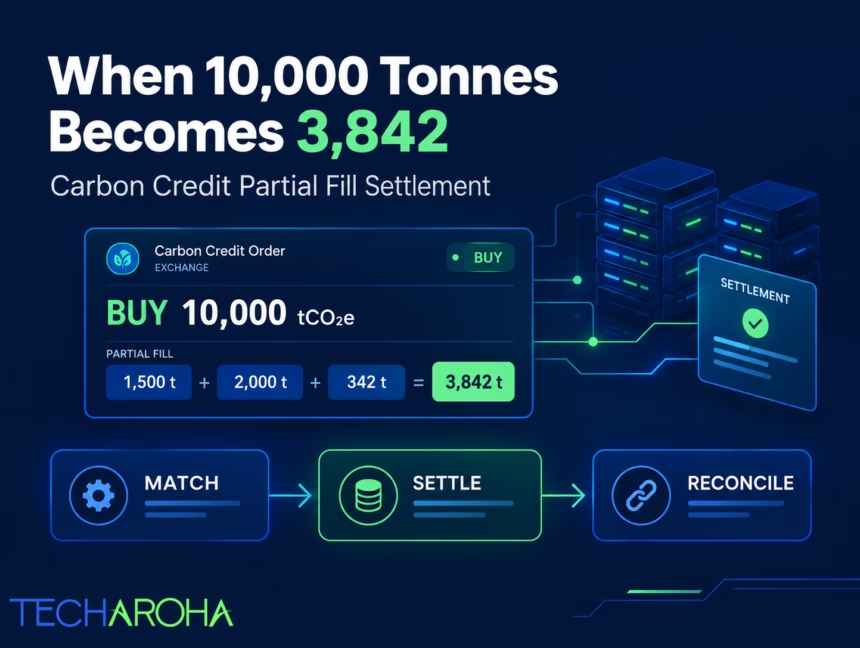
A carbon exchange can display a beautiful order book and still have fundamentally broken trading infrastructure. The real test begins when a buyer submits an order for 10,000 tonnes, but the matching engine can only execute 3,842 tonnes across multiple eligible sellers. What happens to the remaining 6,158 tonnes? More importantly: This is where carbon credit partial fill settlement becomes an architecture problem rather than a UI feature. Traditional exchange infrastructure already understands partial fills. Carbon markets make the problem harder because the underlying asset isn’t simply “10,000 units.” A carbon order can depend on vintage, methodology, geography, project, registry, authorization status, corresponding adjustment, removal/reduction classification, co-benefits, eligibility rules and available inventory.That means the matching engine cannot simply ask: “Does price match?” It needs to ask: “Does price match and does this exact inventory satisfy the buyer’s eligibility constraints at execution time?” And settlement has to preserve that decision. Why Partial Fills Are More Complicated in Carbon Markets Consider this order: Order Parameter Buyer Requirement Quantity 10,000 tCO₂e Maximum price $18/t Registry Approved registry Vintage 2022–2025 Methodology Removal Geography Eligible jurisdictions Eligibility Corporate procurement criteria Time-in-force IOC The order enters the exchange. The engine finds: But Seller D’s inventory subsequently fails an eligibility check. The executable quantity is therefore 3,840 tonnes, not 8,340. That single change creates several state transitions. Order state NEW → PARTIALLY_FILLED → CANCELLED/EXPIRED Inventory state AVAILABLE → RESERVED → TRADED → SETTLED Settlement state PENDING → PARTIALLY_SETTLED → SETTLED Registry state TRANSFER_REQUESTED → CONFIRMED / FAILED A production platform must maintain these states independently without allowing them to contradict one another. That is the core challenge behind carbon credit partial fill settlement. 1. Start With the Matching Engine, Not Settlement Settlement problems are frequently symptoms of weak execution architecture. A robust carbon exchange should separate at least these logical layers: The important architectural principle is that matching creates an execution commitment; settlement fulfils that commitment.Settlement should not independently decide what was traded. If the settlement service recalculates eligibility or price independently from the matching engine, the platform can create discrepancies between: That is precisely what an exchange operator wants to avoid. Read: The Authorization Wall: How Custom Carbon Exchanges Must Architect for Article 6 Corresponding Adjustments 2. Eligibility Must Be Part of Matching A common architecture mistake is to treat eligibility as a front-end filter. For example: “Show the buyer only CORSIA-eligible credits.” That is not enough. The eligibility decision needs to survive all the way into execution. Suppose a buyer wants 5,000 tonnes of eligible inventory. The matching engine finds three lots: Seller Available Price Eligibility Executable A 1,200 $14.80 Yes 1,200 B 2,000 $15.10 Yes 2,000 C 3,000 $15.40 No 0 The engine should not match 5,000 tonnes and “sort out eligibility later.” The correct result is: 3,200 tonnes executable + 1,800 tonnes residual. This distinction becomes especially important when eligibility can change because of: For institutional trading, eligibility should therefore be represented as a versioned execution condition, not simply a UI attribute. 3. Order Types Determine Partial-Fill Behaviour Not every order should behave the same way. A carbon exchange may support several order instructions depending on its market design. Order Type Partial Fill? Typical Behaviour Limit Yes Execute available eligible quantity and leave residual Market Usually yes Execute against eligible liquidity subject to protection rules IOC Yes Fill available quantity immediately; cancel residual FOK No Execute only if entire eligible quantity can be filled GTC Yes Leave residual active until filled/cancelled/expired GTD Yes Remain active until specified expiry Smart Order Yes Route across eligible liquidity sources For carbon credit partial fill settlement, this distinction matters because the residual order is not necessarily another settlement. The platform must clearly separate: Executed quantity from Remaining quantity For example: The settlement engine must never accidentally treat the original 10,000 tonnes as the settled amount. 4. Partial Fill Is an Execution Event, Not an Order Event This is a subtle but critical architecture decision. One order can generate multiple executions. For example: The order has therefore executed: 3,842 tonnes But the exchange has three separate execution records. Each execution should have its own immutable identifiers and economic details. At minimum: This event-level structure is what makes downstream reconciliation possible. 5. The Smart Order Router Has a Different Job A smart order router should not simply find the cheapest credit. It should find the best executable eligible liquidity according to the exchange’s routing policy. Imagine: The router can evaluate: This becomes particularly valuable when the exchange operates as an aggregation layer rather than a single order book. The router should also preserve execution provenance. If 10,000 tonnes are sourced through four venues, the platform needs to know exactly where every tonne originated. 6. The Hard Part: Carbon Credit Partial Fill Settlement This is where many marketplace architectures become fragile. Suppose: Buyer order = 10,000 tonnes The engine executes: Total: 3,842 tonnes Settlement should operate on the 3,842-tonne execution set, not the original order. A simplified flow looks like: The settlement orchestrator should maintain a state machine rather than a single Boolean such as: settled = true A more useful model is: That distinction becomes essential when registry APIs are asynchronous or unreliable. 7. Registry Confirmation Should Not Be Treated as a Synchronous Assumption Carbon exchanges often depend on external registry infrastructure. The exchange might successfully execute a trade, but the registry transfer could: Therefore: Trade execution ≠ registry settlement. The platform needs a durable settlement workflow. For example: The exact ordering can vary depending on custody and counterparty-risk design, but the state transitions must be explicit. 8. Idempotency Is Mandatory Imagine the registry confirms a transfer. Your webhook receives the confirmation. The service processes it. Then the same webhook arrives again. If the system simply says: “Transfer confirmed → add 1,500 tonnes” you have a serious accounting problem. Instead, settlement events need unique evidence identifiers. For example: The settlement processor should verify whether that evidence has already been consumed. Conceptually: This is one of the most important

Building a carbon exchange is not primarily a software decision. It is an ownership, liquidity, compliance, and time-to-market decision. Here is how founders and CTOs should actually choose between building, buying, or going white-label. You have the business model.You know who will supply the credits.You may already have project developers, corporate buyers, brokers, or investors interested.Then someone asks the uncomfortable question: “Are we building the exchange ourselves, buying existing software, or launching on a white-label platform?” That decision can determine how much control you have three years from now. Get it wrong, and you can end up with a platform that launches quickly but cannot support your compliance model, a custom system that consumes a year of capital before generating liquidity, or a white-label solution that looks like your exchange but behaves like someone else’s product. That is why the build vs buy carbon exchange decision should not be reduced to development cost. The real question is:Which implementation route gives your business the right combination of speed, control, compliance, economics and future ownership?There are three realistic routes: The right answer depends on what you are actually trying to own. Build vs Buy Carbon Exchange: Start With the Business Model, Not the Software A common mistake is starting with a feature checklist. “Does it have an order book?”“Does it support wallets?”“Does it have an admin dashboard?”“Can buyers purchase credits?” Those questions matter, but they come too late. A carbon exchange is not simply a website where tonnes are listed.Behind every transaction may be: The implementation route should therefore follow the business model and market structure. If your exchange is fundamentally different from existing platforms, customization becomes strategically important.If your model is conventional and speed is everything, buying may make sense.If you need your own brand and customer relationship without funding an entire exchange architecture from scratch, white-label can be the middle ground. The Three Carbon Exchange Routes Factor Custom Build Buy Existing Platform White-Label Initial speed Slowest Fast Fastest Upfront investment Highest Low–Medium Medium Customization Very High Limited Medium–High Brand ownership Full Depends on vendor Usually high IP ownership Negotiable/full Vendor-owned Usually vendor-owned core Registry integration Custom Depends on vendor Configurable Compliance logic Designed around your model Vendor constraints Depends on architecture Scalability Designed for your roadmap Product-dependent Depends on shared architecture Vendor dependency Lower High High Best for Strategic exchange operators Standard requirements Fast market entry But there is a more important distinction. You are not choosing between three software packages. You are choosing where your competitive advantage will live. Option 1: Build a Custom Carbon Exchange A custom build means the exchange is engineered around your requirements rather than forcing your requirements into somebody else’s product.This does not necessarily mean writing every component from zero.A competent development partner can use established engineering patterns, cloud infrastructure, security frameworks, payment infrastructure, and reusable components while custom-building the business-critical layers. Build makes sense when you need: The biggest advantage is control. You decide how credits are represented.You decide which attributes affect eligibility.You decide how orders are matched.You decide how settlement works.You decide which integrations become core infrastructure. That control becomes particularly valuable when the market evolves. A regulation changes.A registry changes its integration model.A new credit category becomes commercially important. Your buyer requires a new settlement mechanism. With a custom platform, those changes become engineering decisions rather than vendor negotiations. But a custom build has a serious disadvantage. Time. A serious exchange cannot be treated like a standard marketplace website. Architecture, security, testing, registry integrations, matching, settlement, and operational controls all take engineering effort. That means custom development is usually a poor choice for a company that simply wants to “test whether people will buy carbon credits.” It becomes much more attractive when the exchange itself is intended to become a long-term business asset. Option 2: Buy an Existing Carbon Exchange Platform Buying software is attractive because it appears to eliminate the hardest part of the problem. The vendor has already built: You configure it and launch. For a company with standard requirements, this can be perfectly reasonable. Buy when: But there is a question founders often forget to ask: What happens when your business becomes more successful than the software you bought? That is the real risk. A platform can be excellent today and still become restrictive tomorrow. Imagine that your exchange eventually needs: If the vendor cannot support those changes, your growth becomes constrained by someone else’s product roadmap. The hidden cost of buying The licence fee is only one part of the equation. You should evaluate: Licence + integration + customization + migration + vendor dependency + switching cost A cheap platform can become expensive if every meaningful change requires paid customization. Option 3: White-Label Carbon Exchange This is where the decision becomes more interesting. A white-label carbon exchange allows you to launch under your own brand while using an underlying platform infrastructure provided by another company. For a company that wants market presence quickly, this can be attractive.You can potentially get: without financing every component of the platform from scratch.The critical word, however, is architecture. Not every white-label solution is actually suitable for carbon markets. A generic crypto exchange with a new logo is not automatically a carbon exchange. Carbon credits have attributes that influence whether a transaction is valid. For example: A serious white-label architecture therefore needs more than a branded front end.It needs appropriate tenant isolation, configurable business rules, registry integrations, permissions, transaction controls, and compliance-aware workflows. Read our Article- What Does a Carbon Exchange Actually Cost to Build? A Module-by-Module Breakdown The Build vs Buy Carbon Exchange Decision Matrix Instead of asking which route is “best,” score each route against your actual requirements. Decision Factor Build Buy White-Label Budget sensitivity ★★ ★★★★★ ★★★★ Speed to launch ★★ ★★★★ ★★★★★ Product differentiation ★★★★★ ★★ ★★★ Platform control ★★★★★ ★★ ★★★ Compliance customization ★★★★★ ★★ ★★★★ Registry flexibility ★★★★★ ★★–★★★ ★★★ Long-term ownership ★★★★★ ★★ ★★★ Engineering independence ★★★★★ ★★ ★★★ MVP validation ★★★ ★★★★★ ★★★★★

Ask five carbon exchange founders what it costs to build their platform, and you’ll get five different numbers, none of which they fully trust. That’s not because nobody knows. It’s because most of the numbers floating around “$50k for an MVP,” “$2 million for an institutional-grade exchange” come from vendors quoting a category, not a scope. And scope is the entire game. We’ve architected and built live carbon market infrastructure, including Carbon Plant, an FSA-registered NFT-based carbon credit exchange, and Planet First Registry, the registry layer underneath it. So this isn’t a theoretical pricing exercise; it’s the same breakdown we walk actual founders through before they commit budget. This article exists for one reason: to give you a real, defensible carbon exchange development cost framework, module by module, complexity tier by complexity tier, before you sign with anyone. If You’re Reading This, You’re Probably Asking One of These Questions If any of those sound familiar, keep reading. If you’re purely comparison-shopping template exchanges with no compliance requirements, this probably isn’t the right guide for you. Why Carbon Exchange Development Cost Estimates Vary So Wildly? Most published numbers ignore the variable that actually moves the budget: which modules you’re building, and how deep each one needs to go. A carbon exchange isn’t one product. It’s a stack of independent systems that happen to share a brand: A vendor quoting “$60k” is very likely quoting a shell: a UI, a basic order form, and a single database, with no real matching logic, no registry sync, and no compliance layer. A vendor quoting “$600k” may be pricing a multi-jurisdiction, multi-registry institutional platform with dedicated matching workers per tenant. Neither number is wrong. They’re just answering different questions. Carbon Exchange Development Cost by Module Here’s the breakdown we actually use in scoping conversations, organized by the components that make up a functioning exchange. Module What It Covers Relative Cost Weight Matching Engine Order book, trade execution, partial fills, fractional quantities High Registry Integration Verra, Gold Standard, Puro, ACCU, or custom registry sync High Credit Tokenization NFT or ledger-based representation of credits, lifecycle states Medium–High KYC/KYB & Compliance Identity verification, jurisdiction-aware onboarding rules Medium Fee Engine & Settlement Tiered fees, multi-currency settlement, reconciliation Medium Wallet & Custody Credit and fiat/stablecoin custody, transfer, security Medium Multi-Tenant/White-Label Layer Tenant isolation, per-tenant branding and config High (if included) Reporting & Audit Trails Compliance-ready trade history, exportable reports Low–Medium A single-registry, single-currency exchange with basic KYC sits at the lower end of a build. Add multi-registry connectivity, multi-tenancy, and jurisdiction-specific compliance rulesets (CCTS, Article 6, CORSIA-domestic, EU ETS), and the same “exchange” becomes a materially larger engineering project. Read- White-Label Carbon Trading Platform: Launch in Weeks Now. The Three Factors That Actually Drive Carbon Exchange Development Cost 1. Complexity Tier Every build falls into one of three tiers: Every tier up adds engineering months, not just feature checkboxes. This is the single biggest driver of carbon exchange development cost, and the one most quotes gloss over. 2. Jurisdiction and Regulatory Scope A platform serving one compliance regime is a fundamentally different build than one serving five. Article 6.4 eligibility logic, CCTS-specific reporting, CBAM-adjacent import calculations, and CORSIA-domestic rules don’t share a codebase cleanly. Each jurisdiction you support adds configuration, testing, and often legal review to the timeline. 3. Integration Depth How many registries does the platform need to talk to? Does it need to reconcile against Verra and Gold Standard and a national registry simultaneously? Does settlement need to support fiat, stablecoin, and direct bank transfer? Every integration is a dependency you don’t control, and dependencies you don’t control take longer to harden than the code you write yourself. Build vs. White-Label: What Actually Changes the Number A properly engineered white-label carbon exchange built on genuine multi-tenant architecture with tenant-isolated data and per-tenant registry routing compresses timeline and cost dramatically compared to a from-scratch build, because the matching engine, fee logic, and compliance framework already exist. You’re paying primarily for tenant onboarding, branding, and jurisdiction-specific configuration, not for rebuilding the core exchange. A from-scratch build makes sense when your compliance requirements, tenant model, or credit types don’t fit any existing architecture, or when owning the entire codebase is a strategic requirement for your investors or regulators. Neither path is inherently cheaper in all cases. It depends entirely on how far your requirements sit from a standard exchange pattern. What Most Founders Get Wrong When Budgeting A Simple Framework for Getting an Accurate Number Before you ask any vendor for a quote, have answers ready for: Any vendor who can give you a real carbon exchange development cost estimate without asking these questions first is quoting a template, not your platform. Where This Leaves You The honest answer to “how much does it cost to build a carbon exchange” is: it depends on which of the eight modules above you actually need, at what depth, across how many jurisdictions. That’s not a dodge; it’s the actual shape of the decision. What we can do is take your specific scope the registries, the jurisdictions, the tenant model, the compliance depth and turn it into a preliminary cost estimate you can actually take to a board, an investor, or your own internal budget review. Get a Preliminary Cost Estimate for your carbon exchange build, scoped against your actual registries, jurisdictions, and compliance requirements not a generic template. Want to sanity-check the number yourself first? We’re building a Carbon Platform Cost Calculator that maps your requirements to a realistic range before you ever get on a call. (Related reading: our guide to building a Carbon Credit Exchange Platform, our white-label carbon trading platform breakdown, and our carbon registry interoperability piece.)