

If you’ve searched for anything about AI implementation for small businesses, you’ve probably already hit the same wall everyone else does: a hundred articles telling you AI is “transforming” every industry, and almost none telling you what to actually do on a Monday morning with a real budget and a real team.
This guide is the second kind. It’s written for owners and operators who don’t need to be convinced AI matters you already know that. What you need is a clear-eyed look at how AI implementation for small business actually works in practice: what it costs, what it takes, where it fails, and how to tell a genuine implementation partner from someone reselling you a chatbot with a markup.
Most of the AI advice online is written for companies with a data science team, a six-figure software budget, and a CIO whose entire job is evaluating vendors. That’s not your situation, and pretending otherwise is why so much AI advice feels useless to small business owners.

Doing this well has to work under real constraints: a lean team, a tight budget, no in-house engineering department, and zero tolerance for a six-month project that never ships. That’s not a lesser version of enterprise AI; it’s a different discipline entirely, and it rewards a different kind of partner.
The businesses that get real value from it aren’t the ones with the biggest budgets. They’re the ones who picked one specific, painful bottleneck and fixed it completely, instead of trying to “adopt AI” as a company-wide initiative with no clear owner.
Before you spend a rupee or a dollar, it helps to know where this tends to pay off fastest. In our experience building real systems for real clients, these are the areas that consistently produce measurable returns:
1. Document and data processing. If your team spends hours a week manually reading, summarizing, or entering data from invoices, reports, or contracts, this is usually the single highest-ROI place to start. A system here can cut hours of manual review down to minutes, with a human checking the output instead of doing the work from scratch.
2. Customer support and FAQs. A common early win in AI implementation for small businesses. Not a chatbot that frustrates customers with canned answers; a system trained on your actual product, policies, and past support tickets that can resolve the 60–70% of questions that are genuinely repetitive, and hand off the rest to a human cleanly.
3. Internal workflow automation. HR onboarding, CRM data entry, scheduling, approval chains the unglamorous internal processes that eat staff hours without anyone noticing until you add it up. This is often where the least visible work has the highest cumulative impact.
4. Content and marketing operations. Drafting first passes of product descriptions, support documentation, or marketing copy — with a human editor still in the loop — can meaningfully reduce the time your team spends on repetitive writing tasks.
5. Sales and lead qualification. Automatically scoring and routing inbound leads based on actual buying signals, instead of a sales rep manually triaging every form submission.
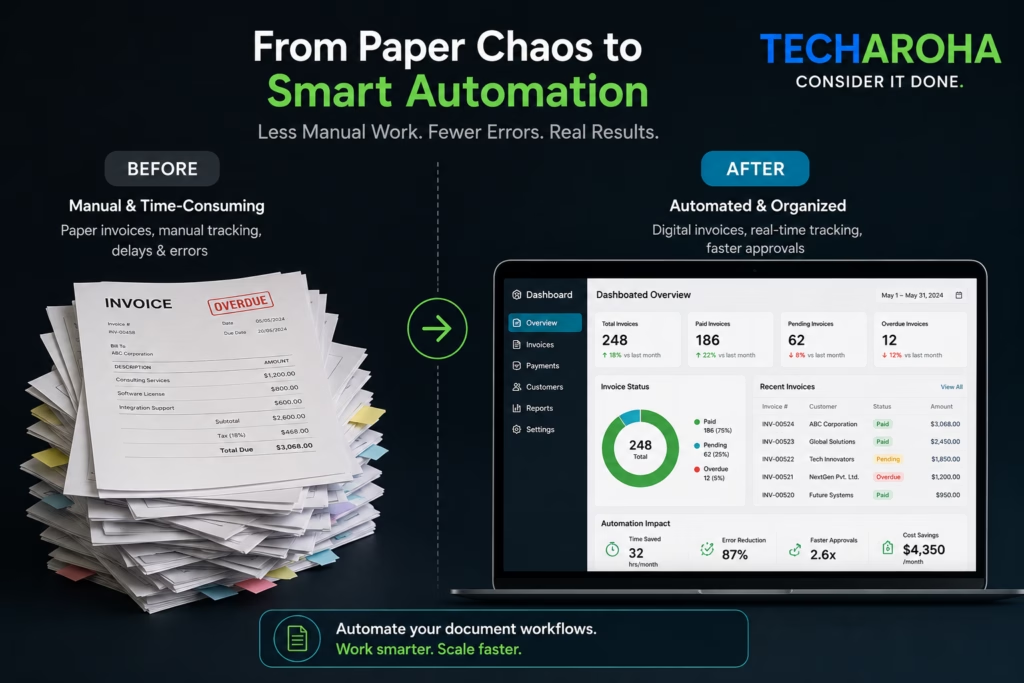
Notice what all five have in common: they’re specific, measurable, and tied to a real bottleneck. That’s the pattern behind every successful project and the opposite of “let’s add AI because our competitor did.”
This is the question everyone wants answered first, and almost nobody answers honestly. Costs vary enormously depending on scope, but here’s a realistic range based on what we see across real engagements:
The honest advice here: don’t start by shopping for a tool. Start by defining the specific bottleneck you’re solving and what “fixed” looks like in numbers — hours saved, errors reduced, response time improved. The cost conversation only makes sense once you know exactly what you’re paying to fix.
We’ve watched enough of these projects, both the ones that worked and the ones that quietly died, to know the pattern behind the failures.
Not every AI vendor is built for small business needs, and the difference shows up long before the contract is signed.
A genuine partner starts by asking what’s currently slow, manual, or error-prone in your business — and won’t move forward until you can both answer that clearly. They’ll tell you when AI isn’t the right fix, even if that costs them the sale. They build around your actual data and workflow instead of forcing you into a generic template. And they stay accountable after launch, because a system that isn’t maintained doesn’t stay useful for long.
This is the exact philosophy behind how we approach this work at Techaroha. We’re not an AI enthusiast agency chasing every new model release — we’re implementers. We’ve built real, production AI systems for organizations ranging from a global bank’s document analysis workflow to HR and CRM automation bots that run inside live operations every day. The same discipline applies whether the client is an enterprise or a growing small business: define the bottleneck, build the system that fixes it, measure whether it worked.
Before you talk to any vendor, answer these four questions honestly:
If you can answer all four clearly, you’re ready to start evaluating partners. If you can’t, that’s not a reason to abandon the idea — it’s a sign you need the strategy conversation before the build conversation, and a good partner will tell you that upfront instead of taking your money for a project that was never going to succeed.
AI implementation for small business isn’t about keeping up with a trend — it’s about fixing something specific, measurable, and genuinely painful inside your business, with a partner who’s actually shipped production systems before, not just demos.
If you already know the bottleneck you want to fix, that’s the best possible starting point for a conversation. If you’re still not sure, that’s worth talking through too — the strategy conversation costs nothing, and it’s the difference between a project that works and one that quietly disappears in six months.
Techaroha implements AI inside real business workflows and builds custom software accelerated by AI-assisted development — for startups, enterprises, and everything in between. If you’re evaluating AI implementation for small business, talk to us about what’s actually worth building. Consider it done.