
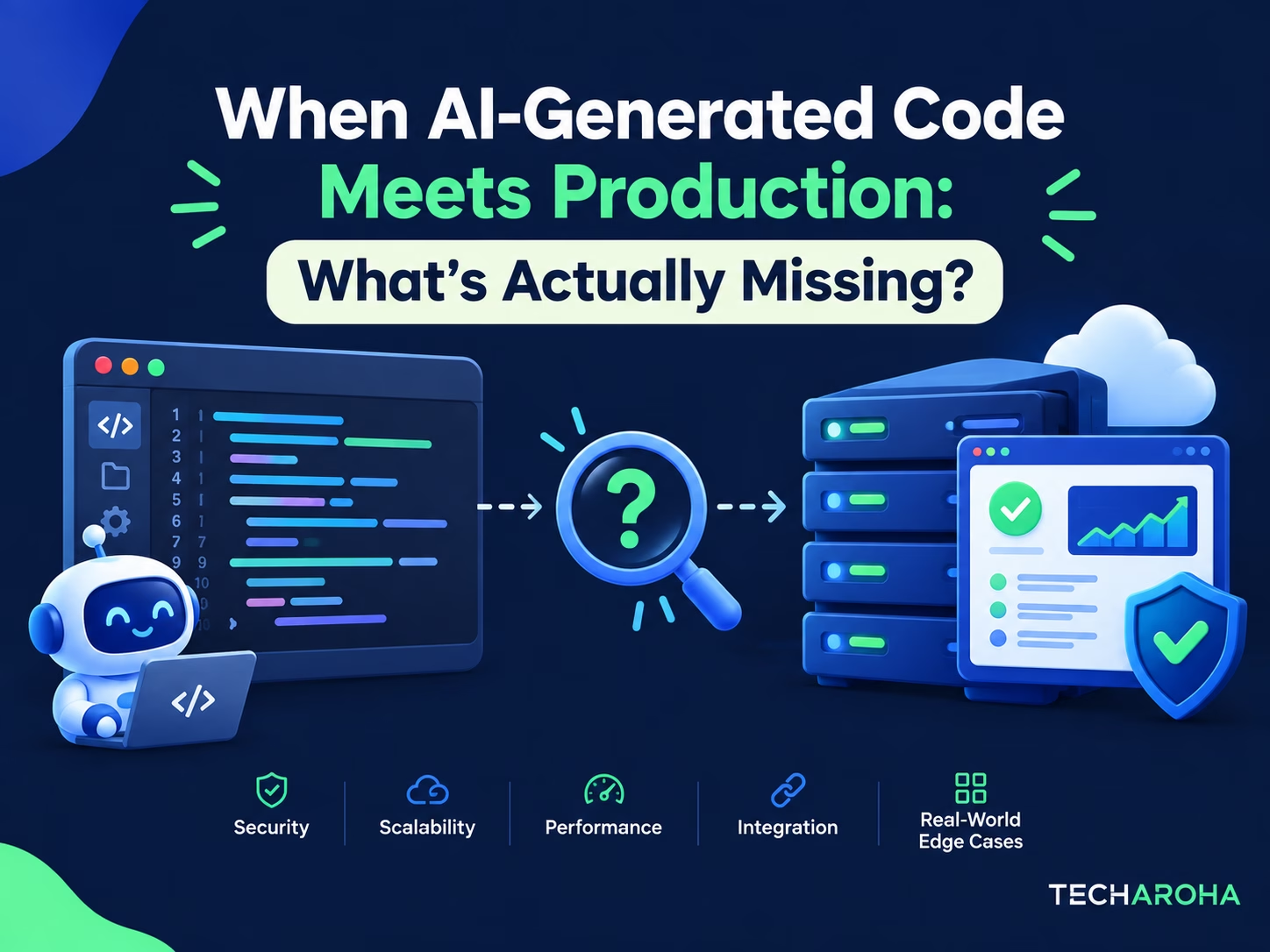
Every founder who has watched Copilot autocomplete a working API endpoint in ninety seconds has had the same thought: “Why do we even need engineers anymore?” It’s the first question anyone comparing AI-generated code vs production-ready software eventually has to answer honestly.
Then that endpoint goes live. A user sends a slightly malformed request. The service crashes, drags two other services down with it, and nobody has logs to explain why. That gap between code that runs and software that survives real users, real traffic, and real attackers is the entire subject of this blog. It is also the gap most teams discover far too late.
This is the honest, technical breakdown of AI-generated code vs production-ready software: what AI coding tools genuinely deliver, where they stop, and what has to happen between “it compiles” and “it’s live.”
AI coding assistants ChatGPT, GitHub Copilot, Claude, Cursor, and a growing list of autonomous coding agents have changed how fast a first version of software can exist. A working prototype that once took three weeks now takes three days. That speed is real, and it is valuable.
But speed at the generation stage does not equal readiness at the deployment stage. The conversation around AI-generated code vs production-ready software keeps surfacing because founders are shipping AI output directly to users, then discovering the failure modes only after something breaks: a data leak, a downtime spike during a funding demo, or a customer complaint that no one can trace back to a root cause.
Understanding AI-generated code vs production-ready software is not an academic exercise. It is the difference between a business that scales and one that spends its first eighteen months firefighting.
Read: The AI MVP Trap: Built Fast, Owned by Nobody
Before breaking down what’s missing, it’s worth being precise about what AI tools do well, because the honest answer is: a lot.
None of this is trivial. Used well, AI-assisted development can cut initial build time by 30–50% on the kind of features that don’t require deep architectural judgment. The problem starts when teams assume that because the code runs locally, the job is done.

Here is the distinction in one sentence: AI-generated code solves the problem in front of it; production-ready software survives the problems it hasn’t seen yet.
| Dimension | AI-Generated Code | Production-Ready Software |
|---|---|---|
| Correctness | Works for the tested case | Works across edge cases, malformed input, and concurrent load |
| Security | Rarely validates trust boundaries | Threat-modeled, input-sanitized, auth-hardened |
| Architecture | Optimized for “does it work” | Optimized for scale, maintainability, and failure isolation |
| Testing | Often untested or self-tested by the same AI | Covered by unit, integration, and regression suites |
| Observability | No logging or monitoring by default | Full logging, alerting, and tracing built in |
| Documentation | Comments only | Architecture docs, runbooks, API specs |
| Ownership | No one accountable for long-term behavior | Engineering team owns uptime, fixes, and evolution |
This table is the practical summary of AI-generated code vs production-ready software, and every row on the right side is a step most AI-only workflows skip entirely.
AI tools generate code at the function or file level. They rarely reason about how that code fits into a larger system — how services communicate, where state lives, what happens when one component fails. A senior engineer reviewing AI output for architecture fit is the single highest-leverage step in the entire AI-generated code vs production-ready software conversation, because a wrong architectural decision made on day one is expensive to unwind on day two hundred.

AI-generated code frequently ships with the exact vulnerabilities security teams have spent a decade eliminating: SQL injection points, missing input sanitization, hardcoded secrets, weak session handling, and overly permissive API access. An AI model optimizes for “this satisfies the prompt,” not “this resists an attacker.” Security testing — static analysis, dependency scanning, and manual review of trust boundaries — is non-negotiable before anything touches production, especially in fintech, healthcare, or any system handling customer data.
Code an AI wrote and tested against its own assumptions is not the same as code tested against your actual users. Unit tests, integration tests, and regression suites catch the failures that only appear when real data, real concurrency, and real third-party APIs enter the picture. Without this layer, every new feature risks silently breaking an old one.
AI-generated code often treats the database as an afterthought — a place to store and retrieve values, not a system with constraints, relationships, and long-term integrity requirements. Schema migrations, backup strategy, and data validation rules are where AI output is weakest, and where mistakes are hardest to reverse.
A working script on a developer’s laptop is not a deployment process. Production-ready software needs a CI/CD pipeline that runs tests automatically, blocks bad builds, and deploys with rollback capability. AI tools don’t build this — someone has to design it around the code, not after an incident forces the issue.
AI-generated code has no concept of your expected traffic, your budget, or your growth curve. It won’t tell you that your architecture works fine for 500 users and falls over at 5,000. Infrastructure decisions — load balancing, caching, database indexing, horizontal scaling — require someone thinking two years ahead, not one prompt ahead.
When something breaks in production, the question isn’t “can we fix it,” it’s “how fast can we see it.” AI-generated code almost never includes logging, error tracking, alerting, or tracing. Without observability, every incident becomes a guessing game, and every guessing game costs uptime and customer trust.
Very little software is built from a blank slate. Most business systems need to talk to a CRM, a payment gateway, a legacy database, or a third-party API with its own quirks and rate limits. AI tools generate code assuming an idealized environment. Bridging that code into a messy, real-world stack is where a large share of actual engineering effort goes — and where AI assistance contributes the least.
Inline comments explain what a function does. They don’t explain why the system was built a certain way, what trade-offs were made, or how a new engineer should approach the codebase six months from now. Production systems need architecture documentation, API specifications, and runbooks — the operational knowledge that keeps a system maintainable after the original builder has moved on.
An AI model doesn’t know your compliance requirements, your customer commitments, or the specific way your business logic needs to behave under edge-case conditions. Human code review — by engineers who understand both the codebase and the business it serves — catches the mistakes that no amount of automated testing will flag, because those mistakes are about intent, not syntax.
Software doesn’t stop needing attention once it ships. Dependencies go out of date. Traffic patterns shift. New features strain old assumptions. AI-generated code has no owner by default — production-ready software needs a team accountable for keeping it running, patched, and evolving as the business changes.
The realistic path from an AI prompt to a system real users can depend on looks like this:
Requirements → Specification → AI Code Generation → Code Review → Architecture Validation → Security Testing → Automated Testing → Integration Testing → CI/CD → Infrastructure → Monitoring & Observability → Production → Maintenance
Notice that “AI Code Generation” is one box out of thirteen. That ratio is the clearest way to visualize AI-generated code vs production-ready software: generation is fast and increasingly commoditized, but the surrounding process — the part that determines whether software actually survives contact with users — hasn’t gotten any shorter.
The most common mistake isn’t using AI to write code. It’s assuming that because the AI-generated code passed a quick manual test, it’s ready to carry real business risk. A few patterns show up again and again:
Every one of these is preventable. None of them are caught by writing better prompts. They’re caught by the review, testing, and architecture steps that sit between AI-generated code and production-ready software.
This isn’t a warning aimed only at non-technical founders. CTOs and technical leads at growing startups face the same pressure — ship fast, ship now, worry about the rest later. The businesses that get this right treat AI coding tools as an accelerator inside a disciplined engineering process, not a replacement for one. That’s the difference between AI-generated code vs production-ready software done well: AI speeds up the parts that benefit from speed, and experienced engineers own the parts that determine whether the system holds up.
Techaroha has spent over a decade building production systems for institutional clients — including AI-powered document analysis for Mizuho Bank and a biometric payment solution for SafeXpay and the lesson has stayed consistent across every technology era: speed and reliability aren’t opposites, they’re sequential. Use AI where it genuinely accelerates development. Then let senior engineers validate the architecture, security, testing, and observability layers that decide whether the software survives production.
That’s the practical resolution to AI-generated code vs production-ready software not choosing one over the other, but knowing exactly where the handoff between them needs to happen.
If you already have AI-generated code sitting in a repository, wondering whether it’s ready to carry real traffic and real customers, that question has a concrete answer. It just needs a second set of eyes that has shipped production systems before.
Have AI-generated code already? Let our engineers review it before you put it into production.