

Most pitch decks for a new carbon exchange lead with the market size slide. $1.26 trillion by some projections, tripling by 2030 in others. What they rarely show is the one artifact that actually determines whether the business survives its first eighteen months: the fee schedule, and more specifically, the backend system that enforces it on every single trade, every millisecond, without drift.
That gap is where most carbon exchange builds quietly fail. Founders raise on a market-size story, spend the seed round on a matching engine and a KYC flow, and only discover in month nine that their fee logic can’t handle a partial fill, a fractional tokenized credit, or a multi-currency settlement without a finance team manually reconciling spreadsheets every week. By then, the investors asking for unit economics aren’t hearing “we have a scalable revenue architecture.” They’re hearing “we’re still figuring out how we get paid.”
This post is written for the people who ask the harder question before the money moves: founders raising a seed or Series A round for a carbon exchange, private equity firms doing technical diligence on a carbon fintech target, and corporate venture builders deciding whether to spin up an internal trading desk or acquire one. We’re not describing a platform we’ve shipped and are trying to sell you. We’re walking through how a serious engineering team architects carbon trading platform monetization from the backend up, so you have a real benchmark for whatever build, buy, or diligence conversation comes next.
Investors and acquirers evaluating carbon trading platform monetization rarely start with the pitch deck’s revenue slide anymore. They start by asking to see the system that actually collects the money.
Every category of digital exchange, from equities to crypto to carbon, eventually converges on the same lesson: the revenue model is not a business-side afterthought bolted onto a working matching engine. It is core infrastructure, and it has to be designed alongside the order book, not after it ships.
Here’s why that sequencing matters so much for carbon specifically:
Carbon trading platform monetization done well is a foundational design decision, not a monetization plugin you add once traffic shows up. That’s the mindset shift this post is built around.
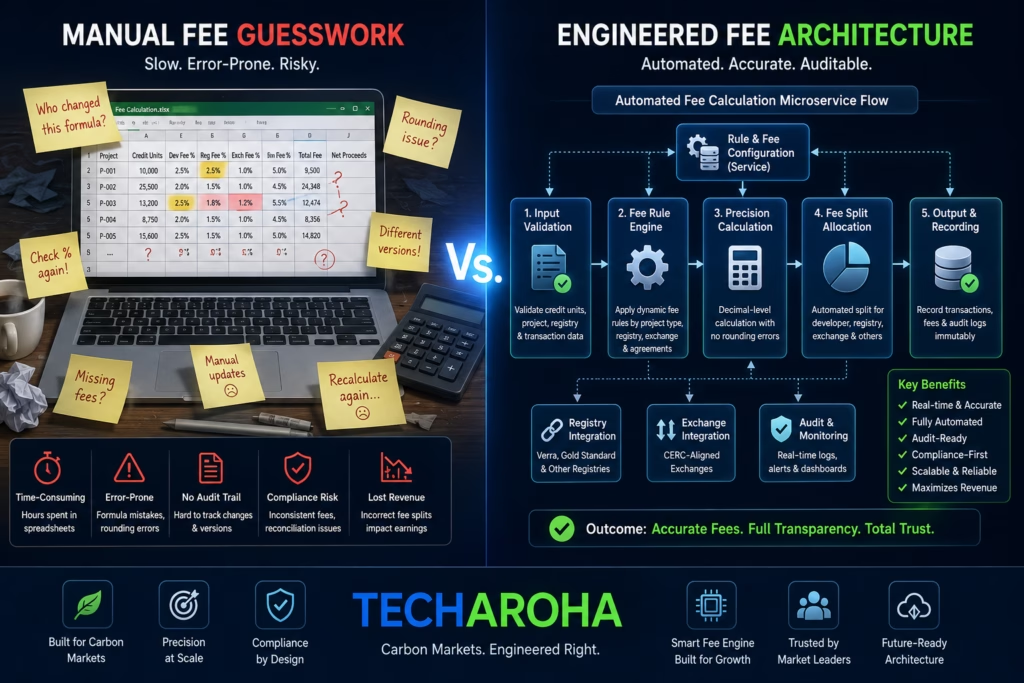
Most existing coverage of carbon exchange economics does a reasonable job cataloguing the revenue streams available to a platform operator. It’s worth naming them plainly, because founders and PE diligence teams should know the full menu before anyone talks architecture:
| Revenue Stream | What It Charges | Typical Buyer |
|---|---|---|
| Taker/maker transaction fees | A percentage of trade value, often tiered by volume or order type | All traders, weighted toward active desks |
| Project listing fees | A flat or percentage fee for onboarding a new credit project to the registry | Project developers, aggregators |
| API monetization for Scope 3 reporting | Subscription or usage-based access to structured emissions data | Corporates, ESG software vendors |
| Premium market data feeds | Recurring subscription for real-time pricing, order book depth, historical data | Institutional funds, brokers, analysts |
| Custody and settlement fees | A charge for holding or transferring credits on behalf of a client | Compliance buyers, fund managers |
That list is genuinely useful as a menu. What it doesn’t answer, and what almost nobody covers, is the harder engineering question underneath it: how does a platform actually enforce five overlapping fee types on the same trade, at the exact millisecond of matching, without one calculation corrupting another or introducing rounding drift across millions of fractional-quantity trades?
That’s the layer we want to walk through, because it’s the layer that determines whether carbon trading platform monetization is a real, auditable revenue architecture or a set of business assumptions nobody has actually tested against production trade volume.
Picture a single trade: a buyer purchases 847.336 tonnes of a removal credit at a matched price. The platform takes a 1.5% platform cut. A dynamic clearing fee of 0.5% applies on top, adjusted slightly based on counterparty risk tier. Both fees need to be calculated, deducted, logged, and reconciled – all within the same matching event, without ever producing a number that doesn’t add back up to the penny.
That’s the job of what we’d call the Fee Engine Microservice: a dedicated, isolated service that sits directly alongside the matching engine, not buried inside it, and not bolted on afterward as a reporting layer.
A matching engine’s only job is speed: find the best counterparty and execute the trade with minimal latency. The moment you start embedding tiered percentage math, counterparty risk lookups, and multi-currency conversion logic directly into that hot path, you slow down the one component of the platform where milliseconds are the whole product.
Separating the two means:
This is the part that separates a platform built by people who understand carbon trading platform monetization at the engineering level from one that will quietly bleed revenue for years.
The core issue: if you calculate 1.5% of 847.336 tonnes and then separately calculate 0.5% on the same base, standard floating-point arithmetic will produce two numbers that, when added back to the trade total, don’t reconcile perfectly. Multiply that tiny drift across millions of trades a year, and a platform can lose real revenue to accumulated rounding error, or worse, generate a settlement discrepancy that a compliance auditor flags during a review.
A production-grade Fee Engine Microservice addresses this with a few concrete disciplines:
The trickiest technical requirement isn’t the math itself – it’s the timing. Multi-tier fees have to be computed and locked at the exact moment of match, not recalculated later against a price that may have already moved.
A workable sequence looks like this:
Get that sequence wrong, and a platform either double-charges counterparties during high-volume periods or silently underrecovers revenue in a way that only shows up months later during a financial audit exactly the kind of finding that kills a Series A term sheet or collapses a valuation during PE diligence.

Once the Fee Engine Microservice is solid, the six revenue streams from the earlier table stop being a slide of bullet points and start being independently switchable modules feeding the same auditable ledger:
The point isn’t that every exchange needs all five running from day one. It’s that carbon trading platform monetization designed this way lets a founder or operator turn revenue streams on incrementally, backed by a fee engine that already knows how to handle them correctly, instead of retrofitting decimal-precision logic into a system that was never built to carry it.
It’s worth being direct about the downside, because “we’ll add proper fee architecture after we have traction” is a decision, not a neutral default:
For anyone evaluating whether to fund, acquire, or build a carbon exchange, a short list of technical questions tends to surface exactly how mature the platform’s revenue architecture really is:
A team that can answer all five with specifics, not reassurances, has almost certainly thought about carbon trading platform monetization as core infrastructure rather than a business-side afterthought, and that’s the team worth funding, acquiring, or partnering with.
Before wrapping up, it helps to anchor carbon trading platform monetization against the specific engineering discipline each revenue stream demands:
Treat that pairing as the real checklist. A revenue model without the matching engineering discipline behind it is a projection, not an architecture.
None of this is a pitch for a specific product. It’s a working blueprint for what a technically credible carbon trading platform monetization architecture actually has to include before revenue projections in a pitch deck mean anything to an engineer reading the fine print.
At Techaroha, we work with carbon exchange founders, financial institutions, and corporate venture teams on exactly this layer of the build: architecting the fee, settlement, and reconciliation systems that sit underneath a trading platform, whether that’s a new exchange from scratch or a revenue-architecture retrofit on an existing one. If your team is evaluating a build, preparing for technical diligence, or trying to figure out why your fee reconciliation doesn’t quite add up, that’s a conversation worth having before the next funding milestone, not after.