

On July 17, the European Commission tabled its EU ETS reform package for the post-2030 period, and buried inside the benchmark language is a structural change that most exchange operators have not fully priced into their systems. From 2031, free allocation of industrial carbon allowances becomes conditional: 80% of each five-year tranche is released against a verified decarbonisation investment plan, and the remaining 20% only lands after a company demonstrates the emissions reductions it promised. Operators who relocate outside the EU have to hand allowances back. This is no longer a static commodity credited to an account once a year. It is a unit whose validity is contingent on a corporate compliance state that can change mid-cycle.
For anyone running or building an EU ETS conditional allowance trading platform, that single design change reaches all the way down into the matching engine. A share of an allowance pool is no longer fungible with another share just because the price and vintage match. Its underlying eligibility now depends on whether the counterparty who received it has met an investment condition the exchange itself has no native way of tracking. This post lays out why an EU ETS conditional allowance trading platform has to separate transaction matching from regulatory validation, how a rules-engine microservice closes that gap, and why exchange founders and CTOs who ignore this now will be retrofitting under regulatory pressure in 2031.
Under the current ETS design, free allocation is a relatively binary event. An installation qualifies, receives its allocation, and that allocation behaves like any other EUA the moment it lands in the registry account. Buyers on secondary markets have never needed to ask deeper questions about how a counterparty’s allowance arrived in their wallet, because the compliance work was front-loaded and finished before the unit ever reached a trading venue.
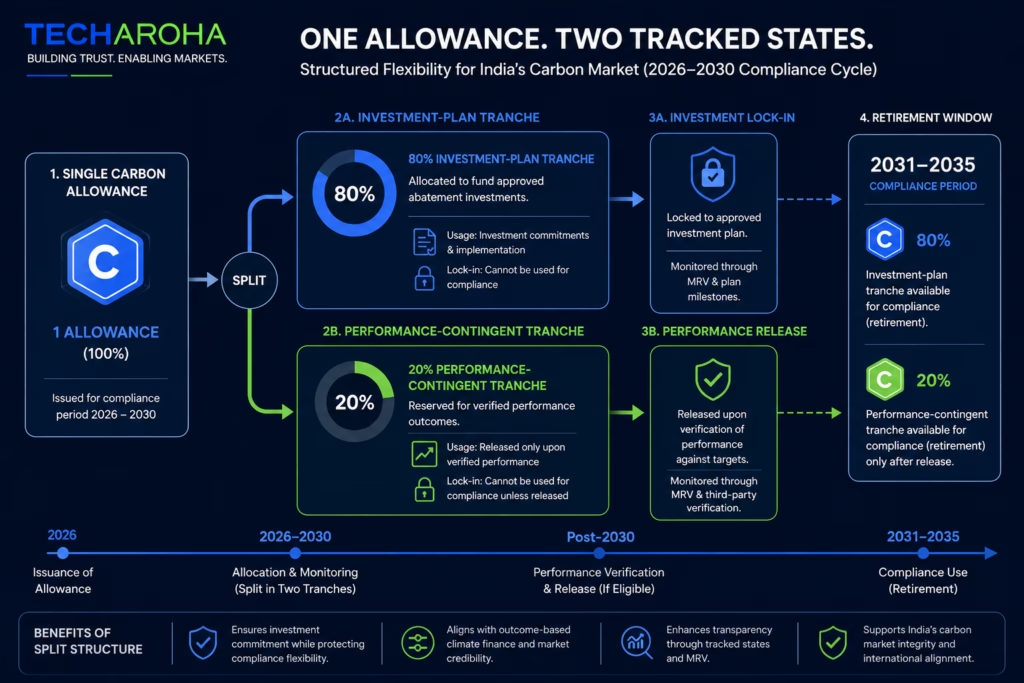
The post-2030 framework breaks that assumption in two ways. First, allocation itself is staged and reversible in a way it has never been before: 80% up front against a plan, 20% held back pending verified performance. Second, the Commission has attached real teeth to non-compliance, including clawback exposure for operators that relocate or fail to execute their investment plans. That means a unit that was perfectly valid at issuance can become subject to a freeze, a clawback claim, or a compliance dispute later in its life, and none of that history is visible in a simple price-and-volume order book.
An EU ETS conditional allowance trading platform that treats every allowance as an identical, interchangeable unit is structurally blind to this. It will happily clear a trade between a buyer who needs guaranteed compliance-grade inventory and a seller whose allocation is provisionally valid, pending a 2033 verification the exchange has no visibility into. That is not a hypothetical edge case. It is the default behavior of any matching engine built purely around price and volume, and it is exactly the kind of operational gap regulators, auditors, and institutional counterparties will start asking pointed questions about well before the 2031 rules take effect.
Most carbon exchange infrastructure inherited its core matching logic from equities and commodities markets, where a unit’s eligibility is settled long before it reaches the order book. That inheritance is a liability here. A conventional Central Limit Order Book asks two questions before it clears a trade: does the price cross, and is there enough volume. Neither question touches the thing that actually determines whether a post-2030 allowance is safe to transact: the real-world compliance status of the entity that originally received it.
Bolting a compliance check onto the front end, as a filter a trader can bypass through a direct API call or an internal override, does not solve the problem. It just moves the failure point somewhere less visible. If the validation logic lives in the UI layer instead of the settlement layer, any institutional desk connecting through FIX or a raw API integration skips it entirely. This is the same category of mistake we flagged in our earlier work on carbon smart order routing: compliance-relevant state has to be enforced where the trade actually settles, not wherever happens to be convenient to build first.
The correct framing for an EU ETS conditional allowance trading platform is this: the matching engine’s job is price discovery and execution speed. It should never also be the system of record for whether a specific allowance is currently eligible to trade. Those are two different concerns, owned by two different services, and conflating them is what creates the operational risk that keeps compliance officers up at night.
The fix is architectural, not cosmetic. An EU ETS conditional allowance trading platform needs a dedicated rules-engine microservice sitting between order placement and clearing, with its own data model, its own API contract, and its own audit trail, entirely separate from the core matching engine.
Here is how that separation actually works in practice on an EU ETS conditional allowance trading platform.
The matching engine keeps doing what it does best: ingesting orders, applying price-time priority, and finding crossing trades on the CLOB. It should have no awareness of a counterparty’s investment plan status, and that is by design; you do not want compliance logic recompiled and redeployed every time a rule changes, which is exactly what happens when eligibility checks are hardcoded into core trading infrastructure.
The rules-engine microservice sits alongside it, and every order that reaches the point of matching gets routed through a real-time eligibility check first. That check pulls corporate compliance data through API hooks connected to whatever data source is authoritative for a given allowance’s status: a registry feed, an internal compliance database populated by the operator’s regulatory filings, or a verification service tracking Investment Booster and Industrial Decarbonisation Bank disbursement milestones. The rules engine evaluates the order against a structured eligibility schema: plan-approval status, tranche disbursement stage, clawback flags, relocation flags, and returns a simple pass, hold, or reject before the order is allowed to complete a match.

This is not a one-time gate. Because allocation status under the post-2030 rules can change mid-cycle, a company’s 20% performance tranche can be withheld, a clawback can be triggered, and an EU ETS conditional allowance trading platform built this way has to support real-time revalidation, not just a check performed once when the allowance was first credited. A unit that was eligible at 9 am can become provisionally frozen at 2 pm if new compliance data lands, and the rules engine has to be able to place a hold on that inventory across every open order referencing it, not just block new trades going forward.
Building it as a microservice, rather than a module baked into the exchange’s core codebase, buys three things that matter here specifically. It lets the compliance logic change independently of the trading engine, which matters enormously given how often the Commission is expected to issue implementing regulations and guidance through the 2030s. It creates a clean, isolated audit trail for every eligibility check, every hold, every override, timestamped and queryable on its own, which is precisely the kind of evidence a regulator or an institutional counterparty’s due diligence team will ask for. And it lets an EU ETS conditional allowance trading platform swap or upgrade its compliance data sources over time, as better registry integrations and verification services come online, without touching the part of the system that actually needs to stay fast and stable: order matching.
A rules engine is only as good as the data it can pull, and this is where a lot of exchange projects underestimate the integration work. At minimum, an eligibility check for a post-2030 allowance needs to resolve: which tranche of the five-year allocation cycle the unit belongs to, whether the 80% up-front portion or the 20% performance-contingent portion; the current status of the underlying investment plan, including any conditional approval or revision flags; relocation and clawback exposure tied to the originating operator; and jurisdictional flags where a unit is entangled with CBAM phase-out schedules or cross-scheme eligibility questions.
None of this lives inside a typical exchange today, which is exactly the gap an EU ETS conditional allowance trading platform is built to close. It has to be pulled, normalized, and cached from external sources through a well-defined API layer, with sensible fallback behavior when a source is temporarily unavailable because an EU ETS conditional allowance trading platform that halts all trading every time a registry API times out will lose institutional flow just as fast as one that ignores compliance risk entirely. Getting this balance right, between conservative risk handling and operational uptime, is a genuine engineering problem, not a checkbox.
Institutional trading desks and ESG-mandated fund managers are not going to connect serious capital to a venue that cannot answer a basic question: is this specific unit currently valid to hold against my compliance obligation. Once the post-2030 rules are live, that question stops being theoretical. A compliance officer doing due diligence on a new exchange will ask exactly how allowance eligibility is checked, how often, and what happens when a unit’s status changes after a trade has already cleared.
An EU ETS conditional allowance trading platform that can answer those questions with a clear architecture diagram, a documented API contract for its rules engine, and a queryable audit trail is speaking the language an institutional compliance team already understands. One that answers with “our matching engine checks price and volume” is not going to close that account. This is the difference between a generic trading software build and enterprise-grade market infrastructure, and it is the difference that decides which exchanges actually capture post-2030 volume.
We have built this exact kind of decoupled architecture before, on Carbon Plant, our FSA-registered environmental impact exchange, and on Planet First Registry, the underlying carbon registry that supports it. Keeping settlement-critical state eligibility, custody, and compliance status enforced at the data and clearing layer rather than left to a front-end filter is a design principle we apply as a default, not an afterthought bolted on after a near-miss.
If you are an exchange founder, a CTO evaluating whether your existing matching engine can survive the post-2030 rules, or an ESG director trying to understand what your trading counterparties should be able to show you about allowance eligibility, this is exactly the kind of build we specialize in: a custom EU ETS conditional allowance trading platform with a decoupled rules-engine microservice, real-time API hooks into compliance data sources, and an audit trail built to satisfy institutional due diligence, not just internal reporting.
The 2031 rules are not close enough to ignore and not far enough away to leave for next year’s roadmap. If your platform’s matching logic still treats every allowance as identical, now is the window to fix it before a regulator, an auditor, or a lost institutional client does it for you.
If your roadmap includes launching or upgrading an EU ETS conditional allowance trading platform, book a technical scoping call with our team to walk through what a decoupled rules-engine architecture would look like for your specific exchange, registry, or clearing infrastructure.