

The first half of 2026 handed the voluntary carbon market a statistic that reframes everything: credit retirements — actual, verified demand from corporate buyers — hit an all-time record high, while global issuances dropped by 44% compared to the same period in 2025, according to AlliedOffsets data. Read that twice. Demand is at its peak. Supply is collapsing.
This is not a temporary correction. High-integrity spot credits take years to develop, verify, and issue. The pipeline that produces them is structurally constrained, and no amount of buyer appetite can compress that timeline. What buyers — and the platforms serving them — are doing instead is moving aggressively into forward offtake agreements: locking in future vintage deliveries today, often before a project has issued a single credit, in exchange for upfront or milestone-linked capital.
For platform builders and exchange operators, this shift carries a hard technical consequence. The infrastructure required to operate a carbon forward contract platform is fundamentally different from a spot trading engine. The two are not just different in scale. They are different in kind.
A spot trade engine is conceptually straightforward. A buyer submits a purchase order, the system matches it against available inventory, the registry API confirms the serial transfer, and the credit is retired. Settlement is near-instantaneous. Risk is bounded at the transaction level. The engine does not need to care about what happens in three years.
A carbon forward contract platform cannot inherit that architecture. Every assumption changes.
Delivery is deferred — sometimes by five to ten years. The project that will produce the credits may not yet have completed its first verification cycle. Pricing may be fixed at signing but subject to quality adjustment clauses tied to co-benefit outcomes. Capital may flow in tranches, not as a lump sum. Default scenarios — what happens if the project underperforms, misses a verification window, or suffers a reversal event — must be encoded, not handled manually.
Any development team that attempts to build forward contract infrastructure on top of a spot matching engine will hit structural limits within the first contract cycle. The data model, the state machine, and the risk management layer all need to be purpose-built.
Before writing a line of code, it is worth being precise about the functional envelope a carbon forward contract platform must cover. These are not nice-to-have features. They are the baseline required to make a forward offtake agreement enforceable and auditable on a digital platform.
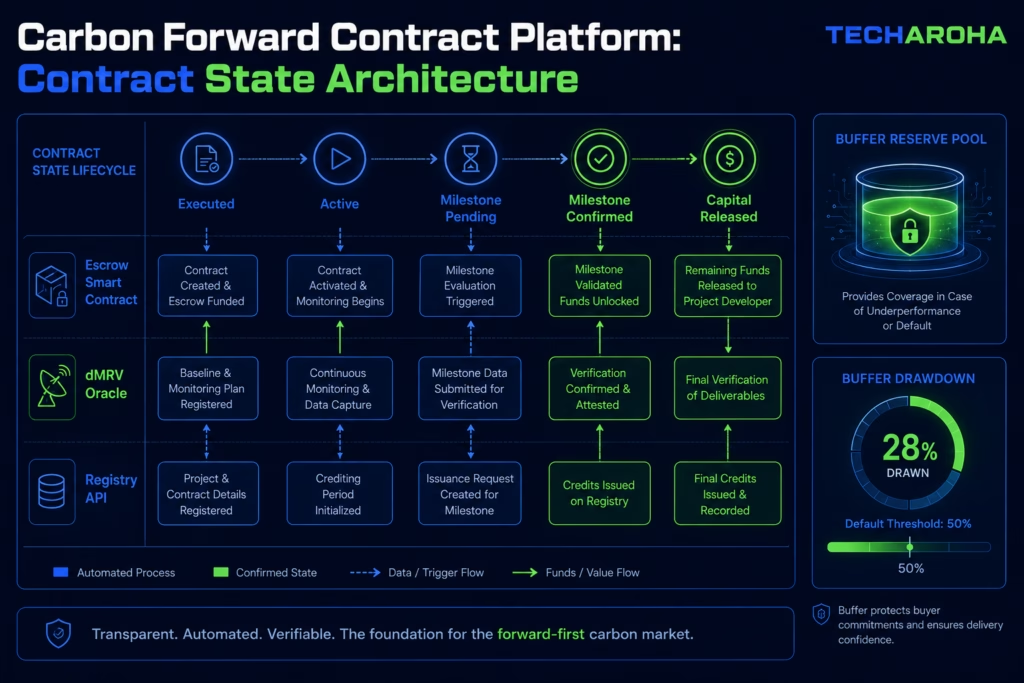
The technical core of a carbon forward contract platform is the milestone escrow module. This is where structured finance meets programmable infrastructure.
The design pattern works as follows. At contract execution, the buyer’s capital commitment is moved into a permissioned escrow state — either via a smart contract on a compatible ledger (EVM-compatible chains, Hyperledger Fabric, or permissioned Hedera environments have all been used in production carbon infrastructure) or via a custodied fiat escrow account managed by the platform’s treasury layer, depending on regulatory context. The capital does not move again until a milestone condition is satisfied.
Each milestone is defined in the contract as a structured data object containing three fields: the event type (e.g., “initial biomass verification”), the verification source (e.g., a named third-party auditor or a specific satellite data feed), and the release amount (the capital tranche to be unlocked on confirmation). The platform’s milestone engine polls the verification source, receives a signed confirmation event, cross-references it against the contract’s milestone schedule, and if the condition is met, initiates the capital release to the project developer’s account.
The critical design decision here is the oracle architecture. dMRV data does not arrive in a form that a contract engine can consume directly. Satellite imagery needs to be parsed into standardized biomass delta signals. IoT sensor aggregates need to be normalized and signed by a trusted verification node before they can trigger a financial event. A well-built carbon forward contract platform includes a dMRV oracle layer that transforms raw monitoring data into signed, timestamped attestation events that the escrow engine can resolve against.
For nature-based projects, the milestone sequence typically runs: independent validation → first monitoring report → initial credit issuance confirmation. For engineered removals — biochar, enhanced rock weathering, direct air capture — the milestone triggers are more granular: feedstock tonnage confirmation, operational capacity certification, and then periodic tonne-verified issuance against the contracted volume.
A carbon forward contract platform that does not encode default handling is not a platform. It is a promissory note management system. Default scenarios are not edge cases in forward carbon markets — project timelines slip, verification bodies discover discrepancies, and force majeure events affect land-based projects routinely.
The engineering solution is a two-layer default architecture.
The first layer is the delivery buffer. At contract inception, the platform locks a percentage of the project’s expected issuance volume — typically 10 to 20 percent — into a buffer account. This buffer is denominated in anticipated credits, not capital, and is managed via a registry subaccount or an on-chain token reserve, depending on the platform’s issuance model. If the project delivers short in any given vintage year, the platform automatically draws from the buffer to fulfill the buyer’s contract position.
The second layer is the capital clawback mechanism. If the buffer is exhausted and the project remains in default — delivery shortfall exceeds the buffer reserve within a defined cure period — the platform enforces a partial or full capital recovery against the remaining escrow balance. This requires the contract to define a clear priority waterfall: what portion of the undeployed escrow reverts to the buyer, what portion is forfeited, and under what conditions the developer retains any remainder.
The state machine for this layer needs to be auditable. Every state transition — from active to in-default, from buffer-drawn to clawback-initiated — must produce a timestamped, immutable record that both counterparties and any dispute arbitration body can interrogate. In permissioned ledger implementations, this audit trail is a natural property of the architecture. In fiat-custodied implementations, it requires a purpose-built event log that mirrors the escrow’s transaction history.

Every carbon forward contract platform, regardless of how it manages escrow and milestones internally, eventually needs to reconcile against a recognized carbon registry. Verra’s VCS, Gold Standard, Puro.earth, and emerging national registries under Article 6.4 of the Paris Agreement all have different API surfaces, issuance batch structures, and retirement protocols.
The forward module must treat the registry as the definitive source of credit issuance truth. When a vintage year closes and the project’s monitoring period is verified, the registry issues serials for that vintage. The platform’s integration layer fetches those serial records, matches them against the contracted volume, confirms delivery, and only then triggers the corresponding capital release. Registry issuance confirmation is the final-stage oracle event in the milestone resolution chain.
This is where many first-generation platforms fail. They track contract delivery manually, via spreadsheets and email confirmations from project developers, and attempt to reconcile retroactively. A purpose-built carbon forward contract platform encodes the registry API as a first-class integration: polling on a defined schedule, parsing issuance batch data, flagging discrepancies between contracted volume and actual issuance, and surfacing those discrepancies to both counterparties before the capital release decision is made.
For platforms operating under Article 6 frameworks, there is an additional compliance layer: corresponding adjustments. The host country must issue a corresponding adjustment before an internationally transferred mitigation outcome (ITMO) can be retired by a foreign buyer. The platform must track corresponding adjustment status as a prerequisite state for final settlement, not an afterthought.
There is a tendency in the market to treat forward offtake agreements as a documentation and workflow challenge. Sign the contract, track deliveries in a spreadsheet, release capital manually when the annual report arrives. For small-volume, bilateral agreements between two sophisticated counterparties, that approach works until it doesn’t.
At scale — multiple projects, multiple vintage years, multiple buyers with different credit type preferences and delivery schedules — the manual model collapses. The legal cost of managing defaults manually is high. The reputational cost of a disputed capital release is higher. And the operational cost of reconciling registry issuance data against contracted positions without automation is prohibitive.
The builders who are getting ahead in this market understand that a carbon forward contract platform is infrastructure for structured project finance, not a trading desk extension. The architecture decisions made at the beginning — how milestone states are encoded, how the dMRV oracle layer is designed, how the default buffer is custodied — determine whether the platform can scale to hundreds of simultaneous contracts or whether it becomes a liability at contract twenty.
Techaroha has built live environmental exchange infrastructure, including Carbon Plant, an FSA-registered NFT-based exchange for the UG Group. The engineering stack for a carbon forward contract platform — milestone escrow design, dMRV oracle integration, registry API reconciliation, and default buffer accounting — is the natural next layer above the spot exchange infrastructure we have delivered for clients including Mizuho Bank and Magnati.
If you are building a carbon exchange, a voluntary market registry, or a structured procurement platform and you need the forward contract module to be built to production standard — not prototyped — this is the problem we solve.
For teams scoping a carbon forward contract platform for the first time, the build sequence matters. The contract state machine and the milestone escrow module are the non-negotiable core. The dMRV oracle layer can be phased — in the first generation, signed verification attestations from named third-party auditors can substitute for automated satellite feeds. The default buffer and clawback mechanism should be built from day one, not retrofitted after the first default event.
Registry integration should go live before any live contract is executed. The reconciliation logic between contracted volume and actual issuance is too important to treat as a post-launch problem.
The carbon forward contract platform market is at an inflection point. The buyers are already there — $12.3 billion in offtake deals were signed in 2025 alone. The projects are there. What is missing is the platform infrastructure to manage these agreements at the complexity and volume they are already reaching.
That gap is exactly where custom platform development creates durable value.
Techaroha builds custom carbon credit exchange platforms, registries, and forward contract infrastructure for clients globally. If you are scoping a carbon forward contract platform, book a discovery call to discuss your architecture requirements.