
There is a number that the carbon credit industry rarely talks about openly: 40%.
That is the share of older carbon offset credits that a 2024 study found lacked verifiable, reliable emission savings. Forty percent. In a market now valued at over $933 billion globally and projected to eclipse $16 trillion by 2034, that credibility gap is not just an environmental scandal — it is a revenue catastrophe for every platform operator, project developer, and corporate buyer who built their compliance strategy on a foundation of manual Monitoring, Reporting, and Verification (MRV).
If you are building or operating a carbon credit trading platform in 2026 and your MRV stack is still driven by PDF submissions, spreadsheets, or periodic on-site audits, you are not just behind on technology. You are actively bleeding money – and leaving your clients exposed to regulatory penalties, reputational risk, and the growing premium gap between AI MRV carbon credit platform development and legacy verification approaches.
This blog makes the ROI case that most vendors won’t give you: why AI-powered MRV is not a feature upgrade, it is the financial architecture of a competitive carbon trading business.
Traditional MRV works like this: project developers collect field data manually, compile reports over months, and submit them to a third-party Validation and Verification Body (VVB) for assessment. A single auditor working with conventional manual verification can assess between 100 to 150 projects per year. Meanwhile, a platform enabled by AI MRV carbon credit platform development allows that same auditor to verify approximately 10 projects per day – a throughput increase of over 2,400%.
That is not a marginal efficiency gain. That is the difference between a platform that can scale to 5,000 active projects and one that bottlenecks at 200.
For platform operators, this throughput directly translates into listing capacity, verification fee revenue, and the speed at which credits can reach the market. Every day a credit sits in verification limbo is a day its issuing developer is not generating revenue – and a day your platform is not earning transaction fees.
The math is uncomfortable when you lay it out directly. If your platform processes 1,000 credits per month at a 3% transaction fee on an average credit value of $24 per tonne (the current market rate for premium nature-based credits), you generate $720 per month. A platform with AI MRV carbon credit platform development that processes 10,000 credits per month at the same fee structure generates $7,200. The infrastructure cost difference between those two scenarios is far smaller than that revenue gap suggests.
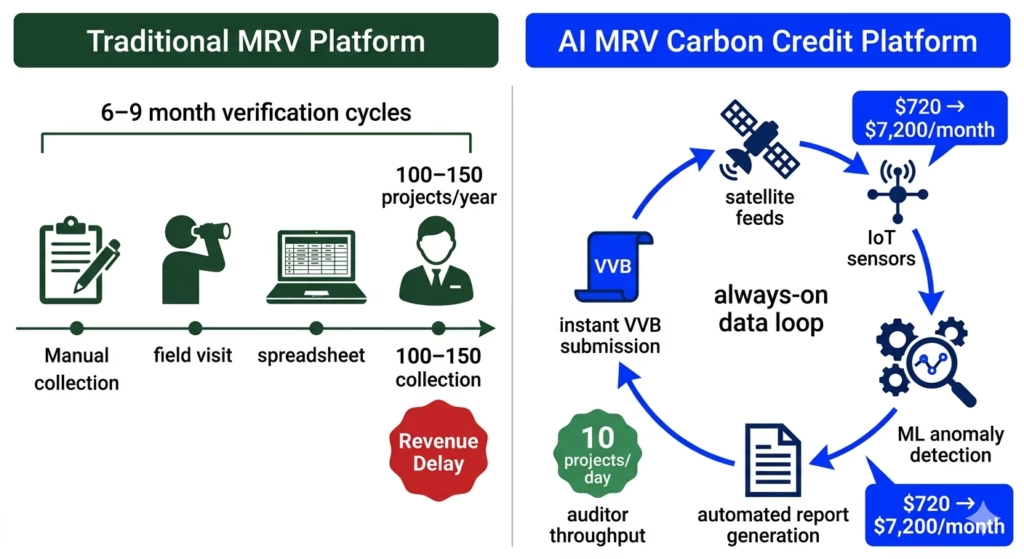
When we talk about AI MRV carbon credit platform development, we are describing a layered technical architecture that replaces human-dependent data pipelines with automated, continuous intelligence systems. Each layer removes a cost center and converts it into a competitive advantage.
Here is the market signal that should reframe your development roadmap: credits carrying the ICVCM’s Core Carbon Principles (CCP) label now command 15 to 25% price premiums over unverified equivalents. High-integrity, technology-verified credits are not just more trusted — they are measurably worth more per tonne.
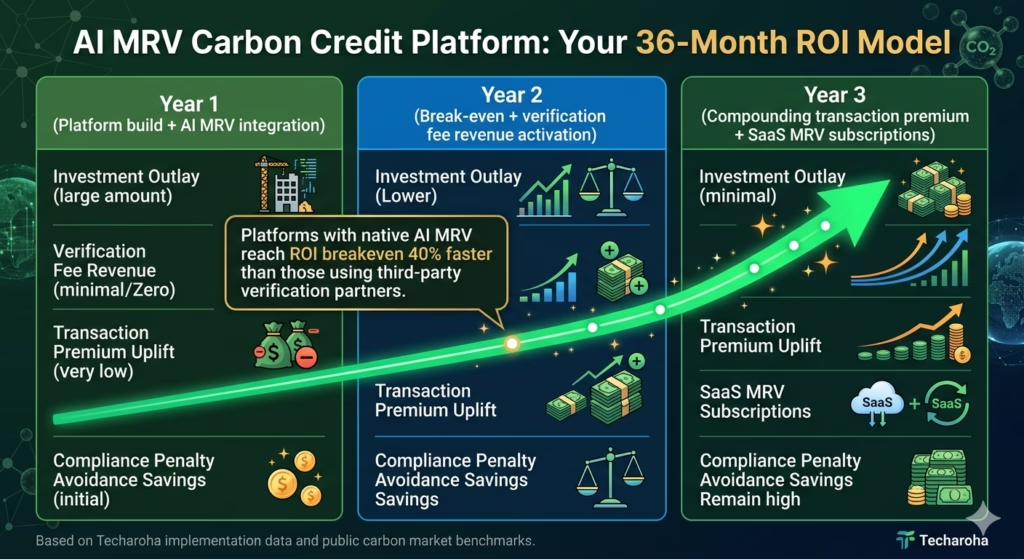
For platform operators, that premium is a direct multiplier on your transaction fee revenue. If your platform enables project developers to achieve CCP-rated credits through AI MRV carbon credit platform development, and the average credit on your exchange trades at $28 instead of $22, your 3% transaction fee earns $0.84 per credit instead of $0.66. At 500,000 annual credit retirements, that differential is $90,000 in additional fee revenue – from the same number of trades, with no additional marketing spend.
The same logic applies to the verification fee revenue stream that most carbon platform operators undermonetize. If your platform offers AI-powered MRV as a managed service – ingesting IoT data, running satellite checks, generating compliance reports – you can charge project developers a per-tonne or per-project verification fee that traditional platforms cannot. This is the SaaS layer that converts your exchange from a transaction venue into a recurring revenue engine.
Enterprise subscribers paying $4,000 per month for AI-assisted MRV compliance management on even 50 accounts generate $2.4 million per year – independent of trade volume. That revenue is stable, contractually predictable, and commands the valuation multiples of software infrastructure rather than commodity brokerage.
The window for building AI MRV carbon credit platform development capacity as a competitive differentiator is narrowing. By 2027, an estimated 90% of carbon credit transactions globally will require satellite-based verification as a baseline compliance standard — not a premium feature.
India’s CCTS is already operational, with mandatory emissions intensity targets creating a domestic compliance market that will reward platforms with robust, auditable MRV infrastructure. The EU’s Corporate Sustainability Reporting Directive (CSRD) is expanding Scope 3 emissions reporting requirements in ways that make AI-verified credits the only viable option for multinational buyers. The ICVCM’s tightening methodology approvals signal that credits without continuous digital monitoring trails will face increasing liquidity discounts.
Platforms built without AI MRV carbon credit platform development capacity today will face two choices in 2027: expensive retrofit integration with third-party dMRV providers who will extract 40 to 60% margin on every verification, or exit from the high-integrity credit segments where price premiums and institutional buyer demand are concentrated.
Neither is a good option. The platforms that survive the next market maturity cycle will be those whose AI MRV infrastructure is native, not bolted on.
Not every development shop that claims AI MRV carbon credit platform development expertise delivers the architecture that the 2026 carbon market actually requires. The questions that separate credible partners from vendors who will leave you with a technical debt problem three years from now are specific.
Does the partner understand MRV methodology layers – the difference between Verra VM0042, Gold Standard’s Activity-Specific Quantification frameworks, and how ICVCM’s Core Carbon Principles translate into data validation rules? A partner who builds generic AI dashboards without deep carbon market methodology knowledge will produce a system that fails its first independent audit.
Can the platform ingest IoT sensor streams, satellite imagery APIs, and drone LIDAR data natively — or does it depend on manual CSV uploads? The former is AI MRV carbon credit platform development. The latter is a reporting tool with an AI label.
Does the architecture support the MRV workflow automation that major registries now expect: continuous monitoring, automated anomaly flagging, auditor permissioned access, and immutable data trails that can withstand VVB scrutiny? These are not aspirational features for 2028 – they are the baseline for high-integrity credit issuance today.
And critically: does the partner have demonstrable experience building financial exchange infrastructure alongside environmental data systems? AI MRV carbon credit platform development sits at the intersection of climate science, financial compliance, and real-time data engineering. The talent required to build it well is rare, and the consequences of building it wrong are measured in regulatory exposure and lost market positioning.
The voluntary carbon market crossed $1.4 billion in 2024 and is on a trajectory to $23.99 billion by 2030 – a 35% compound annual growth rate. The compliance market is already at $113 billion and climbing. In a market scaling this fast, the operators who control the verification infrastructure do not just participate; they extract the margin that flows through every credit that passes their platform.
AI MRV carbon credit platform development is how you own that infrastructure layer. It is how you convert a trading venue into a $10 million-plus annual revenue engine. It is how you protect your clients from the greenwashing accusations that destroyed the reputations of platforms that cut corners on verification integrity in 2022 and 2023. And it is how you future-proof your technology against regulatory standards that will mandate continuous digital monitoring within 18 to 24 months.
The credits are already trading. The market is already scaling. The only question is whether your platform’s AI MRV carbon credit platform development infrastructure is built to capture the premium, or built to watch it flow to the competitors who moved first.
Ready to build a carbon credit platform with AI-powered MRV at its core? Techaroha specializes in end-to-end carbon credit trading platform development from IoT sensor integration and satellite MRV pipelines to automated audit trail generation and registry compliance workflows. Talk to our team about what a purpose-built AI MRV architecture looks like for your market, your regulatory environment, and your revenue model.
[Contact Techaroha → Carbon Credit Platform Development Services]