
The carbon markets are no longer a fringe ESG checkbox – they are a boardroom imperative. With compliance obligations tightening under schemes like the EU ETS, India’s Carbon Credit Trading Scheme (CCTS), and the expanding voluntary markets, corporate procurement teams are now facing a decision that carries multi-million dollar consequences: invest in carbon credit trading platform development from scratch, or license an off-the-shelf solution?
Most blog posts frame this as a technology question. They are wrong. It is a return-on-investment question – and one where the conventional wisdom almost always points companies in the wrong direction. In this analysis, we unpack the true cost calculus behind carbon credit trading platform development so you can make a data-driven decision, not a vendor-driven one.
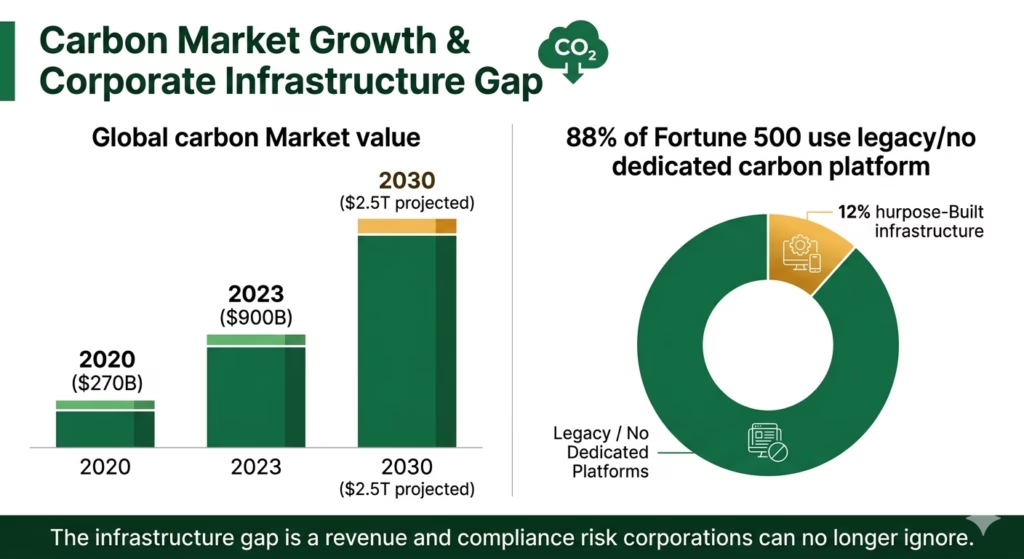
Global carbon credit markets surpassed $900 billion in transaction value in 2023 and are projected to exceed $2.5 trillion by 2030 (BloombergNEF). Yet only 12% of Fortune 500 companies report having purpose-built internal infrastructure for trading and tracking carbon assets. The remaining 88% are either using spreadsheets, disconnected ERP modules, or generic commodity platforms never designed for the regulatory nuance of carbon.
This gap is not just an operational inconvenience. It is a direct financial risk. Mis-matched carbon credit inventories, double-counting errors, and failed audit trails have already resulted in regulatory penalties exceeding $40 million in documented cases across the EU and California markets. For any mid-to-large corporate running a climate strategy, dedicated carbon credit trading platform development – whether built or bought – is no longer optional.
Building a proprietary carbon credit trading platform development project is alluring. You control the roadmap, own the IP, and can tailor every workflow to your compliance regime. But the real numbers rarely match the initial estimate.
| Component | Typical Cost Range | Timeline |
| Core Registry & Ledger Engine | $120,000 – $250,000 | 4–6 months |
| Trading & Matching Engine | $80,000 – $180,000 | 3–5 months |
| Regulatory Compliance Modules | $60,000 – $140,000 | 2–4 months |
| API Integrations (VERRA, Gold Standard, CBL) | $40,000 – $90,000 | 2–3 months |
| Reporting & Audit Trail Layer | $30,000 – $70,000 | 1–2 months |
| Security, DevOps & Infrastructure | $50,000 – $100,000 | Ongoing |
| TOTAL (Year 1 Build) | $380,000 – $830,000 | 12–18 months |
These figures assume a competent development partner handling your carbon credit trading platform development. In-house builds typically add 40–60% in hidden costs: internal project management, QA cycles, staff training, and the compounding risk of scope creep in a domain as regulation-dense as carbon markets.
Critical insight: 70% of in-house carbon credit trading platform development projects exceed original timelines by 6+ months, according to industry surveys by Carbon Intelligence. Every delayed month represents missed trading windows, compliance exposure, and deferred ESG reporting accuracy.
Pre-built SaaS platforms for carbon markets have proliferated rapidly. At first glance, a $2,000–$8,000/month license for carbon credit trading platform development seems like a bargain compared to a $500,000 build. But enterprise buyers routinely discover three category-specific pitfalls that erode this apparent saving:
The most successful corporate carbon programs in 2024 are not choosing between ‘build’ and ‘buy’ in the traditional sense. They are commissioning accelerated carbon credit trading platform development – partnering with specialist development firms who deliver custom platforms on pre-architected carbon market frameworks. This approach collapses timelines from 18 months to 4–6 months while retaining full IP ownership and regulatory flexibility.
ROI Comparison: 3-Year Total Cost of Ownership
| Factor | In-House Build | Off-the-Shelf SaaS | Specialist Development Partner |
| Year 1 Cost | $500K–$830K | $24K–$96K | $180K–$350K |
| Year 2–3 Costs | $200K+ (maintenance) | $48K–$192K | $60K–$120K |
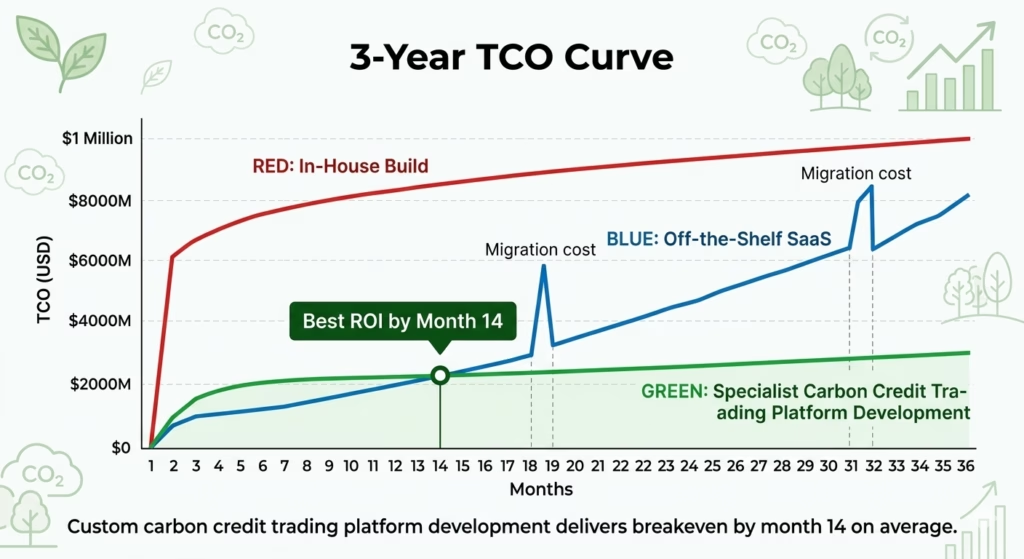
| 3-Year TCO | $700K–$1M+ | $72K–$288K* | $240K–$470K |
| Regulatory Flexibility | High | Low | High |
| Time to First Trade | 12–18 months | Days | 4–6 months |
| IP Ownership | Full | None | Full |
| Migration Risk | Low | High | Low |
| Compliance Coverage | Custom | Limited | Multi-jurisdiction |
*Excludes migration costs averaging $85,000 per platform switch and non-compliance penalties.
The specialist development partner model for carbon credit trading platform development consistently produces the highest 3-year ROI for mid-to-large enterprises because it eliminates both the timeline risk of in-house builds and the compliance inflexibility of SaaS. More importantly, it generates a compounding advantage: every year you own your platform, the amortized cost of carbon credit trading platform development decreases while your trading capability compounds.
Whether you opt for custom carbon credit trading platform development or evaluate SaaS, these five capabilities determine whether your investment pays back or bleeds:
1. Multi-Registry API Integration
Your platform must natively connect to VERRA, Gold Standard, CBL, and emerging national registries. Platforms limited to one registry force manual reconciliation – the single largest source of compliance errors in corporate carbon programs.
2. Real-Time Pricing & Order Book
Carbon credit prices can swing 15–30% intraday on policy news. Carbon credit trading platform development without a real-time matching engine leaves corporates buying at suboptimal prices, directly eroding offset budget efficiency.
3. Automated MRV (Monitoring, Reporting, Verification)
Regulators are transitioning to continuous MRV requirements. Platforms that support automated data feeds from IoT sensors, satellite verification partners, and auditor APIs are already mandatory for high-integrity markets.
4. Blockchain-Anchored Audit Trail
Double-counting of carbon credits remains a systemic risk. Carbon credit trading platform development that incorporates immutable ledger anchoring (even a private/permissioned chain) reduces audit risk and increases buyer confidence – directly impacting the premium you can command when selling surplus credits.
5. ESG Reporting Output Modules
Your board, investors, and regulators want carbon data in TCFD, GRI, and CSRD formats. Platforms that output directly to these frameworks eliminate expensive third-party reporting consultancy fees – often $30,000–$80,000 annually.
Custom carbon credit trading platform development is clearly justified when three or more of the following conditions apply:
Companies meeting three or more of these criteria typically see full ROI on their carbon credit trading platform development investment within 14–22 months – driven by avoided compliance penalties, optimised procurement timing, and internal carbon cost allocation accuracy.
Most carbon ROI discussions focus exclusively on compliance cost avoidance. They miss the revenue upside. Corporates that invest in sophisticated carbon credit trading platform development are increasingly monetising their infrastructure in three ways:
None of these opportunities are accessible to companies on SaaS platforms with limited API access or no trading engine. They require intentional carbon credit trading platform development with revenue generation as a design objective from day one.
The carbon market is not a peripheral sustainability metric – it is becoming a core treasury function for any corporation with material emissions. The question for your leadership team is not ‘should we build or buy a carbon platform?’ The question is: ‘How do we commission carbon credit trading platform development that is fast enough to meet our next compliance deadline, flexible enough to scale across jurisdictions, and strategic enough to generate ROI beyond mere compliance?’
The answer, for the overwhelming majority of mid-to-large corporates, is specialist-led carbon credit trading platform development: domain-expert teams who deliver custom, owned platforms on accelerated timelines — collapsing the false trade-off between speed and strategic control.
The carbon clock is ticking. Every quarter without purpose-built carbon credit trading platform development is a quarter of compliance exposure, missed trading optimisation, and competitive disadvantage as your industry peers build infrastructure you will eventually have to pay to catch up to.
Ready to evaluate your carbon credit trading platform development options? Our specialists have delivered custom carbon platforms for enterprises across 14 jurisdictions. Book a free 45-minute ROI scoping call → Techaroha