
Published by Techaroha | Market Analysis | March 20, 2026 | Carbon Markets Weekly
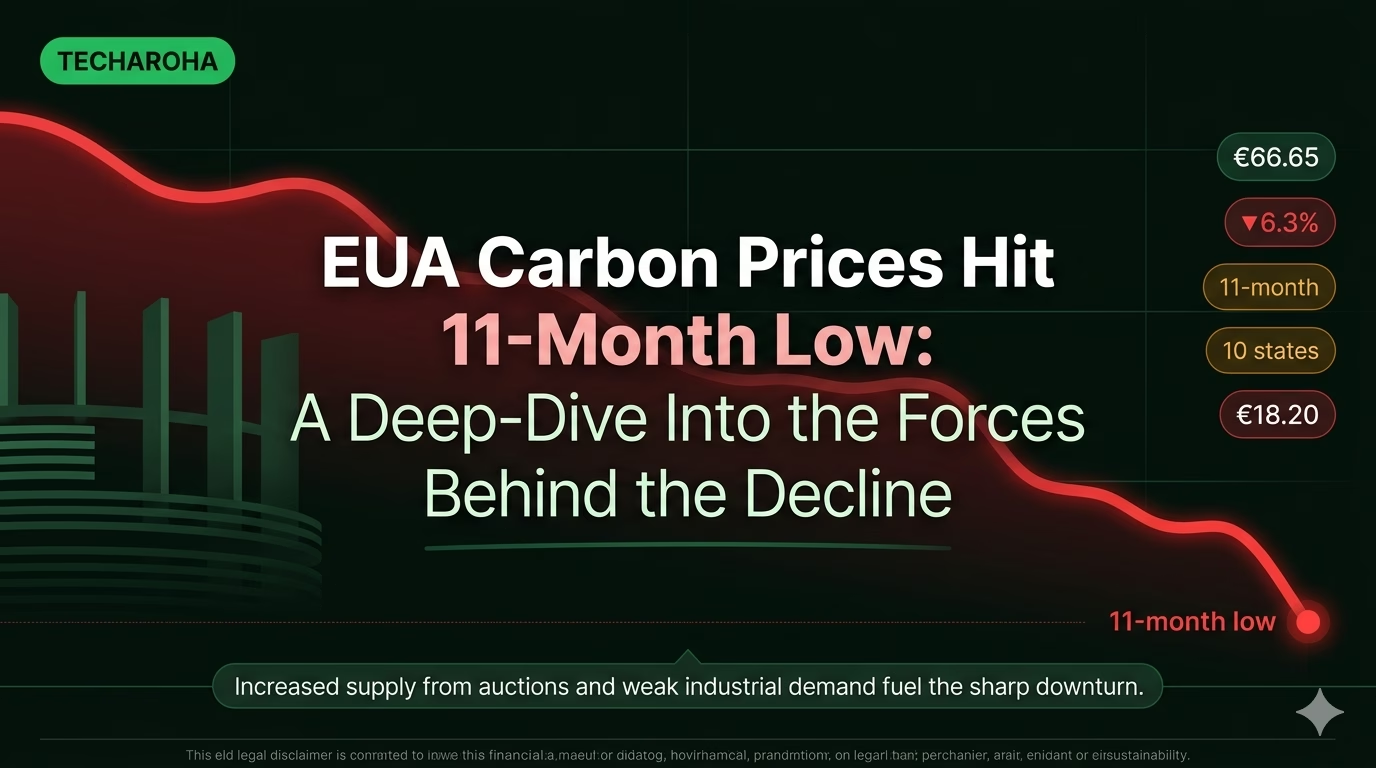
European carbon allowances entered the week of March 17–20, 2026 under considerable selling pressure. The EUA December 2026 contract, the most liquid benchmark contract on the Intercontinental Exchange (ICE), fell for the sixth time in seven sessions, eventually closing Friday at €66.65/tonne. This marks the lowest settlement since April 2025 and represents a cumulative decline of over 27% from the year’s intraday high of €92.04, reached on January 19, 2026.
| Day | EUA Price (€/tonne) | Daily Change | Key Event |
|---|---|---|---|
| Monday Mar 17 | €71.15 | Base | EU Summit agenda published |
| Tuesday Mar 18 | €70.42 | ▼ −0.73 | Von der Leyen MSR letter released |
| Wednesday Mar 19 | €68.90 | ▼ −1.52 | 10-country letter to Commission |
| Thursday Mar 20 | €67.24 | ▼ −1.66 | EU Council summit Day 1 |
| Friday Mar 20 | €66.65 | ▼ −0.59 | Week close — 11-month low |
Table 1: EUA Dec’26 daily settlement prices, week of March 17–20, 2026. Source: ICE / Techaroha.
To put this decline in historical context: EUA prices averaged €65/tonne in 2024 and had been forecast by institutions including ING Think to average €83/tonne across 2026 on the back of tightening supply. That bullish fundamental case has been overwhelmed, at least in the short term, by the political and regulatory uncertainty described in the sections below.
The March 19–20 European Council summit in Brussels was the single most consequential near-term catalyst for carbon prices this week. Although formally centred on the EU’s response to economic pressures from the ongoing Middle East conflict, the summit placed energy cost reduction and by extension the future of the ETS squarely on the agenda for EU heads of government.
Commission President Ursula von der Leyen set the tone in a letter to summit participants in which she outlined measures to tackle rising energy costs across four pillars: electricity prices, network and grid charges, taxes and levies, and carbon costs. Critically, the letter signalled that the Commission would shortly adopt ETS benchmarks “taking into account concerns expressed by industry,” a phrase the market interpreted as a concession to lobbying pressure from carbon-intensive sectors.
Von der Leyen also stated that the Commission would propose “to increase the firepower of the Market Stability Reserve (MSR), so that it can more effectively address excessive price volatility.” This was a double-edged signal: while a stronger MSR can support prices long-term by withdrawing allowances from circulation during surplus conditions, traders interpreted the language as opening the door for short-term price intervention, which depressed sentiment.
On Wednesday, March 18, the day before the summit opened, leaders of ten EU member states delivered a formal letter to the European Commission describing the current ETS framework as an “existential risk” for European strategic industries. The signatory countries were Austria, the Czech Republic, Croatia, Greece, Hungary, Italy, Poland, Romania, Slovakia, and one additional Eastern European state.
Their demands were specific and far-reaching:
The letter argued that energy-intensive industries, particularly those hardest to decarbonise (steel, cement, chemicals, glass), face a “perfect storm” of rising costs, unproven green technologies, and the accelerating loss of free carbon allowances that have historically shielded them from full ETS costs. Combined with energy prices elevated by the Middle East conflict and US tariffs constraining EU export competitiveness, the coalition argued the current framework threatens deindustrialisation.
The political weight of this letter should not be underestimated. Ten member states collectively represent a blocking minority in EU Council procedures. Their coordinated action signals that ETS reform is no longer an industry lobbying campaign; it has entered the formal political process. This shift fundamentally changes the reform probability calculus for market participants.
The ten-country push has met significant institutional resistance. Bruegel, the Brussels-based economic think tank, published an analysis arguing that weakening the ETS would be “economic self-sabotage” on five grounds:
This debate will directly shape the ETS Directive revision due in 2026 – the outcome of which represents the single largest structural risk (and opportunity) in the carbon market.
A critical and often misunderstood dynamic this week was the unusual decoupling of EUA prices from natural gas prices – a relationship that has historically been one of the strongest correlations in European energy markets.
The ICE December 2026 Dutch TTF contract surged 40% between February 27 and March 3, driven by the escalating US-Israel military action against Iran and concerns about disruptions to LNG supply routes through the Strait of Hormuz. Normally, higher gas prices increase carbon demand: utilities switch to coal (higher emissions, needing more EUAs) and industrial producers face higher input costs, reducing output and triggering EUA purchases to cover compliance obligations.
This time, however, the political overhang from ETS reform speculation was powerful enough to suppress the typical carbon-gas correlation. While gas spiked, EUAs remained under pressure, reflecting the market’s judgment that near-term reform risk outweighs fundamental supply-demand tightening. European gas storage levels compounded concerns, with storage at just 29% capacity on March 12 – well below seasonal averages and approaching the lows last seen during the 2022 energy crisis.
| Market Indicator | Value | Change vs. Prior Week | Direction |
|---|---|---|---|
| EUA Dec’26 (ICE) | €66.65/tonne | √−6.3% | ▼ Bearish |
| TTF Gas Dec’26 (ICE) | €45.33/MMBtu | +40% (2-wk) | ▲ Bullish |
| EU Gas Storage | 29% | Below 5-yr avg | ⚠ Warning |
| Speculative Fund Longs | 94M allowances | −6.6% (Feb wk) | ▼ Reducing |
| UK Allowance (UKA) | GBP 53.28/tonne | Wider spread vs EUA | ▼ Lagging |
Table 2: Key cross-market indicators, week of March 20, 2026. Sources: ICE, E3G, S&P Global.
Structural selling from financial investors has been a significant amplifier of the price decline. According to ICE Commitment of Traders (COT) data, investment funds held approximately 94 million allowances in long positions as of the week ending February 6, the smallest net long position since October 2025, having cut their exposure by 6.6% in a single week.
Carbon markets have attracted substantial speculative capital since 2021, with investment funds at times holding positions representing a meaningful fraction of the entire compliance market. When regulatory uncertainty spikes, these positions unwind rapidly, creating amplified downward price moves that exceed what fundamentals alone would justify. S&P Global’s carbon analysts noted that “speculation is the largest driver of EUAs over the last six months,” a market structure that creates both opportunity and systemic volatility risk.
The ECB compounded bearish positioning by revising its ETS price outlook lower for the 2026–28 period – a notable shift given that the central bank simultaneously raised its inflation forecast. For many market participants, the ECB’s carbon price revision served as a credibility signal that reform risk is material and lasting.
The week’s price action is not occurring in isolation. It sits within a pivotal structural juncture for the EU ETS. Several concurrent developments make the current period historically significant:
A full revision of the ETS Directive and Market Stability Reserve Decision is scheduled for 2026. This review will determine the system’s design through the end of the fourth trading phase (2021–2030) and set the trajectory for post-2030 ambition. The ten-country letter’s demand to bring this review forward to May compresses the timeline significantly, increasing the risk of rushed decisions with long-term market consequences.
The Carbon Border Adjustment Mechanism (CBAM) entered force in 2026, with certificates for 2026 surrendered in 2027. Simultaneously, free ETS allowances for CBAM-covered sectors (steel, aluminium, cement, fertilisers, electricity, hydrogen) will be reduced by 2.5% in 2026 and 5% in 2027. For aviation, free allocation was eliminated entirely in 2026. This tightening of the supply/demand balance was forecast to be supportive for prices, but the political backlash against the free allocation phase-out is precisely what is driving the ten-country revolt.
ETS2 – the new carbon market covering road transport, buildings, and additional industrial sectors is scheduled to launch in 2027, with a cap targeting 42% emission reductions by 2030 versus 2005 levels. However, discussions about delaying ETS2 to 2028 have intensified, adding further policy uncertainty to the broader carbon pricing landscape.
276 million allowances will be placed into the MSR between September 2025 and August 2026 — a significant supply withdrawal that would ordinarily be bullish. Von der Leyen’s signal that the MSR’s “firepower” will be increased suggests the Commission is considering further structural supply management, which could cut either way for prices depending on the specific mechanism chosen.
| Segment | Price (March 20) | Driver | Outlook |
|---|---|---|---|
| EUA (Compliance) | €66.65/tonne | EU summit, reform risk | Bearish short-term |
| VCM — Nature-based | €18.20/tonne | Corporate net-zero demand | Stable/mild growth |
| CORSIA (Aviation) | €6.40/tonne | ICAO Phase 2 uncertainty | Cautious |
| UK Allowances (UKA) | GBP 53.28/tonne | UK-EU linkage risk | Bearish |
Table 3: Carbon market segment overview, March 20, 2026. Sources: ICE, CBL, ICAO, Techaroha estimates.
The Voluntary Carbon Market (VCM) has been relatively insulated from the EUA price decline, as VCM demand is driven primarily by corporate net-zero commitments rather than regulatory compliance. Nature-based solutions credits (forestry, soil, blue carbon) continue to attract premium pricing, though the market continues to grapple with additionality and permanence concerns following the 2023–24 credibility controversies.
CORSIA credits, governing aviation’s international emissions, trade at a significant discount to EUAs, reflecting the more nascent and less liquid nature of the aviation compliance market and ongoing uncertainty about ICAO’s Phase 2 eligible unit standards.
Carbon market participants are currently navigating one of the highest-uncertainty environments in the ETS’s history. Three plausible scenarios frame the range of outcomes:
The EU Council reaches a compromise that accelerates the ETS review timeline but preserves the core price signal. Free allocation extensions are modest and conditioned on measurable decarbonisation. The MSR is strengthened but not weaponised for price suppression. In this scenario, the structural supply tightening from CBAM phase-out and aviation free allocation removal reasserts itself, with EUAs recovering toward €75–80 by Q4 2026. Probability: 45%.
Political pressure produces a substantive weakening of the ETS: a material extension of free allocation, a slower cap reduction trajectory, or a direct price intervention mechanism. Investment funds accelerate their long unwind. EUAs test the €58–62 support zone. This would represent a fundamental impairment of the carbon price signal. Probability: 30%.
Escalation of the Middle East conflict disrupts LNG supply materially, forcing European utilities to switch en masse to coal. EUA demand spikes from compliance buyers. The political reform narrative is overwhelmed by fundamental demand. EUAs rebound sharply to €80+ as speculative funds rebuild long positions. Probability: 25%.
The 11-month low in EUA prices this week reflects a market repricing political risk, not a fundamental deterioration in the carbon balance. The underlying supply-demand dynamics of the EU ETS remain structurally supportive: the cap continues to tighten, the MSR continues to withdraw allowances, free aviation allocation has ended, and CBAM is forcing a genuine reckoning with carbon costs for imported goods.
What has changed is the perceived probability that policymakers will intervene to blunt the carbon price signal in response to industrial competitiveness pressures and geopolitical energy shocks. Whether that intervention materialises, and to what degree, is now the dominant variable in the market.
For Techaroha readers: the key question is not whether carbon prices will recover- on a structural horizon, the energy transition makes higher carbon prices inevitable. The question is whether the EU has the political will to let the price signal do its intended work. We will track each development in next week’s update.
DISCLAIMER
This article is produced by Techaroha for informational and educational purposes only. It does not constitute financial, investment, or regulatory advice. Carbon market prices are highly volatile and subject to regulatory, geopolitical, and macroeconomic risks. Readers should conduct their own due diligence before making any investment decisions. Data sourced from ICE Futures, Carbon Pulse, E3G, Bruegel, S&P Global, Fastmarkets, Euronews, and Emba Power.