
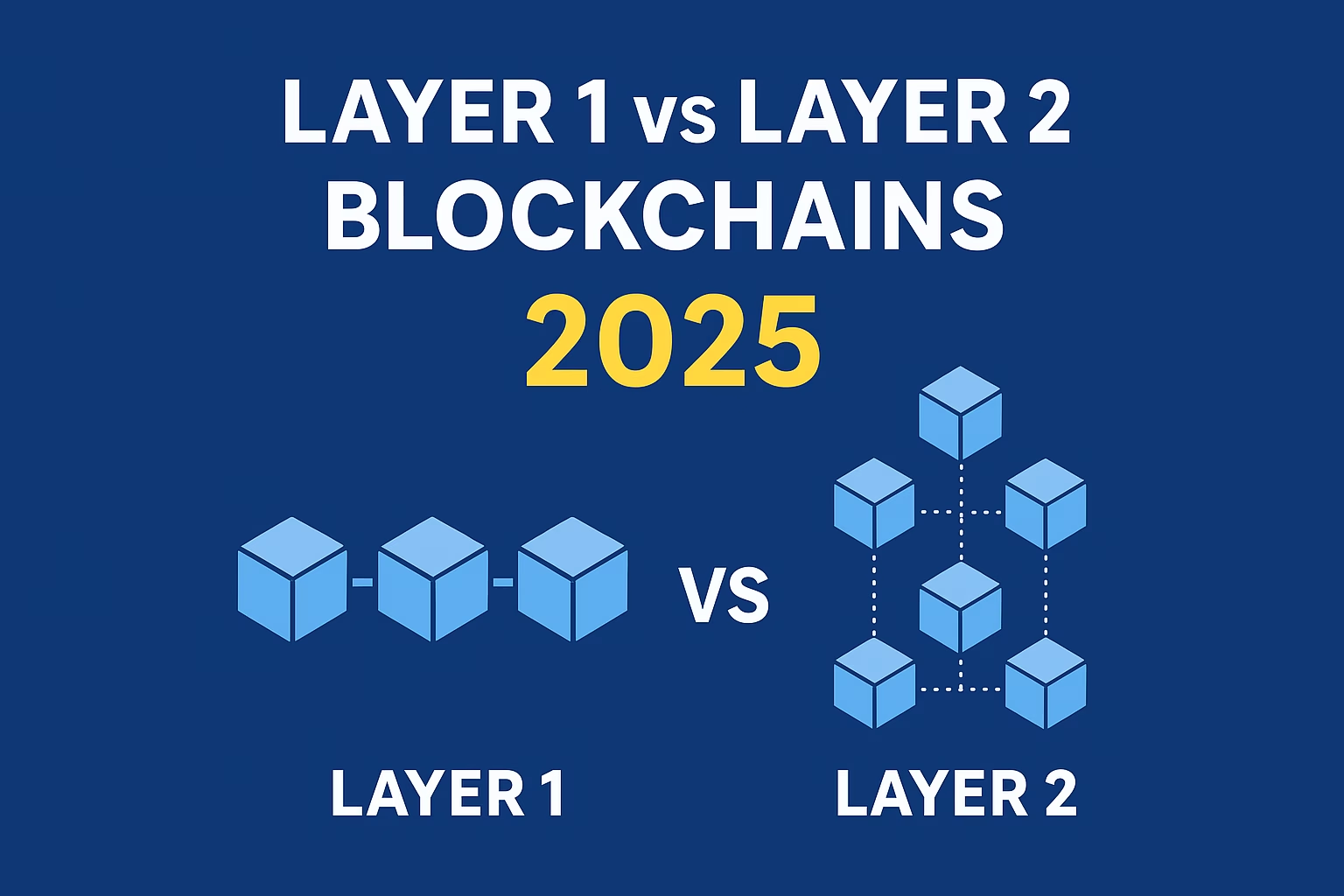
If you have been looking into blockchains technology and cryptocurrencies for the past few years, you’re probably heard the terms layer 1 and layer 2 more than once. Whether you’re an investor actually putting time into where to allocate your capital, a developer pondering where to build your next dApp, or just a mildly invested crypto nerd who wants to sound cool at the dinner party, the layer 1 vs. layer 2 discussion is relevant. In 2025, this debate has only grown louder. Ethereum still dominates much of the developer and DeFi ecosystem, but Solana, Avalanche, and other Layer 1s are pushing boundaries. Meanwhile, Layer 2s like Arbitrum, Optimism, zkSync, and Base are scaling Ethereum in ways that seemed almost impossible just a few years ago. So, which will you choose? Layer 1 or Layer 2? Let’s dig deeper. What Are Layer 1 Blockchains? A Layer 1 blockchain is the base layer, or protocol, which transaction is recorded digitally on the network. Examples of layer 1s include Bitcoin and Ethereum. All activity happens “on-chain”, with either miners or validators validating it on the blockchain, which records every transaction. Layer 1s provide: Examples of Layer 1s in 2025: Again, we should think of Layer 1 as the “main highway.” Every car (transaction) goes on the same highway, and the overall network decides how to manage traffic. What Are Layer 2 Blockchains? A Layer 2 blockchain that sits on top of Layer 1 for the purpose to add improvements to scalability, efficiency, or cost. Instead of competing with the base layer, it extends it. The most notable example: Ethereum Layer 2s. Gas fees on Ethereum were prohibitive to the point simple swaps were costing $100+. This gave rise to Layer 2s. Types of Layer 2s: Layer 2 is like adding express lanes to the main highway. Cars move faster, but still anchor their legitimacy to the main Layer 1 road. Why the Distinction Matters in 2025 Here’s the reality: blockchain adoption is growing beyond DeFi and NFTs. Supply chain systems, gaming, RWAs, CBDCs, and corporate sustainability credits are starting to utilize relatable public or hybrid blockchains. This demand gives rise to the following three friction points: That’s why the Layer 1 vs Layer 2 conversation isn’t just academic. – it outlines where businesses and developers and investors are going to build and deploy real applications. The Case for Layer 1 Pros Cons Real-World Example In the 2021 bull run, when Ethereum users were paying over $200 per transaction at the height of congestion, it no longer made sense for the casual user and developers were forced to explore other networks. Some left for Solana (fast, cheap), others waited for Ethereum’s scaling roadmap to evolve. The Case for Layer 2 Pros Cons Real-World Example In 2023-2024 Arbitrum and Optimism saw huge growth in TVL (total value locked with billions of liquidity in DeFi). Coinbase even launched Base, a Layer 2 chain on Ethereum, subsequently legitimizing L2s as more than experimental… they were now the default scaling strategy for Ethereum. Layer 1 vs Layer 2: Which Is Better The real answer is not one is universally “better“, it’s about fit for purpose. Hybrid Approaches: The Future Is Multi-Layered By 2025, we will predominantly see hybrid models developed: This means you don’t really have to choose strictly one way or the other. Developers are designing and building with modularity in mind, utilizing Layer 1 security, and Layer 2 scalability. Final Thoughts The rise of Layer 1 vs Layer 2 blockchains isn’t a war with a clear winner. It’s more like the evolution of the internet itself. In the early days, websites had to choose between dial-up and DSL. Today, we take broadband for granted. Similarly, in the future, users won’t ask, “Am I on L1 or L2?” They’ll just expect apps to be fast, cheap, and secure. The best builders and investors today will anticipate that reality and position themselves accordingly. So, if you’re asking: Layer 1 or Layer 2? The smarter answer is: both — strategically, depending on your needs. FAQs on Layer 1 vs Layer 2 Blockchains 1. What is the difference between Layer 1 and Layer 2 blockchains? Layer 1 blockchains are base networks that processes and secures transactions directly (e.g.: Ethereum, Solana, Bitcoin). Layer 2 blockchains are scaling solutions built on top of layer 1 blockchains that improve the speed and cost of transactions, while Layer 1 still secures the transaction. 2. Is Ethereum a Layer 1 or Layer 2? Ethereum is a layer 1 blockchain, however it has many layer 2 solutions on top of it to help with the scaling and reducing gas fees. (e.g.: Arbitrum, Optimism, zkSync) 3. Why do we need Layer 2 blockchains if Layer 1 exists? Layer 1 blockchains often suffer from scalability issues, such as high gas fees and low throughput. Layer 2 blockchains and solutions allow for improved scalability and reduce costs for the user by processing transactions offchain or in batches. 4. Which is more secure: Layer 1 or Layer 2? Layer 1 blockchains are generally more secure since they validate everything on-chain. Layer 2 blockchains get their security from the layer 1 blockchain they are built on, however there can sometimes be vulnerabilities in the infrastructure and bridges around them. 5. Are Layer 2 blockchains the future of Ethereum? Yes. Ethereum’s roadmap is heavily dependent on scaling with layer 2 rollups, ideally Ethereum will act as a settlement layer, while most user activity happens on Layer 2. 6. Which is cheaper: Layer 1 or Layer 2? Layer 2 blockchains are much cheaper. A swap on Arbitrum might cost a few cents, and on Layer 1 Ethereum the same swap could cost a few dollars especially during peak times. 7. Should I build my dApp on Layer 1 or Layer 2? It depends on what you are trying to do. If you need max security and liquidity choose a Layer 1 like Ethereum. If you need fast, low-cost transactions – think
The world’s race to decarbonize its economy has never needed carbon markets more. More than 28% of global emissions fall under a carbon price as of 2025 and voluntary markets reached a half-year high of 95 million carbon credit retirements in the first six months of the year. Demand is there, but scrutiny is even more so — buyers want to know that every credit they purchase actually reflects a genuine and unique reduction in emissions. At the core of this is a series of carbon registries, the official record-keepers of issuance, transfer and retirement of credits. They have always been the trusted “source of truth.” But as markets grow in scale and digitize, blockchain-based systems are arriving to supplement them — offering transparency, programmability, and efficiency. The question isn’t whether blockchain will replace registries (it won’t), but how the two might coexist to enhance trust and efficiency. This blog explores what traditional registries like Verra or Gold Standard offer in comparison to blockchain platforms, and the pros, cons, and risks of bringing the two together. We’ll also consider recent developments, such as India’s Carbon Credit Trading Scheme, and the growing popularity of high-integrity credits — before we answer the questions on the lips of businesses and investors in 2025. A quick primer: what a carbon registry actually does A carbon registry functions as the central, immutable ledger for carbon credits, assigning each one a serial number and accompanying documentation that proves its origins and lifespan. These ledgers are the assurance that buyers can check to prevent the risk of double-counting, and they confirm the approved methodology, the lineage of ownership, and that a credit has been permanently retired. The largest registries at present are Verra, operating under its Verified Carbon Standard (VCS), and Gold Standard. Why this matters in 2025: The carbon market is systematically prioritising “high-integrity” credits. Assessments of additionality, permanence, leakage and the formal consent of the host country, as mandated under the Article 6 framework of the Paris Agreement, have become increasingly stringent. Registry metadata and on-label indicators are thus being enhanced to allow purchasers to filter and evaluate credit quality before committing capital. Where blockchain fits (and where it doesn’t) What blockchain adds (when done right): Tamper-evident audit trails. Tamper-evident audit trails. Such on-chain records can potentially be used to trace all credit movement and every loan, with links to the serials on the registry and to the documents proving verification. Programmability. With smart contracts, escrow, dvp, retire-on-evidence milestones can all be automated (e.g., IOT/satellite proof on nature projects). Interoperability & liquidity. Tokens can be used to represent claims, make it possible for fractional ownership and create secondary markets – subject to the condition that the token is cryptographically bound to the originating serial and retirement status. Each carbon credit can be represented as a unique NFT (non-fungible token), meaning that just as every registry-issued credit has a distinct serial number, its on-chain version can be minted as an NFT with embedded metadata (project ID, methodology, MRV hashes). This ensures 1:1 traceability between the registry unit and the blockchain representation. Limits & Risks: (lessons from 2021–2024): What’s new in 2025 (and why it changes the calculus) Risks to Monitor Duplicate tokens: A credit token lacking a current registry serial may be erroneously repeated. Weak methodologies: Blockchain can’t fix poor additionality or permanence—it just records data.Regulatory drift: Regulatory texts (e.g. Article 6, CCTS) evolve, requiring adaptive technical designs. Liquidity vs. quality: Markets are prioritizing integrity over speculation in 2025. Pros & Cons: Side-by-Side Aspect Traditional Registries Blockchain Layers Trust Accepted by regulators, airlines, and corporations. Adds transparency if linked properly; otherwise creates risk. Data Comprehensive but siloed, sometimes slow to update. Open, real-time records accessible globally. Efficiency Manual processes, limited automation. Smart contracts automate transfers and settlements. Risk Low, as long as registry governance holds. High if tokens are unbacked or duplicated. How they work together (the practical stack) Blueprint for 2025 infrastructures, suitable for both developers and buyers: Origin within a recognized registry (Verra or Gold Standard). Treat the registry as the definitive source for serials, holder data, and retirement events. The registry retains primacy. Create a permissioned, append-only on-chain replica, recording serials, approved methodology IDs, and hashes from the validation report. Frame tokens within strict boundaries: Leverage programmable contracts for delivery-versus-payment, escrow, and milestone releases—especially suited for nature-based projects with staged verification. Publish quality metadata—new GS labels and risk ratings—directly on-chain. This enables buyers to filter by integrity before executing transactions. Concrete signals in India: Both public and private sectors are advancing carbon-credit infrastructure, from regionally mandated carbon banks on Hedera to NABARD’s on-farm pilots. Growing demand is anticipated for digital MRV and interoperable slugs that externally settle while still keyed to the on-chart registry. Real-world examples (2025) Quick buyer checklist (2025) Bottom line Always treat the Verra and Gold Standard registries as authoritative for issuance, ownership, and retirement. Use the blockchain as an additive, not as an alternative, channel for transparent and automated processes—registry governance remains sovereign. NFT structures make sense only when each NFT directly mirrors a registry serial; without that link, they become shadow assets. Implement a 1:1 token-to-serial linkage with automated on-chain burn triggered by registry retirement, designed expressly to avert double counting. Synchronize with CCTS, CORSIA, Article 6 provisions, and the latest registry tags. The threshold for integrity is trending upwards, and 2025 data is already showing that buyers are steering toward supply that is evidently higher quality. FAQs Which is “better”: blockchain or traditional registries?Neither stands alone. Registries confer authority; blockchain brings speed and traceability. Can I make valid climate claims with just a token?No. Claims depend on a registry retirement (and any Article 6 or CORSIA stipulations). Tokens must cite those retirements. What statistics define 2025’s market?About 28% of emissions will sit under a carbon-priced system; retirements will hit 95 million in the first half of 2025—a record for any half. Does India’s CCTS allow tokenized trading?CCTS lays out compliance frameworks and targets; token frameworks must

The worldwide push toward sustainability has thrust carbon credits into the heart of corporate and governmental Climate change fighting plans. Yet today’s carbon credit markets are plagued by issuers trading in opacity, double counting, and suboptimal validation. Here is where blockchain can help. We are utilizing blockchain to symmetrize carbon credits; tokenizing, storing and trading of them on a registries – making such credits theoretically traceable, and significantly slashing shady practices on the carbon market, effectively enabling businesses of any size to buy, sell, or retire these without encountering bureaucratic or financial barriers. This guide will take you through the steps to create a blockchain carbon credit platform, as well as demonstrate projects that are already doing it, and answer the big questions we hear most. Why Use Blockchain for Carbon Credit Platforms? But before we get into how to build a carbon credits platform, we should discuss what makes blockchain such a great tool for managing carbon tokens: Step 1: Define the Platform Objectives Begin by determining whom you are creating the platform for and what problem it solves. Here are a few possible goals:- Also, consider what type of network you want to use: Will it be a public blockchain such as Ethereum, Polygon, or BNB Chain, or will you opt for a private or consortium chain with limited access? Step 2: Choose the Right Blockchain Architecture Scalability, cost, and adoption are dictated by blockchain architecture. Options include: EVM-Compatible Chains (Ethereum, Polygon, Avalanche) : Excellent for interoperability & smart contracts. Famous for its strong smart contract functionality and large development community, Ethereum is a public blockchain. Scalability and transaction speed are the ones that bother people when using it, since it provides transparency/shared ledger and decentralization. Private Permissioned Chains (Hyperledger Fabric, Quorum) : For Governments and enterprises who are interested in control. Hyperledger Fabric is a blockchain framework intended for enterprise applications that offers a modular architecture. It provides private transactions and confidential contracts, perfect for businesses who want to protect sensitive data. Its scalability and support for pluggable consensus mean that organizations can adapt the system to their own requirements. Corda: Designed for financial institutions, Corda is a permissioned blockchain with a focus on privacy and transactions directly between parties. Because of its special consensus mechanism, relevant parties could access transaction records for the purpose of enhancing the privacy protection. Step 3: Tokenize Carbon Credits Carbon credits must have a digital form to be traded on blockchain. Tokenization transforms each of the verified credits (which is usually 1 ton of CO₂) into a digital asset: ERC-20 tokens : To fungible carbon credits (This is for the purpose of general trading). ERC-721 NFTs : Unique credits paired w/ certain projects & complete with metadata (project location, details about the project, verification docs). Example: You have a reforestation project in Brazil which generates 10,000 credits, you now have 10,000 NFTs with geo-tagging + verification documents. Benefits of Tokenization: Step 4: Build Core Platform Modules For an effective carbon credit blockchain platform, we required a few important modules: Carbon Credit Issuance Module Marketplace & Trading Exchange Registry & Retirement System Verification & Compliance Tools User Wallet Integration Step 5: Integrate Smart Contracts Smart contracts are contracts with terms written directly into code. In carbon credit trade, smart contracts are able to automatize the operations concerning the release, transfer, and retirement of carbon credits through predefined conditions. The automation of these processes reduces intermediary intervention, transaction costs, and time as well. A business looking to offset its emissions, for example, might negotiate a smart contract which automatically buys the necessary credits when certain constraints are met (which simplifies the process and guarantees that the business remains in compliance). Smart contracts are the Lego bricks of automation: This eliminates intermediaries and reduces costs. Step 6: Add Transparency Features In order to gain trust, platforms have to provide an easy way for the stakeholders to verify the credits. Transparency features include: Step 7: Ensure Scalability & Security Scalability is important as potentially thousands of credits could be issued per day. Security measures: Step 8: Launch & Onboard Stakeholders Once the platform is ready: Real-World Examples of Blockchain Carbon Platforms These examples show the growing adoption of blockchain in climate solutions. Benefits of Blockchain-Based Carbon Credit Platforms Transparency & Trust Efficiency & Automation Global Accessibility Cost Reduction Real-Time Tracking Enhanced Market Liquidity Inclusive Participation Regulatory Compliance & Auditability Data Integration with IoT & AI Boosting Corporate Sustainability Reputation Cost of a blockchain-based carbon credit platform development It is an expensive proposition to create a sophisticated carbon trading system. The final price depends on the location of your development team, the functionality of your platform, the blockchain you pick and whether or not you. It’s easy to become bogged down in the weeds of pricing, however, be it a white label carbon credit platform, or a customized one-of-a-kind project built from the ground up. Prices can vary from $60,000 for standard platforms to over $200,000 for comprehensive solutions. Conclusion The carbon credits market can be revolutionized by blockchain technology, which can make it transparent, less convoluted, efficient, and fraud-proof. From tokenized credits, to facilitating frictionless trading across the globe, blockchain-based platforms guarantee trust and scalability in combating climate change. We at TechAroha are professionals in providing customized blockchain solutions including carbon credits platform, tokenization infrastructure and ESG solutions. We integrate sustainability with state-of-the-art blockchain technology to enable businesses, governments and NGOs to create the climate markets of the future. FAQs: Blockchain Carbon Credit Platforms What is a blockchain-based carbon credit platform?A digital platform based on blockchain technology for financing of carbon credits and withdrawal of those from trading with traceability and full transparency. How does tokenizing carbon credits work? Every credit is then tokenized into a digital token (fungible ERC-20 or NFT ERC-721) and is a crypto-certificate of 1T of CO₂ removed or avoided. Why build carbon credits on the blockchain and not traditional registries? Facilitate global access independently through Blockchain; it is double

What is Blockchain Technology? Blockchain is a decentralized technology that enables secure and transparent peer-to-peer transactions over a distributed network. At its core, blockchain is a digital ledger where data is stored in blocks that are linked together in a chronological chain using cryptographic techniques. Key components include: Blockchain works through a step-by-step process: transactions are broadcast to a network of nodes, validated by consensus mechanisms (proof of work, stake, etc.), and grouped into blocks. Each block is then added to the chain, forming an immutable record. Types of blockchains include: Blockchain’s impact lies in its ability to enhance trust, security, and efficiency across various sectors by decentralizing processes traditionally reliant on intermediaries. Applications of Blockchain Blockchain implementation can happen in various domains across industries. Here are some key domains where blockchain technology is being actively implemented or explored: Moreover, blockchain is exploring applications in voting systems to enhance transparency and security in elections, preventing fraud and improving voter turnout. These diverse applications highlight blockchain’s potential to transform industries by providing trust, efficiency, and security in data management and transaction processes. As the technology evolves, its impact across sectors continues to expand, promising innovative solutions to longstanding challenges. Getting Started with Blockchain Implementation To get started with blockchain implementation, several prerequisites and choices must be considered: Prerequisites: Choosing the Right Blockchain Platform: Choosing the right platform depends on use case requirements (e.g., scalability, privacy), ecosystem support, and development complexity. Each platform offers unique features suited to different applications, from decentralized finance (DeFi) to supply chain management and beyond. Setting Up the Development Environment Real-World Case Studies: Successful Blockchain Implementations in India 1. State Bank of India (SBI): Blockchain for KYC and Trade Finance Overview: The State Bank of India (SBI) has leveraged blockchain technology to streamline its Know Your Customer (KYC) processes and enhance trade finance operations. Implementation: Impact: 2. Maharashtra Government: Blockchain in Land Records Management Overview: The Government of Maharashtra implemented blockchain technology for land records management to combat issues of land fraud and disputes. Implementation: Impact: 3. Yes Bank: Blockchain for Supply Chain Financing Overview: Yes Bank utilized blockchain technology to enhance supply chain financing, providing more efficient and secure financing solutions to businesses. Implementation: Impact: 4. Niti Aayog: Blockchain in Healthcare Overview: Niti Aayog, the Indian government’s policy think tank, piloted blockchain projects in the healthcare sector to enhance data security and patient care. Implementation: Impact: 5. Tea Board of India: Blockchain for Tea Traceability Overview: The Tea Board of India implemented blockchain technology to ensure the traceability and quality of tea exports. Implementation: Impact: These case studies illustrate how various sectors in India are successfully adopting blockchain technology to solve complex problems, improve efficiency, and build trust among stakeholders. As blockchain technology continues to evolve, its adoption is likely to expand across more industries, further driving innovation and growth in the country. Challenges and Considerations of Blockchain Implementation While blockchain offers a plethora of benefits, there are certain hurdles to overcome before widespread adoption becomes a reality. Here’s a closer look at some key challenges and considerations: 1. Scalability and Transaction Speed: Current blockchain solutions often struggle to handle massive amounts of transactions. Imagine a busy highway – too many cars (transactions) can lead to congestion and slowdowns. Similarly, popular blockchains can experience delays in processing transactions, making them unsuitable for high-volume applications. 2. Regulatory Uncertainty and Lack of Standardized Protocols: The regulatory landscape surrounding blockchain is still evolving. Governments are grappling with how to oversee this new technology, and a lack of clear regulations can create uncertainty for businesses considering blockchain adoption. Additionally, the absence of standardized protocols across different blockchain platforms can hinder interoperability, making it difficult for different systems to communicate and share data seamlessly. 3. Security Concerns: While blockchain boasts robust security features, it’s not entirely immune to vulnerabilities. Hackers are constantly innovating, and new attack vectors might emerge. Additionally, the security of a blockchain system also depends on the security practices of the participants involved. Weaknesses in individual nodes or poorly designed smart contracts could create security breaches. 4. Need for Industry-Wide Collaboration and Adoption: Blockchain thrives on a network effect – its value increases as more users participate. However, widespread adoption requires collaboration across different industries. Businesses need to work together to develop standards, best practices, and interoperable solutions. Without industry-wide buy-in, the benefits of blockchain might remain limited to specific applications or niche markets.These challenges don’t negate the potential of blockchain, but they highlight the need for ongoing development and collaboration. As these hurdles are addressed, blockchain is poised to revolutionize the way we conduct transactions and share data across various industries. This blog explored blockchain technology, its key components, implementation steps, and real-world applications across industries. From finance to healthcare, blockchain’s potential to revolutionize is immense. Now is the time to explore the possibilities! Techaroha offers a comprehensive suite of services including blockchain, AI integration, and Metaverse solutions to help you navigate this technological revolution.