
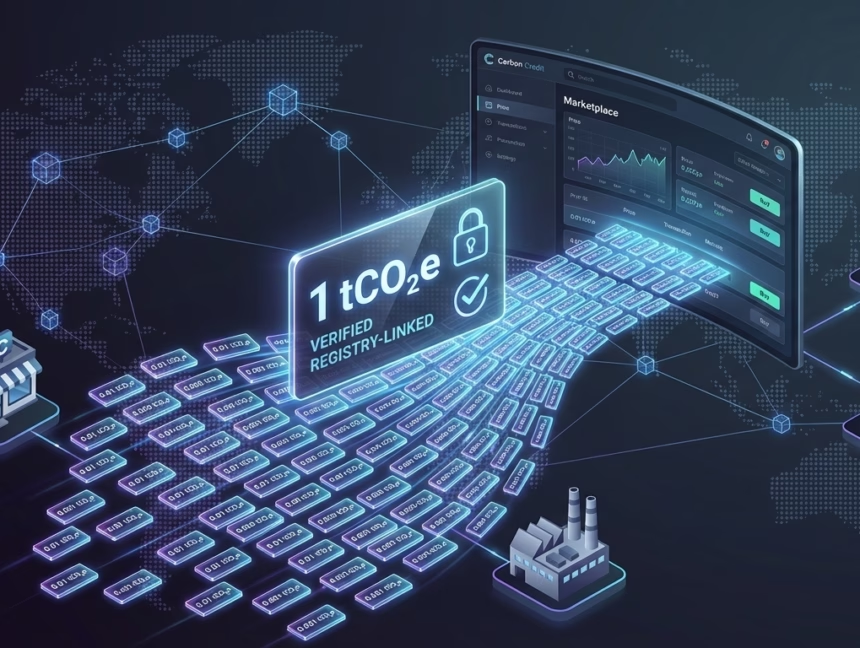
The global carbon credit market crossed $2 billion in 2024, yet nearly 73% of small and mid-sized businesses remain locked out. High minimum purchase requirements, rigid contract sizes, and manual trading processes make participation impractical for organizations with modest emissions footprints. Fractional carbon credit tokenization changes this dynamic by transforming verified carbon credits into divisible digital assets that can be traded, owned, and retired in precise quantities. Instead of purchasing entire credits in bulk, organizations can access carbon markets with accuracy, flexibility, and lower capital commitments—while platform operators unlock new revenue at scale. This is no longer experimental. Companies deploying tokenized carbon credit platforms are achieving 300%+ ROI within 18 months, expanding buyer access by over 400%, and dramatically improving credit utilization. The $30,000 Entry Barrier: Why Traditional Carbon Markets Fail SMEs Conventional carbon markets were built for enterprise buyers. A typical transaction requires minimum purchases of 1,000 credits or more, translating to $30,000–$50,000 per deal. For a regional logistics firm emitting 200 tons annually, this means buying five times more offsets than needed—or not participating at all. According to 2024 market research: This creates a systemic contradiction: organizations best positioned to adopt sustainability practices are excluded by infrastructure designed for large buyers only. How Fractional Carbon Credit Tokenization Expands Market Access Fractionalization applies proven financial engineering principles—used in real estate and private equity—to environmental assets. Instead of selling entire credits, blockchain-based carbon platforms divide a single verified credit into smaller, tradable units. How it works at a high level: A café offsetting 0.37 tons per month can now purchase exactly that amount—without overbuying or exiting the market altogether. For sellers and brokers, this unlocks previously unreachable buyer segments, generating higher transaction frequency and predictable recurring revenue. How Fractional Carbon Credit Tokenization Works (Step-by-Step Flow) Case Study: $180K Platform Investment Generating $750K in Annual Revenue A renewable energy project developer launched a tokenized carbon marketplace in Q2 2024 to address three challenges: Before implementation: After fractional tokenization launch: Results in 12 months: One key challenge: registry integration delays slowed initial onboarding.Solution: parallel registry synchronization and phased token minting reduced future onboarding time by 60%. Total platform cost: $180,000First-year net revenue uplift: $750,000ROI: 316% (excluding multi-year recurring revenue) Technical Architecture for Tokenized Carbon Platforms Successful platforms rely on four tightly integrated components: 1. Tokenization Engine with Registry Integration 2. Fractional Ownership Smart Contracts 3. Automated Marketplace & Price Discovery 4. Compliance & Retirement Infrastructure Is Fractional Carbon Credit Tokenization Legal and Compliant? Yes—when implemented correctly. Fractional tokens do not create new carbon credits. They represent partial ownership of existing, verified credits. Compliance alignment includes: Well-designed platforms operate as technical infrastructure, not issuers of environmental claims—ensuring regulatory compatibility. Traditional Carbon Trading vs Tokenized Fractional Markets Factor Traditional Markets Fractional Tokenization Minimum purchase 1,000+ credits Any fraction Buyer access Enterprises only SMEs + enterprises Liquidity Low High Settlement Manual Instant Transparency Limited On-chain Who Should Build a Fractional Carbon Credit Platform? This model delivers maximum value for: If you manage supply, demand, or compliance—owning the infrastructure compounds value. Revenue Models Platform Operators Often Overlook Beyond transaction fees: A platform processing $30M annually can generate $1.15M+ from the same infrastructure. Why Timing Matters: The 24-Month Advantage Window Early entrants benefit from: Late movers will pay rent to infrastructure owners—or struggle to compete. Implementation Roadmap: 90 Days to Market Weeks 1–4: Architecture & compliance designWeeks 5–10: Smart contracts, marketplace, registry integrationWeeks 11–13: Security audits, pilot launch, scale testing Speed matters. Every month of delay compounds opportunity cost. Fractional Carbon Credit Tokenization as a Competitive Advantage The carbon market is consolidating around platform ownership, not participation. Owning tokenized infrastructure means: This isn’t just about compliance—it’s about who controls climate market infrastructure. FAQs Is fractional carbon credit tokenization legal?Yes, when credits are locked or retired at the registry level and fully traceable. Can fractional credits be retired partially?Yes. Smart contracts allow retirement of exact fractions. Which blockchains are best for carbon markets?Ethereum, Polygon, and enterprise private chains depending on cost and compliance needs. How do platforms prevent greenwashing?By linking every fraction to a verified source credit with immutable audit trails. Ready to Calculate Your Platform ROI? Get a 30-minute feasibility call—no sales pitch, just numbers. You’ll receive: Contact Techaroha today to assess your fractional carbon credit tokenization opportunity.[Start Your Platform Assessment →]
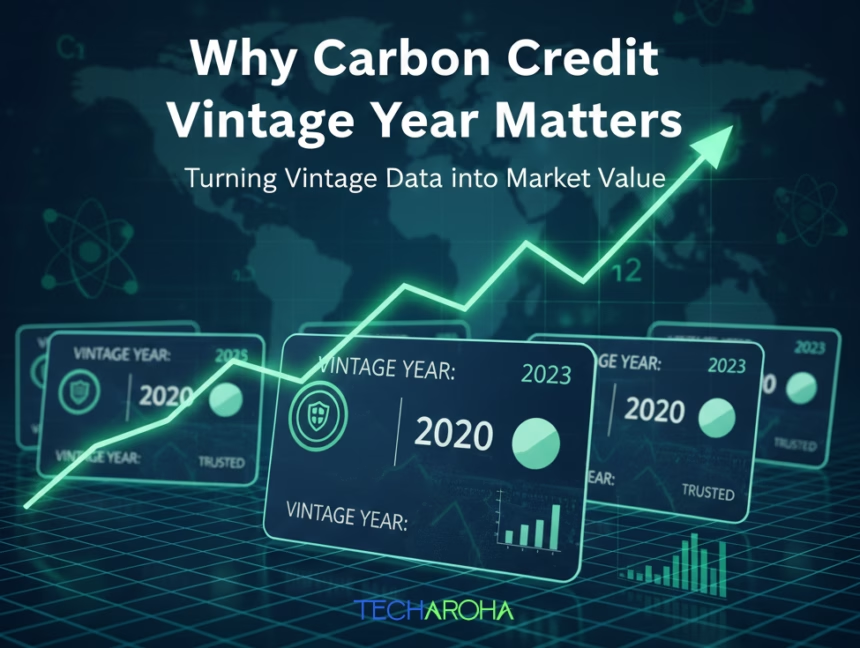
Carbon credit vintage year directly influences pricing, buyer confidence, regulatory eligibility, and overall market liquidity. Trading platforms that actively track, analyze, and optimize vintage data gain a decisive competitive advantage. Most carbon trading systems treat vintage year as static metadata—something to display, not leverage. At Techaroha, we engineer vintage year as a dynamic value driver embedded into pricing logic, compliance workflows, and buyer decision tools. What Is a Carbon Credit Vintage Year—Beyond the Definition At a basic level, vintage year refers to the year in which the emission reduction or carbon removal occurred. But in real-world carbon markets, vintage year communicates far more than timing. It signals: Key insight: Vintage year is not historical context—it is a pricing and trust lever that directly affects transaction outcomes. Why Buyers and Regulators Care More Than Ever As carbon markets mature, scrutiny around credit quality has intensified. Today: The result is a fragmented market where two otherwise identical carbon credits can trade at significantly different prices—purely based on vintage year. Platforms that make this intelligence visible, actionable, and automated don’t just inform users—they earn trust and drive higher-quality trades. The Hidden Platform Problem: Vintage Blind Spots Most carbon trading platforms underperform not because of market demand—but because of how vintage data is handled internally. Common platform blind spots include: These gaps lead to systemic inefficiencies: ❌ Poor buyer decision-making experience❌ Heavy reliance on manual verification and spreadsheets❌ Reduced buyer confidence and lost trading volume In effect, the platform becomes a listing portal—not a trading system. How Techaroha Tracks Vintage Year as a Value Signal Techaroha architects carbon trading platforms where vintage year functions as an active system variable, not passive reference data. Our SaaS frameworks are designed to embed vintage intelligence directly into platform logic through: The result: higher conversion rates, faster trade execution, and improved margin realization across the platform. Optimizing Carbon Credit Value Using Vintage Intelligence When vintage year is treated as structured intelligence, not static information, platforms unlock advanced value-optimization strategies. With the right SaaS architecture, platform owners can: This transforms the platform from a passive marketplace into a decision engine—one that actively guides buyers, protects sellers, and maximizes overall market efficiency. Why Carbon Market Players Are Building Custom Platforms As carbon markets evolve, leading participants are moving beyond generic exchanges and one-size-fits-all marketplaces. They require platforms that offer: Techaroha designs and builds white-label, enterprise-grade carbon trading platforms—customized to each client’s vintage rules, compliance frameworks, and growth roadmap. Who This Platform Is Built For (Lead Qualification) This platform intelligence is essential if you are: If vintage year influences your pricing, eligibility, or buyer trust, platform-level intelligence is no longer optional. Conclusion Carbon credit markets are maturing—and expectations are rising. Platforms that treat vintage year as static data will struggle with trust, liquidity, and compliance.Those that transform it into actionable intelligence will lead the next phase of carbon trading.Techaroha doesn’t sell a carbon credits platform; we build the systems that make them trade better. 👉 Looking to build or upgrade your own carbon credit trading platform? Let’s architect it together.
Imagine spending 1,800 hours every year just proving your company is sustainable. That’s nearly the time it takes to launch a new product line – wasted on paperwork. For mid-sized enterprises, ESG compliance costs can exceed $500,000 annually, draining resources that could fuel innovation, growth, or new product development. The challenge? Tracking carbon emissions, validating sustainability claims, and providing auditable proof to regulators is complex, fragmented, and error-prone. Manual processes buckle under the weight of ESG demands. Blockchain offers a way out – automating compliance, cutting costs by up to 40%, and restoring trust with transparent, tamper-proof records. This isn’t just about ticking boxes. It’s about transforming ESG from a burden into a competitive advantage. The ESG Compliance Challenge Organizations today face three major pain points: Manual reporting simply cannot scale. The more complex ESG regulations become, the more companies struggle to keep up. This is where blockchain-enabled automation steps in. How Blockchain Automates ESG Compliance Blockchain reimagines ESG reporting by creating a distributed ledger that records, verifies, and reports sustainability data automatically. This shift means ESG compliance is no longer retrospective. It becomes proactive, continuous, and automated. Real-World Applications Blockchain isn’t a theory – it’s already transforming ESG compliance. These examples show how blockchain moves ESG compliance from paperwork to performance. Benefits and ROI Companies adopting blockchain ESG automation report: Blockchain doesn’t just tick boxes – it turns sustainability into a competitive edge. This isn’t just operational efficiency. It’s about building trust, credibility, and market leadership. Why Stakeholders Care Investors, regulators, and customers are increasingly skeptical of self-reported ESG data. Greenwashing scandals have eroded confidence. Blockchain changes the narrative: When ESG becomes measurable and verifiable in real time, it shifts from a compliance burden to a brand differentiator. Implementation Roadmap Getting started with blockchain ESG automation doesn’t have to be overwhelming. Companies can follow a phased approach: The Future of ESG Automation As ESG regulations evolve rapidly, blockchain offers agility. Instead of redesigning reporting processes, companies can simply update smart contract rules. This means: Blockchain doesn’t just automate compliance. It embeds sustainability into the DNA of business operations. Case-Style Narratives To make this transformation tangible, let’s look at mini-stories: These stories show blockchain in action – not as a buzzword, but as a practical compliance engine. Transform ESG Compliance with Blockchain Blockchain has matured beyond cryptocurrency – it’s now a practical solution for ESG automation. Organizations that embrace it gain reduced costs, improved data quality, and enhanced stakeholder trust. Ready to cut your ESG reporting costs by 40% and eliminate greenwashing fears? 👉 See blockchain automation in action – schedule a demo today.

The convergence of blockchain technology with environmental, social and governance (ESG) reporting is increasingly poised to be one of the hottest topics in business, finance and tech. With organizations under more scrutiny from regulators, investors and customers to be open about their sustainability practices, blockchain is proving to be a transformative tool. In this deep dive, we’ll discuss how blockchain is building the future of ESG reporting, why it’s important for organizations, and what to look for in the near future. Why ESG Reporting Needs Innovation ESG reporting has moved from being a voluntary disclosure to a critical business function. Companies are now expected to: However, current ESG reporting systems suffer from key challenges: This is where blockchain comes into play. How Blockchain Transforms ESG Reporting Blockchain technology is built on the principles of decentralization, transparency, and immutability — all of which align perfectly with the needs of ESG reporting. Here are the key ways blockchain is revolutionizing this space: Immutable Record-Keeping Every ESG data point that is reported on blockchain becomes a non-editable record. That builds a trail of trust that investors, the regulators, and the customers can rely on. Compared to a traditional database, once information is recorded on the blockchain, it is impossible to edit or delete that data, which prevents any type of post-report manipulation. Such permanency boosts confidence among stakeholders and reduces hassle related to third-party audits, since all historical information is kept in chronological order and is easy to verify. Real-Time Data Sharing Because of blockchain’s near real-time data updates, companies can more frequently report on their ESG metrics rather than waiting for the end of a quarterly or annual reporting cycle. IoT gadgets and sensors can deliver data straight to the blockchain, enabling more dynamic and precise sustainability reporting. For instance, energy use in a factory can be logged automatically every minute, giving management real-time visibility and allowing it to respond proactively when sustainability goals are threatened. Supply Chain Transparency Every step in the process, from sourcing raw materials to delivering the finished product, can be tracked by blockchain, to name a few. It also helps companies validate their claims on ethical sourcing and carbon footprints. Customers can scan a QR code and immediately see a product’s origins, its path from source to store and whether it complies with fair-trade or low-carbon principles. This traceability not only mitigates the risk of fraud, but it also empowers consumers to make conscious sustainable purchasing decisions, subsequently playing a pivotal role in enhancing brand loyalty. Smart Contracts for Compliance Smart contracts can automate ESG compliance by triggering alerts or actions when certain thresholds (e.g., carbon emissions) are exceeded. For instance, if a supplier reports emissions above an agreed-upon limit, a smart contract could automatically flag the violation, freeze payments, or trigger a remediation process. This reduces manual monitoring efforts and ensures compliance is continuously enforced in a fair and transparent manner. Investor Confidence A blockchain-based ESG reporting system provides investors with trusted, verifiable data that can improve decision-making. Investors no longer need to rely solely on third-party ESG ratings, which often lack transparency. Instead, they can access granular, real-time performance data directly from the source. This can lead to better capital allocation, reduced risk exposure, and higher confidence in ESG-focused portfolios. Real-World Applications of Blockchain in ESG Blockchain implementation in ESG reporting is no longer a theoretical concept. Practical implications include: Benefits for Businesses Adopting blockchain for ESG reporting can yield multiple benefits: Challenges and Considerations Although blockchain technology has massive potential, it brings certain challenges: Future Outlook: Blockchain & ESG in 2025 and Beyond As we move toward 2025, we expect to see: Blockchain can potentially bring transparency, efficiency and fraud resistance to ESG reporting, all of which will be important to the next generation of sustainable business. Conclusion The ESG reporting of the future is one of trust, transparency and automation — things blockchain can provide. With more scrutiny on corporations and more of a call for consumers to support companies that do right, blockchain isn’t a crystal ball solution; rather, it’s a game-changing must-have. Early adopters will have a competitive advantage, while laggards will be caught flat-footed in an economy that prizes sustainability and verifiable impact. FAQs on Blockchain in ESG Reporting & Sustainability What is blockchain’s role in ESG reporting?Blockchain provides a transparent, tamper-proof ledger to store ESG data, improving trust and reducing greenwashing risks. How does blockchain improve supply chain sustainability?It tracks every step of the supply chain, verifying ethical sourcing, reducing fraud, and providing real-time emissions data. Are blockchain ESG solutions expensive to implement?Initial implementation can be costly, but long-term savings from automation and reduced compliance costs often outweigh setup costs. Can blockchain really prevent greenwashing?Yes — because once ESG data is recorded on-chain, it cannot be altered or manipulated, ensuring authenticity. Which industries benefit most from blockchain ESG reporting?Manufacturing, energy, retail, agriculture, and finance are leading adopters due to complex supply chains and compliance needs. Does blockchain consume too much energy for ESG use?Newer blockchains use energy-efficient consensus mechanisms like Proof-of-Stake, aligning better with ESG goals. How can small businesses adopt blockchain for ESG?They can use blockchain-as-a-service platforms or partner with ESG tech providers to avoid building their own infrastructure. Will regulators mandate blockchain ESG reporting in the future?It’s likely — several governments and global bodies are exploring blockchain for standardized ESG disclosures. Can blockchain help with carbon credit trading?Yes — blockchain can tokenize carbon credits, track their lifecycle, and make trading more transparent and efficient. What is the future of blockchain in ESG beyond 2025?Expect AI-driven analytics, tokenized sustainability incentives, and wider adoption across industries, making ESG reporting a continuous, real-time process.