
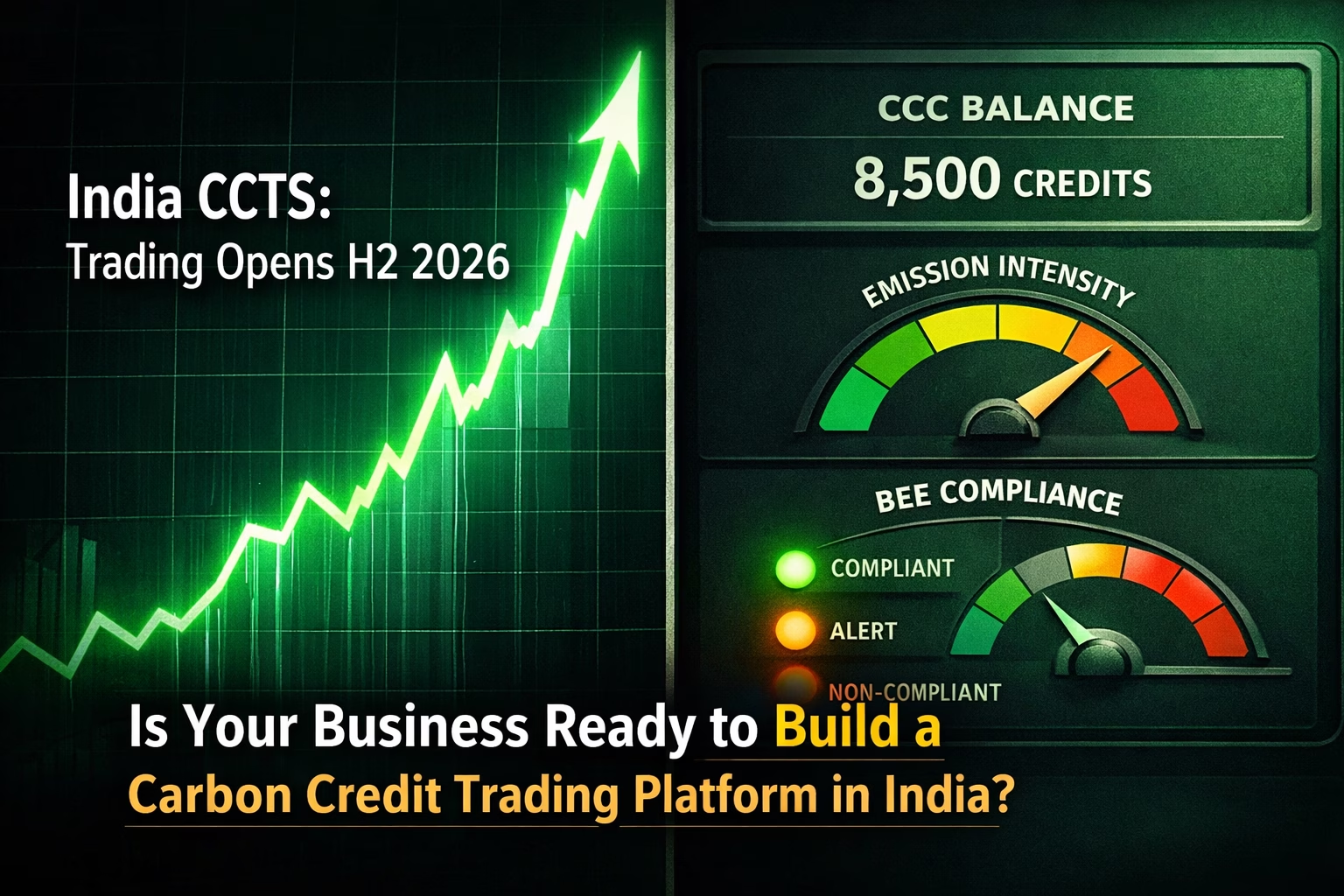
India’s carbon market is no longer a policy ambition on paper. India’s Carbon Market Portal went live at the International Conference on Carbon Markets, Prakriti 2026, in New Delhi, with Union Power Minister Manohar Lal announcing formal trading in Carbon Credit Certificates is expected within four months. That timeline is not a rumour — it is a procurement mandate disguised as a regulatory milestone.
Trading under India’s Carbon Credit Trading Scheme is expected to start in the second half of 2026, covering around 740 obligated entities across nine energy-intensive sectors with legally binding emission intensity targets. For every business in those sectors — and for every technology company, ESG consultancy, financial institution, and climate-tech firm that serves them — the window to build a compliant carbon credit trading platform in India is not open indefinitely. It is closing, quarter by quarter, as first movers lock in infrastructure advantages.
This blog is not about whether India’s carbon market will succeed. That question is settled. This is about whether your organisation will own the infrastructure that runs it — or pay to access someone else’s.
Most discussions about the Carbon Credit Trading Scheme focus on policy timelines. Few address what the scheme technically requires from any carbon credit trading platform in India that wants to operate within it compliantly.
The compliance mechanism under CCTS will be jointly managed by the Ministry of Power, the Ministry of Environment, Forest and Climate Change, and the Bureau of Energy Efficiency, with Carbon Credit Certificates traded through the country’s power exchanges and the Central Electricity Regulatory Commission acting as trading regulator.
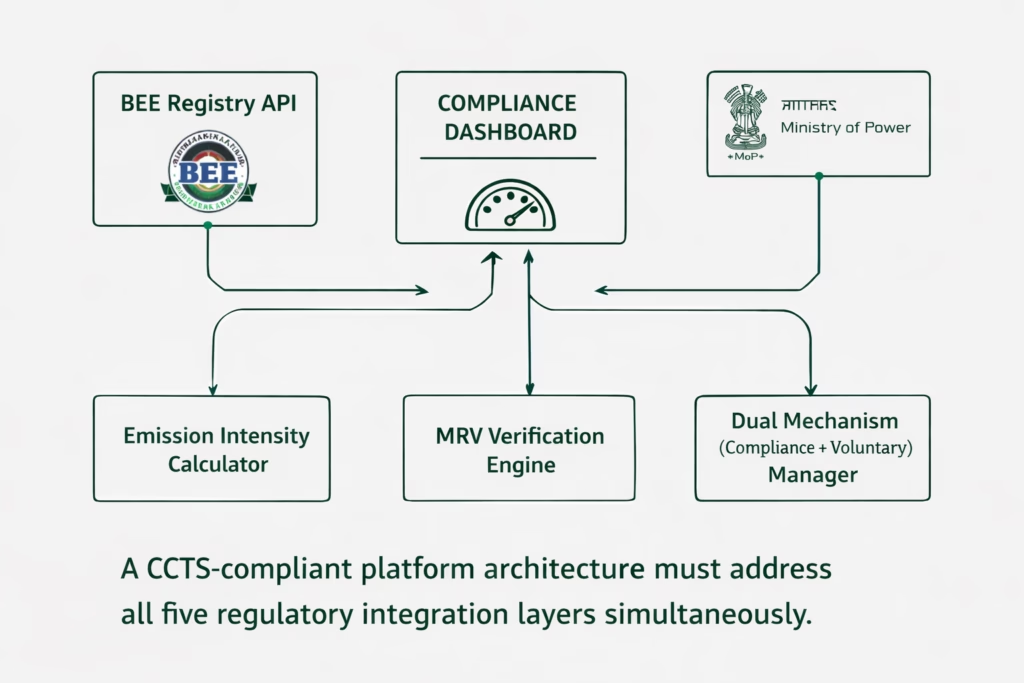
That multi-regulator structure has direct consequences for platform architecture. A carbon credit trading platform in India operating within CCTS must integrate with:
1. The BEE Registry (operated by Grid Controller of India Limited)
the registry for issuance operated by Grid Controller of India Limited is being set up as the official CCC issuance infrastructure. Your platform must connect via API to track issuance, retirement, and transfer of certificates in real time.
2. Power Exchange Connectivity
CCCs will trade on India’s power exchanges. A carbon credit trading platform in India that cannot connect to these exchange systems for order routing, price discovery, and settlement confirmation will be functionally unusable for compliance trading.
3. MRV Workflow Management
the MRV framework requires annual verification of GHG emissions data, with BEE-accredited Carbon Verification Agencies certifying entity compliance. Your platform must support structured data ingestion from verifiers, document management for audit trails, and automated submission-ready reporting.
4. Emission Intensity Calculation Engine
each covered entity receives GHG emissions intensity targets based on its sub-sector trajectory and relative emissions performance, set as tCO₂e per unit of output for three-year periods with annual compliance targets. The platform must calculate real-time performance against these intensity targets — not absolute emissions — which is architecturally distinct from most EU ETS-style platforms.
5. Dual Mechanism Support
CCTS defines two mechanisms: a compliance mechanism for obligated entities and a voluntary project-based offset mechanism for non-obligated entities who can register GHG emission reduction projects for CCC issuance. A carbon credit trading platform in India serving both markets — as any serious operator should — needs separate workflow logic for compliance and voluntary credit issuance, while sharing a single registry integration layer.
The nine sectors designated for CCTS compliance are Aluminium, Chlor Alkali, Cement, Fertiliser, Iron & Steel, Pulp & Paper, Petrochemicals, Petroleum Refinery, and Textile.
461 companies across these nine energy-intensive sectors have been notified by BEE as obligated entities, with the price of one tonne of carbon credit in India under CCTS expected to range from ₹600–900 per tonne once market-driven trading commences.
At 461 obligated entities each actively buying, selling, or banking Carbon Credit Certificates, the transaction infrastructure demand is substantial. But the ROI case for building a carbon credit trading platform in India does not rest only on serving obligated entities.
In March 2025, the BEE released the Detailed Procedure for the Offset Mechanism, and the government approved eight methodologies for the domestic voluntary market, covering renewable energy, green hydrogen, industrial energy efficiency, landfill methane recovery, mangrove afforestation, offshore wind, and compressed biogas.
That voluntary layer dramatically expands the addressable market. Renewable energy developers, green hydrogen producers, and forestry project operators — none of whom are compliance-obligated — can generate and trade CCCs. A carbon credit trading platform in India built to serve both compliance and voluntary participants becomes infrastructure for the entire Indian carbon economy, not just 461 industrial plants.
The global carbon credit trading platform market is projected to grow from USD 235.50 million in 2026 to USD 1,272.11 million by 2034, a CAGR of 23.47%. India’s domestic market, given its scale — the CCTS compliance mechanism is set to initially cover over 700 million tonnes of CO₂e, placing India among the world’s largest emissions trading systems — will capture a significant share of that growth. The entities building the infrastructure now are not just compliance-ready. They are capturing a market that will compound for a decade.
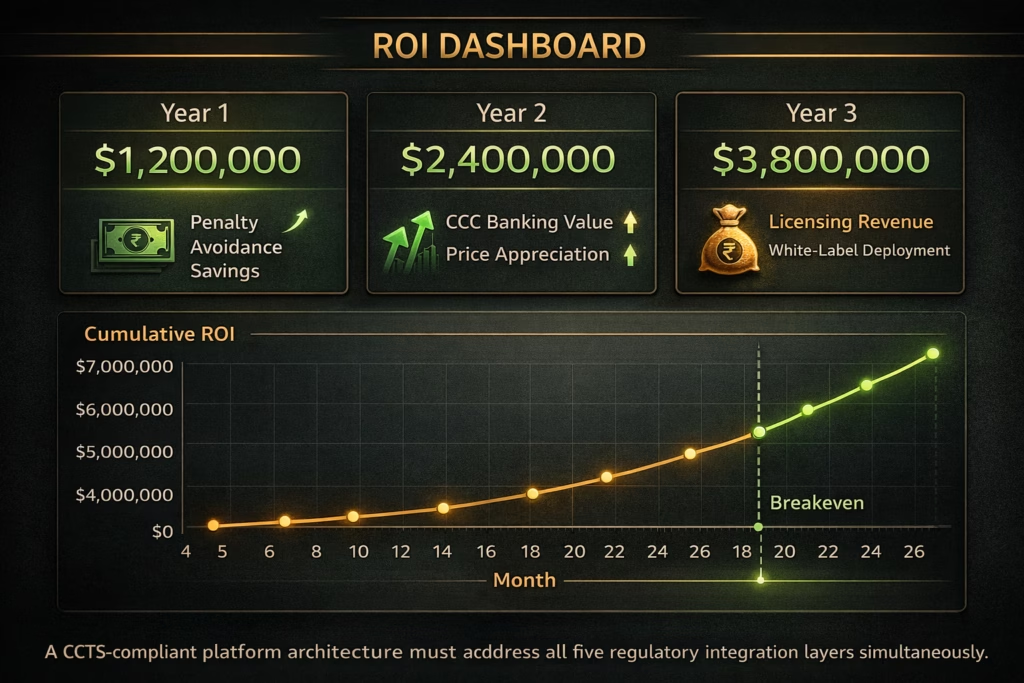
Building a carbon credit trading platform in India before H2 2026 trading commences delivers measurable ROI across three distinct vectors — none of which are purely speculative.
Vector 1: Penalty Avoidance Infrastructure Penalties apply if covered entities fail to meet their compliance obligations. For energy-intensive manufacturers currently without digital MRV and CCC management infrastructure, the first compliance cycle represents direct financial risk. A purpose-built platform converts that risk into a managed process — quantifiable as avoided penalty exposure across the first three-year compliance period.
Vector 2: CCC Price Timing Advantage With ₹600–900 per tonne pricing expected and unlimited banking of CCCs permitted, entities that overachieve their intensity targets in early cycles hold certificates with appreciating value. A carbon credit trading platform in India with real-time intensity tracking allows operators to make informed decisions about banking versus immediate sale — a function manual processes cannot perform with the necessary frequency.
Vector 3: Platform Licensing Revenue A carbon credit trading platform in India built to BEE compliance specifications can be licensed to adjacent entities — trade associations, state governments, supply chain networks — at high margins. The platform you build for your own compliance becomes infrastructure others will pay to access.
A carbon credit trading platform in India positioned for CCTS compliance is not a generic marketplace. The minimum viable architecture for compliance readiness includes:
A GHG Emission Intensity Calculation Engine that processes gate-to-gate Scope 1 and Scope 2 emissions data against sector-specific intensity targets notified by MoEFCC. An MRV Document Management System that supports BEE-accredited verifier workflows, annual audit submissions, and tamper-proof data trails. A CCC Registry Integration Layer connecting to the Grid Controller of India Limited registry for issuance and retirement. A Power Exchange Trading Interface for secondary market CCC transactions through CERC-regulated exchanges. And a Dual Market Module distinguishing compliance entity workflows from voluntary project developer workflows, with separate credit issuance logic aligned to BEE’s eight approved offset methodologies.
Companies that want to participate will need to register through India’s carbon market portal before they can trade carbon credits. Platform development that begins post-registration will be compressed by regulatory deadlines. The businesses initiating their carbon credit trading platform in India today will complete development, conduct testing, and be operational at market launch. Those who wait will be scrambling to meet compliance obligations without functional infrastructure.
India’s carbon market is set to move from blueprint to reality, with full-scale implementation expected by 2026. The regulatory framework is established. The obligated entities are notified. The methodologies for voluntary credits are approved. The national portal is live. What remains is the infrastructure layer — and that is precisely where the commercial opportunity and the compliance imperative converge.
A carbon credit trading platform in India is not a long-term R&D project. It is a 10–16 week development engagement that positions your organisation as infrastructure, not participant. In a market covering 700 million tonnes of CO₂e, the difference between owning the platform and using the platform is the difference between margin and fee, between data asset and data blindness, between first-mover advantage and late-entry cost.
The question is not whether India’s carbon market will need compliant platforms. It already does. The question is which organisations will build them before trading opens — and which will spend the next decade paying access fees to those that did.
If you are evaluating what a CCTS-compliant carbon credit trading platform in India looks like for your sector, timeline, and commercial objectives, the architecture decisions made in the next 90 days will determine your market position for the next decade. Let’s build yours.