

On the morning of March 26, 2026, Brent crude crossed $107 a barrel. Oil traders held their breath. CFOs across every energy-intensive sector scrambled to recalculate Q2 forecasts. And somewhere in the noise, a quieter, more consequential question surfaced one that most boardrooms are not yet asking:
What does $100+ oil mean for carbon credit trading platform development?
The answer is counterintuitive, commercially significant, and for the businesses reading this, time-sensitive.
Wars are terrible for short-term climate investment. Nobody disputes that. When the US-Israel strikes on Iran disrupted the Strait of Hormuz, and Brent surged 15% overnight, the initial narrative was predictable: energy security over climate ambition, fossil fuels back in the spotlight, green transition on pause.
But history disagrees with that narrative – and the data from the last three weeks of trading confirms it.
The same pattern played out in 2022 when Russia invaded Ukraine. Oil spiked. LNG markets fractured. Governments that had been drifting on clean energy suddenly found religion, not because they had a moral awakening, but because energy independence became the most urgent national security issue on the table. Europe deployed renewables at record speed. Solar and wind installations accelerated. And carbon markets? They expanded.
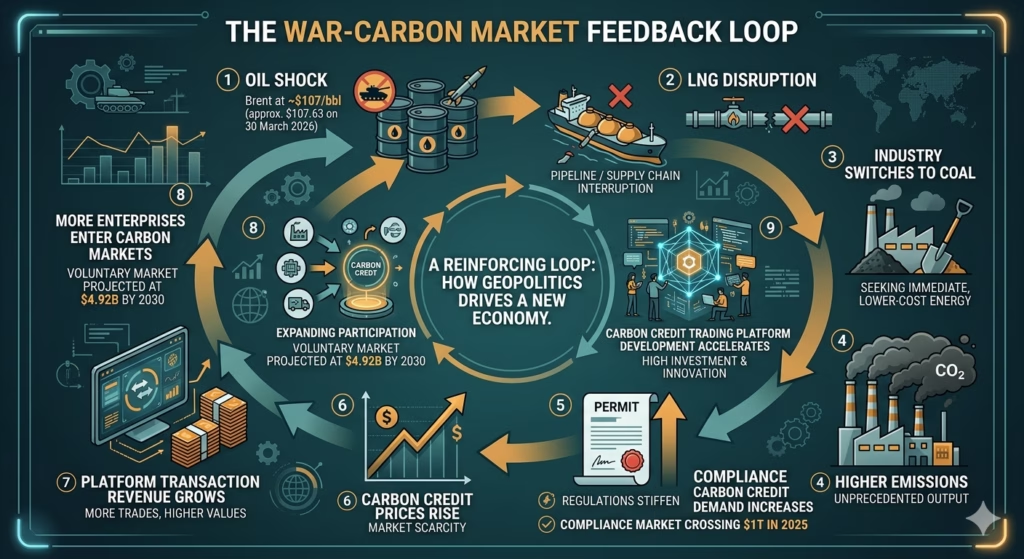
This time, the mechanism is clearer. Compliance carbon markets operate on a direct link to emissions: when industries burn more coal and heavy fuel oil as substitutes for restricted LNG, exactly what BloombergNEF analysts flagged is already happening in this conflict — their carbon liability increases. They must buy more credits. Carbon credit demand rises precisely when fossil fuel chaos strikes.
That is not a coincidence. It is the architecture of the system working exactly as designed.
Let us get specific, because this is where the ROI case for carbon credit trading platform development becomes undeniable.
The global carbon credit trading platform market was valued at $235.50 million in 2026 and is projected to reach $1.272 billion by 2034 – a CAGR of 23.47%. That trajectory was built on regulatory tailwinds alone. Now add a geopolitical multiplier that is forcing higher emissions in the short term while simultaneously making renewable energy more strategically attractive.
The voluntary carbon market, which reached $1.88 billion in 2025, is expected to climb to $2.29 billion in 2026 and $4.92 billion by 2030. Even under a war economy — where corporate spending tightens temporarily — the compliance market picks up the slack. When utilities burn coal because Qatari LNG is stuck behind a military blockade at the Strait of Hormuz, they generate carbon liabilities that cannot be deferred.
On European markets as of March 26, EUA carbon allowances for December 2026 were trading at €70.74 per tonne, firming upward as geopolitical tensions held. Energy market analysts noted that carbon, gas, and power prices are all now moving in lockstep with Middle East headlines. This is a structural integration that was not this visible before February 2026.
The practical implication for your business: Every week of elevated oil prices is a week where carbon compliance pressure intensifies, carbon credit platform transaction volumes grow, and the window for first-mover carbon credit trading platform development narrows.
Here is the mechanism that investors and enterprise strategists often underestimate.
Energy pain creates energy urgency. India, currently facing a weakening rupee and rising inflation from imported oil dependency, is accelerating solar deployment not as a climate gesture but as a survival strategy. Nations that relied on Qatari LNG through the Strait of Hormuz – now functionally impaired – are stress-testing every alternative they have. That urgency does not dissipate when the conflict ends. It crystallizes into policy, infrastructure, and procurement decisions that last a decade.
Each of those policy decisions generates carbon market activity. Carbon credit trading platform development sits at the infrastructure layer of all of it.
Consider the compliance pathway: As countries tighten emissions frameworks in response to temporarily elevated fossil fuel use, they need digital infrastructure to manage, verify, and trade carbon credits at scale. The EU’s Carbon Border Adjustment Mechanism is expanding. India’s Carbon Credit Trading Scheme under the Bureau of Energy Efficiency is formalizing. Saudi Arabia is advancing its own Greenhouse Gas Crediting and Offsetting Mechanism. These are not distant prospects — they are live market structures being built right now, and they all require robust carbon credit trading platform development to function.
Consider the voluntary pathway: ESG-driven corporates whose Q1 energy costs just jumped 20-30% are not abandoning net-zero commitments – they are looking for cost-efficient ways to meet them. A well-built carbon credit trading platform that aggregates high-quality credits, reduces broker spreads, and automates compliance reporting becomes a procurement tool, not just a sustainability checkbox.
Either way, the demand side of the carbon market is expanding. The question is who owns the infrastructure that serves it.
Let us be direct about why carbon credit trading platform development is a high-return investment in the current environment — and why that return is measurable, not aspirational.
Techaroha develops carbon credit trading platforms as purpose-built commercial infrastructure, not generic marketplace templates. Our implementations include smart contract-based credit issuance and retirement, AI-powered MRV verification that commands 15–25% credit price premiums, fractional tokenization for market liquidity, and real-time compliance dashboards aligned to EU ETS, CORSIA, India CCTS, and Article 6.4 frameworks.
For enterprises entering carbon markets in 2026, under the pressure of $100+ oil, rising compliance obligations, and tightening regulatory frameworks, the architecture decisions made at platform inception determine whether you build a $2M compliance tool or a $20M revenue-generating infrastructure asset.
The carbon market does not care whether peace negotiations succeed or fail. Compliance obligations accrue either way. Credit prices rise with geopolitical uncertainty. Transaction volume grows as more enterprises need to offset emissions they cannot yet reduce.
The paradox is real: war may be the most powerful accelerant carbon credit trading platform development has ever encountered.
The question is not whether to build. The question is whether you build before your competitors do.

Every major geopolitical shock in the last 20 years has produced one outcome in energy markets: it accelerated structural change that was already in motion. The 2022 Russia-Ukraine war fast-tracked European renewable deployment by years. The 2026 US-Iran conflict – with Brent at $107, the Strait of Hormuz impaired, and carbon allowance prices moving with war headlines – is fast-tracking carbon market infrastructure demand by the same magnitude.
The carbon credit trading platform development market is growing at 23.47% CAGR even without a geopolitical tailwind. With one, the enterprises that move in the next 90 days will define the infrastructure landscape for the rest of the decade.
Ready to build the carbon trading infrastructure your market needs?
Techaroha builds carbon credit trading platforms for enterprises, financial institutions, and climate-tech founders. From architecture to launch to scale – we build the infrastructure of climate capitalism.