
Imagine a market where pollution carries a price tag and cutting emissions creates tradeable assets worth billions. That’s the carbon credit market-one of the fastest-growing financial ecosystems of our time. With valuations set to soar from USD 1.4 billion today to as high as USD 250 billion by 2050, carbon credits are becoming the next big frontier for investors hungry for profit and impact. What Exactly Are Carbon Credits? The Stock Market Parallel Think of carbon credits as shares in the environment. Just as a stock certificate represents ownership in a company, a carbon credit represents one metric ton of carbon dioxide (or equivalent greenhouse gas) that has been removed from the atmosphere or prevented from entering it. Here’s where it gets interesting for investors: these aren’t abstract environmental tokens. They’re tradeable financial instruments with real market prices, supply-demand dynamics, and profit potential. There are two primary types of carbon credits, similar to how the stock market has different classes of securities: Carbon Allowances (Compliance Market) function like government-issued permits. Governments set a cap on total emissions and distribute allowances to companies, essentially limiting how much they can pollute. If a company emits less than its allowance, it can sell the surplus. If it exceeds its limit, it must buy additional allowances or face penalties. Think of these as regulated securities traded on formal exchanges. Carbon Offsets (Voluntary Market) work more like corporate bonds-companies voluntarily purchase these credits to offset their emissions by funding projects that reduce or remove greenhouse gases. These credits come from projects like renewable energy installations, reforestation initiatives, or carbon capture technology. The key distinction? Allowances are about permission to emit (trading pollution permits), while offsets are about compensation for emissions already released (paying for environmental projects elsewhere). The Market Mechanics: How Carbon Credit Trading Actually Works If you understand how stock markets operate, you’ll grasp carbon markets quickly. The fundamental principle is identical: supply meets demand through transparent trading platforms, and prices fluctuate based on market forces. The Supply Side: Project Developers as “IPOs” Carbon credits enter the market through environmental projects, similar to how companies enter stock markets through IPOs. Here’s the process: Project Creation: Developers identify opportunities to reduce emissions-building wind farms, protecting forests, capturing methane from landfills, or implementing energy efficiency improvements. Validation & Verification: Independent third-party auditors (think of them as the SEC of carbon markets) verify that projects genuinely reduce emissions and meet strict quality standards. This prevents “greenwashing” and ensures credit integrity. Credit Issuance: For every verified ton of CO2 prevented or removed, one carbon credit is issued with a unique serial number, preventing double-counting. Market Entry: Credits are listed on registries and become available for trading on various platforms and exchanges. The Demand Side: Who’s Buying and Why? Multiple buyer categories create demand, each with distinct motivations: Compliance Buyers: Companies in regulated industries (utilities, manufacturing, aviation) must purchase credits to meet government-mandated emission caps. This creates guaranteed demand similar to dividend-paying utilities-stable, predictable, and growing. Voluntary Corporate Buyers: Companies like Meta, Apple, and Netflix purchase credits to meet net-zero commitments and enhance their ESG credentials. Tech giants are leading the charge towards net-zero targets by 2030, while major mining companies and energy giants are making similar commitments. Financial Investors: Hedge funds, banks, and institutional investors trade carbon credits for profit, bringing liquidity and sophistication to the market. Among new entrants in voluntary carbon markets in 2021, oil and gas majors, hedge funds, and banks were among the most active players. Speculators: Traders betting on future price appreciation, similar to commodity futures traders. Trading Platforms: The Stock Exchanges of Carbon Just as stocks trade on NYSE, NASDAQ, or BSE, carbon credits trade on specialized platforms. The market infrastructure mirrors traditional financial markets with increasing sophistication. Major exchanges for carbon credits include New York-based Xpansiv CBL and Singapore-based AirCarbon Exchange, which have created standardized products to simplify trading. In 2022, Zerocap partnered with ANZ Bank and Beta Carbon to successfully trade tokenized Australian carbon credits using blockchain technology. The European Union Emissions Trading System (EU ETS), launched in 2005, remains the most liquid and mature carbon futures exchange. The EU carbon futures market has surged over 1,400% in the last five years, demonstrating the explosive growth potential that early investors have captured. Other major trading systems include: Price Dynamics: Understanding Carbon Credit Valuations Like stocks, carbon credit prices fluctuate based on supply, demand, and market sentiment. However, several unique factors drive valuations: Quality and Type: Not all carbon credits trade at equal prices. Removal credits (which actively remove CO2 from the atmosphere through technology or nature) command premium prices compared to avoidance credits (which prevent future emissions). Removal credits recently accounted for about a third of retirement value, around USD 500 million, despite historically representing less than 20% of market value. Vintage Year: The year a credit was issued affects its value. Recent vintages typically trade at higher prices as they reflect current standards and methodologies. Project Type: Credits from nature-based solutions (forestry, agriculture) often trade differently than technology-based solutions (renewable energy, carbon capture). Investors can choose exposure based on their preferences, similar to selecting growth stocks versus value stocks. Regulatory Environment: Government policies dramatically impact prices. Stricter emission caps, new climate legislation, or carbon border adjustment mechanisms can send prices soaring. Market Sentiment: Corporate net-zero commitments, climate conferences, and public awareness all influence demand and pricing. Current market conditions show interesting dynamics. Average spot prices for carbon credits were around USD 4.8 per tCO2e in 2024, down 20% from 2023, creating potential entry opportunities for value-oriented investors who believe in long-term market growth. Investment Vehicles: How to Get Exposure For investors wanting carbon credit exposure, several pathways exist, each with different risk-return profiles: Direct Carbon Credit Investment Purchase credits directly from project developers or through brokers, then hold and sell when prices appreciate. This approach requires understanding project quality, verification standards, and market timing-essentially like picking individual stocks. Carbon Futures and Options Trade futures contracts on major exchanges,

Carbon markets are hailed as a cornerstone of climate finance, enabling companies and nations to offset emissions by purchasing carbon credits. Yet, despite their promise, carbon credit exchanges remain riddled with trust deficits, inefficiencies, and opaque verification systems. Smart contracts—self-executing agreements coded on blockchain—are increasingly seen as the solution. But beyond transparency and automation, there’s a deeper, underexplored dimension: embedding ethics directly into code. This perspective reframes smart contracts not just as financial tools but as digital guardians of climate justice. What Are Carbon Credits and Why Do They Matter? Yet, scandals around double counting, unverifiable projects, and speculative trading have eroded trust. This is where smart contracts step in. What Are Smart Contracts? Smart contracts are blockchain-based agreements that execute automatically when conditions are met. The Role of Smart Contracts in Carbon Credit Exchanges 1. Automated Issuance of Credits Smart contracts can issue credits once verified emissions data is uploaded, cutting bureaucratic delays. 2. Transparent Verification By integrating IoT sensors and oracles, smart contracts validate projects in real time, reducing fraud. 3. Peer-to-Peer Trading Credits can be traded instantly without brokers, lowering costs and democratizing access. 4. Retirement of Credits Smart contracts automatically retire credits once used, ensuring they cannot be resold. 5. Integration with DeFi and Green Bonds Projects like Project Genesis 2.0 show how smart contracts can attach carbon credits to green bonds, creating hybrid sustainable finance instruments. Benefits of Smart Contracts in Carbon Credit Exchanges Benefit Impact Transparency Immutable blockchain records prevent fraud and double counting Efficiency Automated issuance and trading reduce delays and costs Accessibility Tokenized credits allow global participation Trust Code-enforced rules minimize disputes Scalability Enables integration with DeFi, IoT, and global markets Challenges and Risks Case Studies Unique Perspective: Programmable Ethics in Smart Contracts Most discussions focus on efficiency and transparency. But the real innovation lies in embedding ethics into code: This perspective reframes smart contracts as ethical instruments, not just financial ones. Competitors often overlook this dimension, focusing narrowly on automation. By embedding programmable ethics, carbon markets can evolve into trustworthy, justice-driven ecosystems. Future Outlook Conclusion Smart contracts are revolutionizing carbon credit exchanges by ensuring transparency, automation, and trust. But their true potential lies in programmable ethics—embedding fairness, equity, and climate justice directly into code. This unique perspective positions smart contracts not just as digital tools but as moral compasses for global carbon markets.
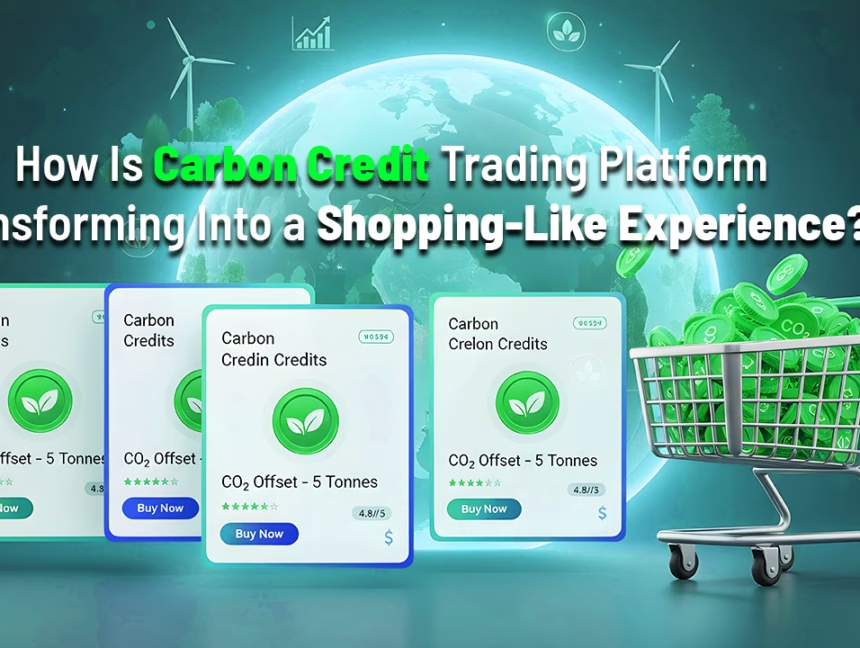
What if trading carbon credits felt as easy as shopping on your favourite online store? At a time when sustainability is reshaping global business, the world needs a simpler, transparent, and intuitive way to participate. This is exactly where technology and Techaroha’s innovation change everything. Why Carbon Credit Trading Needs a Shopping-Like Experience Carbon credits have rapidly evolved from an environmental tool to a mainstream business necessity. Governments, investors, and consumers increasingly expect organizations to demonstrate measurable carbon reduction. And yet, the very process meant to accelerate sustainability buying and selling carbon credits often feels unnecessarily difficult. Most traditional carbon credit exchanges were not designed for everyday users. Their interfaces resemble financial terminals: cluttered dashboards, cryptic terminology, and limited visibility into project authenticity. For many businesses, especially mid-sized or non-financial ones, this creates a psychological barrier. They want to offset emissions, but the platforms make it overwhelming. The Pain Points: This mismatch between the urgency of climate action and platform usability inspired Techaroha to rethink the entire experience. Techaroha’s Vision: Making Sustainability Simple At Techaroha, we believe meaningful climate action should be accessible, not restricted behind complex trading systems. While developing a full-scale Carbon Credit Trading Platform for a client, we reimagined the journey from browsing to purchasing, drawing inspiration from the world’s most intuitive e-commerce interfaces. Our approach was guided by a fundamental question: “Why can’t carbon credit trading feel like online shopping?” If consumers can buy a product with two taps, why can’t businesses purchase carbon credits with similar ease? This single idea reshaped the architecture, usability, and entire philosophy of the platform. A Shopping-Like Carbon Credit Experience: How It Works 1. Browse Like a Marketplace Instead of complicated filters or spreadsheets, businesses can explore carbon credits through a familiar layout- just like browsing product categories on leading marketplaces. This categorized approach reduces intimidation and enhances discoverability. Users can visually compare project types based on what matters most to them: impact, region, price, or certification. 2. Detailed “Product” Pages With Storytelling One of the biggest barriers in traditional platforms is the lack of context. Techaroha’s platform solves this by treating every carbon credit like a detailed product page: This narrative-driven approach transforms credits from abstract numbers into meaningful, traceable climate actions. 3. Transparent Pricing & an Intuitive Cart System Businesses can: This eliminates the ambiguity of auctions, bids, or unclear pricing norms. Everything feels modern, structured, and familiar-just like online shopping. 4. Blockchain-Backed Verification Trust is the backbone of carbon markets. Without it, adoption collapses. Techaroha’s platform integrates blockchain-based verification, ensuring: This adds transparency that traditional systems lack and builds long-term confidence among buyers, auditors, and regulators. 5. Unified Analytics Dashboard Businesses can view: This central hub removes the need for external tracking or spreadsheets. Benefits for Businesses 1. No Expertise RequiredEven organizations without environmental or financial experts can participate confidently. 2. Trust and TransparencyBlockchain-backed verification, detailed project pages, and standardized pricing build credibility. 3. Scalable for AllWhether a startup offsetting 10 tons or an enterprise offsetting 50,000 tons, the system scales seamlessly. 4. Enhances Brand ValueBusinesses can display credible climate action data to customers, investors, and regulatory bodies. 5. Operational EfficiencyAutomated compliance, instant reports, and clear workflows reduce the administrative burden. How Carbon Plant Exchange Demonstrates This Vision One of the most compelling examples of Techaroha’s innovation is Carbon Plant Exchange, a robust carbon credit marketplace we developed for a global client. The platform is available at carbon-plant. co-represents the practical execution of a shopping-like experience in the carbon world. Key Highlights of Carbon Plant Exchange 1. User Experience Inspired by Modern E-Commerce Carbon Plant Exchange feels less like a financial tool and more like a clean, intuitive online marketplace. The entire purchasing flow is designed to be effortless, even for first-time users. 2. Marketplace for Diverse Credits Credits are categorised by project types, regions, and impact metrics. This mirrors the browsing experience people are accustomed to when buying everyday products. 3. Blockchain-Integrated Verification Layer The platform integrates blockchain verification for credit origin, issuance, retirement, and documentation, ensuring complete transparency. 4. Built-in Buyer Dashboard Carbon Plant Exchange includes a buyer analytics module, allowing users to track their sustainability impact and download compliance reports instantly. 5. Enterprise-Ready Architecture Designed for scale, the platform supports: This real-world platform is proof that carbon trading can be made simple, secure, and engaging. Why Shopping-Like Design Is the Future of Carbon Markets The global carbon market is expected to exceed $100 billion in the next few years, fueled by stricter ESG regulations and rising corporate responsibility. In such a landscape, usability becomes a competitive advantage. 1. E-Commerce Has Trained the World People expect: Carbon trading must adapt to these expectations to go mainstream. 2. Businesses Need Speed Sustainability teams are expected to act quickly, often with limited manpower. A smooth shopping-like UX reduces learning curves and accelerates decision-making. 3. Trust Must Be Earned, Not Assumed Transparency, verification, and clarity-features that define modern e-commerce are equally essential in the carbon credit ecosystem. 4. Democratization of Climate Action A simplified interface empowers: The transformation of UX is not just a design shift- it’s an enabler of global participation. Techaroha’s Role in Driving Change Techaroha has positioned itself at the intersection of fintech, sustainability, and advanced technology. Our expertise lies in transforming complex processes into human-friendly digital experiences. Our Strengths Include: By combining these capabilities, we create platforms where sustainability is not a burden- but an effortless part of business. Carbon Plant Exchange, along with other custom solutions delivered for clients, demonstrates our commitment to making climate action scalable, transparent, and engaging. Future Possibilities in Carbon Credit Trading: What Comes Next? The shopping-like carbon credit experience is just the beginning. Future enhancements can include: 1. Subscription-Based OffsettingMonthly automatic offset plans- like subscribing to a streaming service. 2. AI-Powered Credit RecommendationsSuggesting optimal carbon credits based on industry, emission patterns, and ESG goals. 3. Tokenized Carbon CreditsCredits represented as digital assets for global liquidity and traceability. 4. Integration With Corporate ERP & ESG PlatformsSeamless sync with
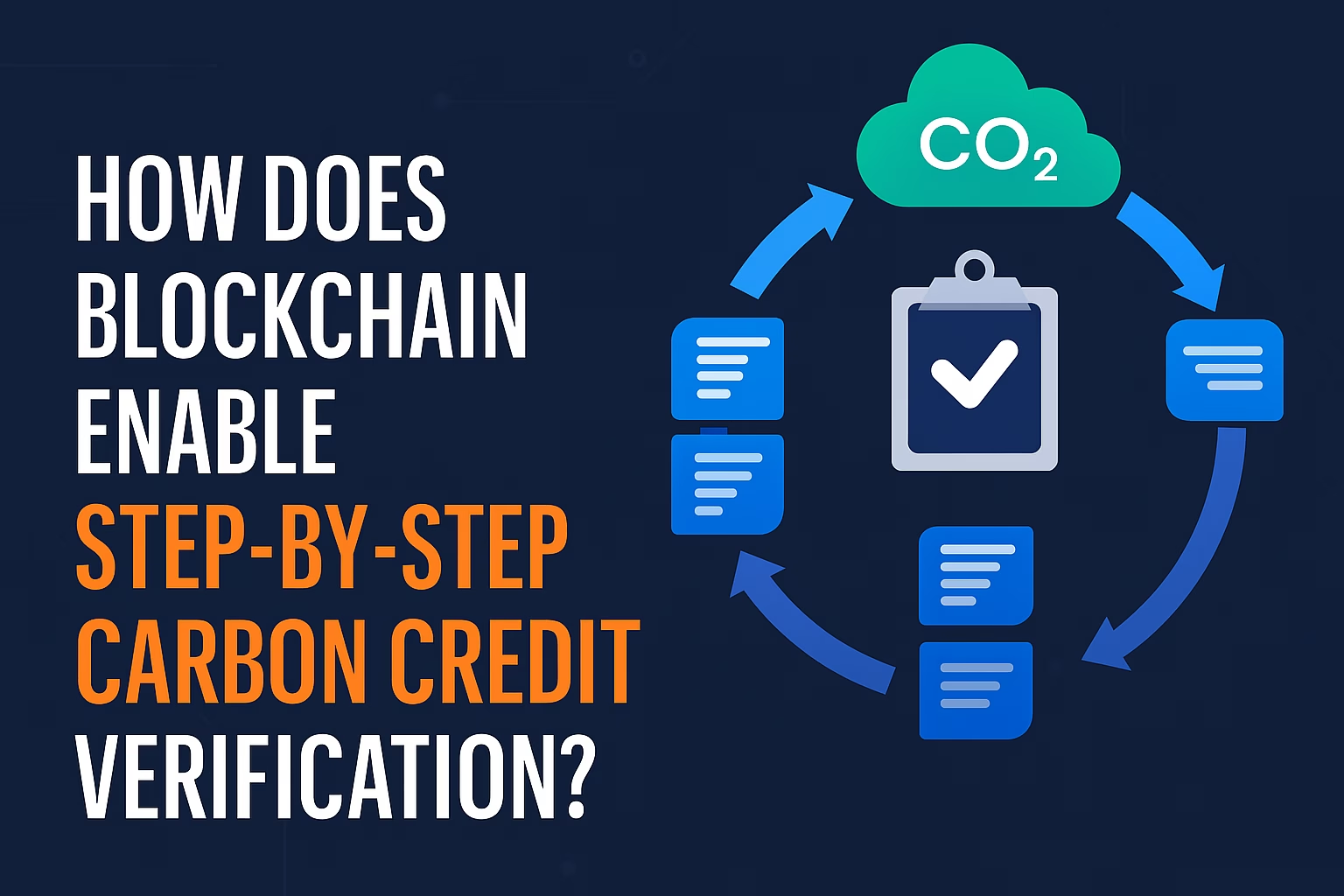
Blockchain carbon credit verification follows a clear workflow: data capture, on-chain logging, automated checks, third-party validation, credit tokenization, and transparent registry updates. Traditional verification faces delays, manual paperwork, double counting, and poor traceability. Blockchain fixes these issues by recording data immutably, enabling real-time validation, automating approval steps, and creating a transparent audit trail. Each project’s data moves through a step-by-step workflow that ensures authenticity, accuracy, and fraud-free carbon credit issuance. Key Takeaways of Blockchain carbon credit verification Step What Happens Who Is Involved How Blockchain Helps 1 Project data collected Project Developer Creates tamper-proof digital record 2 Data uploaded on-chain Field Team / IoT Systems Ensures immutability and timestamps 3 Smart contract checks Blockchain Protocol Automates eligibility validation 4 Third-party verification Auditor / Verifier Provides transparent access to evidence 5 Credit approval & tokenization Registry / Administrator Prevents duplication, assigns unique ID 6 Registry update & tracking Buyers / Market Participants Enables transparent lifecycle monitoring Below is the complete Step-by-Step Blockchain Workflow (Main Body) with all 10 steps, each containing: Step-by-Step Blockchain Workflow for Carbon Credit Verification 🔹 Step 1 – Project Data Collection on Ground What happens:Carbon project data—like tree count, energy generation, methane capture, or biomass levels—is collected using IoT sensors, satellite imagery, drones, and manual field logs. Who performs it:Project Developer, Field Technicians, IoT devices. How blockchain transforms this:Raw measurements are captured with digital signatures and assigned unique IDs before moving on-chain, ensuring the data cannot be altered later. Example:A solar plant logs 5,200 kWh/day of renewable energy using IoT meters synced to a blockchain gateway. 🔹 Step 2 – Data Upload to Blockchain (Immutable Entry) What happens:Collected data is uploaded as hashed, timestamped records on the blockchain. Who performs it:Project Developer or automated IoT integration. How blockchain transforms this:Every entry becomes tamper-proof. Even if a PDF or sensor file changes, the mismatch between hash values exposes manipulation. Example:A forest project uploads GPS-tagged biomass readings from three sample plots, each receiving a blockchain timestamp. 🔹 Step 3 – Smart Contract Initiation What happens:Smart contracts automatically run eligibility checks based on methodology rules (CDM, Verra VCS, Gold Standard, etc.). Who performs it:Blockchain protocol + Project Developer initiates. How blockchain transforms this:Rules for MRV, emission factors, leakage, baselines, and monitoring periods run automatically without human bias. Example:A contract checks if a project meets the minimum canopy density required for afforestation eligibility. 🔹 Step 4 – Third-Party Verification Workflow Activation What happens:The verifier receives permissioned access to the project’s encrypted data bundle. Who performs it:Verifier / Auditor (VVB). How blockchain transforms this:The verifier sees the complete audit trail from day one, reducing the back-and-forth communication that normally takes weeks. Example:An auditor accesses satellite NDVI data and field photos recorded over 18 months, fully stored on-chain. 🔹 Step 5 – On-Chain Validation & Authenticity Checks What happens:Verifiers cross-check on-ground measurements, methodologies, GPS coordinates, and device logs against blockchain-stored records. Who performs it:Verifier. How blockchain transforms this:No record can be altered or backdated, making authenticity verification faster and far more reliable. Example:Verifier confirms that all 42 measurement points match the immutably logged coordinates. 🔹 Step 6 – Smart Contract-Based Approval or Rejection What happens:Once verification is complete, smart contracts trigger an automated approval or rejection. Who performs it:Verifier initiates; smart contract executes. How blockchain transforms this:Reduces human error and processing time by auto-checking criteria like monitoring period, data completeness, and baseline compliance. Example:A project is auto-approved after it meets all 17 validation criteria, speeding up a process that traditionally takes months. 🔹 Step 7 – Carbon Credit Tokenization (NFT or Fungible Tokens) What happens:Approved credits are tokenized as NFTs (unique identifiers) or fungible tokens (where credits are identical). Who performs it:Registry / Blockchain Platform. How blockchain transforms this:Prevents double counting because each credit has an immutable ID, traceable from creation to retirement. Example:1,000 carbon credits become 1,000 NFTs, each tagged with metadata: project type, date, location, and verifier. 🔹 Step 8 – Registry Update + Public Audit Trail What happens:The carbon registry updates issuance records and publishes a transparent, blockchain-backed audit trail. Who performs it:Registry Admin. How blockchain transforms this:Any stakeholder can view credit provenance, ensuring global trust. Example:A buyer can check the full chain—from emission reduction data → verification → tokenization—before purchasing. 🔹 Step 9 – Marketplace Listing or Transfer What happens:Credits are listed on a carbon exchange, sold P2P, or transferred to corporate buyers. Who performs it:Project Developer, Brokers, Buyers. How blockchain transforms this:Traceability and authenticity are visible to every buyer, helping them meet ESG and audit requirements. Example:A corporation purchases 500 credits and immediately verifies their origin using blockchain explorer. 🔹 Step 10 – Retirement & Post-Retirement Reporting What happens:When a buyer uses a credit for offsetting, it is permanently marked as retired on the blockchain. Who performs it:Buyer / Registry Admin. How blockchain transforms this:No possibility of reusing or reselling the credit—retirement becomes permanently recorded. Example:A retired credit automatically updates a company’s net-zero dashboard, proving compliance to auditors. Practical Value (Real-World Use Cases) Blockchain is not just a theoretical improvement—it delivers measurable benefits across real carbon project types. Here’s how it strengthens speed, accuracy, and trust in each use case: 🔹 Renewable Energy Projects (Solar, Wind, Hydro) How blockchain helps: Example:A solar plant uploads real-time 5-minute interval energy logs. Blockchain timestamps prevent any retroactive editing, ensuring accurate emission-reduction calculations. 🔹 Waste Management & Biogas Capture Projects How blockchain helps: Example:A landfill gas project records methane capture data directly from flow meters. Auditors verify the readings without needing manual spreadsheets, reducing verification time by over 40%. 🔹 Forestry & Afforestation Projects How blockchain helps: Example:A reforestation program uploads NDVI-based biomass data for each hectare. Blockchain guarantees that no two credits can be issued from the same area. 🔹 Community Carbon Programs (Clean Cookstoves, Water Filters) How blockchain helps: Example:Each cookstove uses a QR code scanned monthly by local field monitors; the usage logs sync to the blockchain, making the process transparent for buyers funding social-impact projects. Tools, Platforms & Standards (Vendor-Neutral Overview) A trustworthy carbon credit system must