
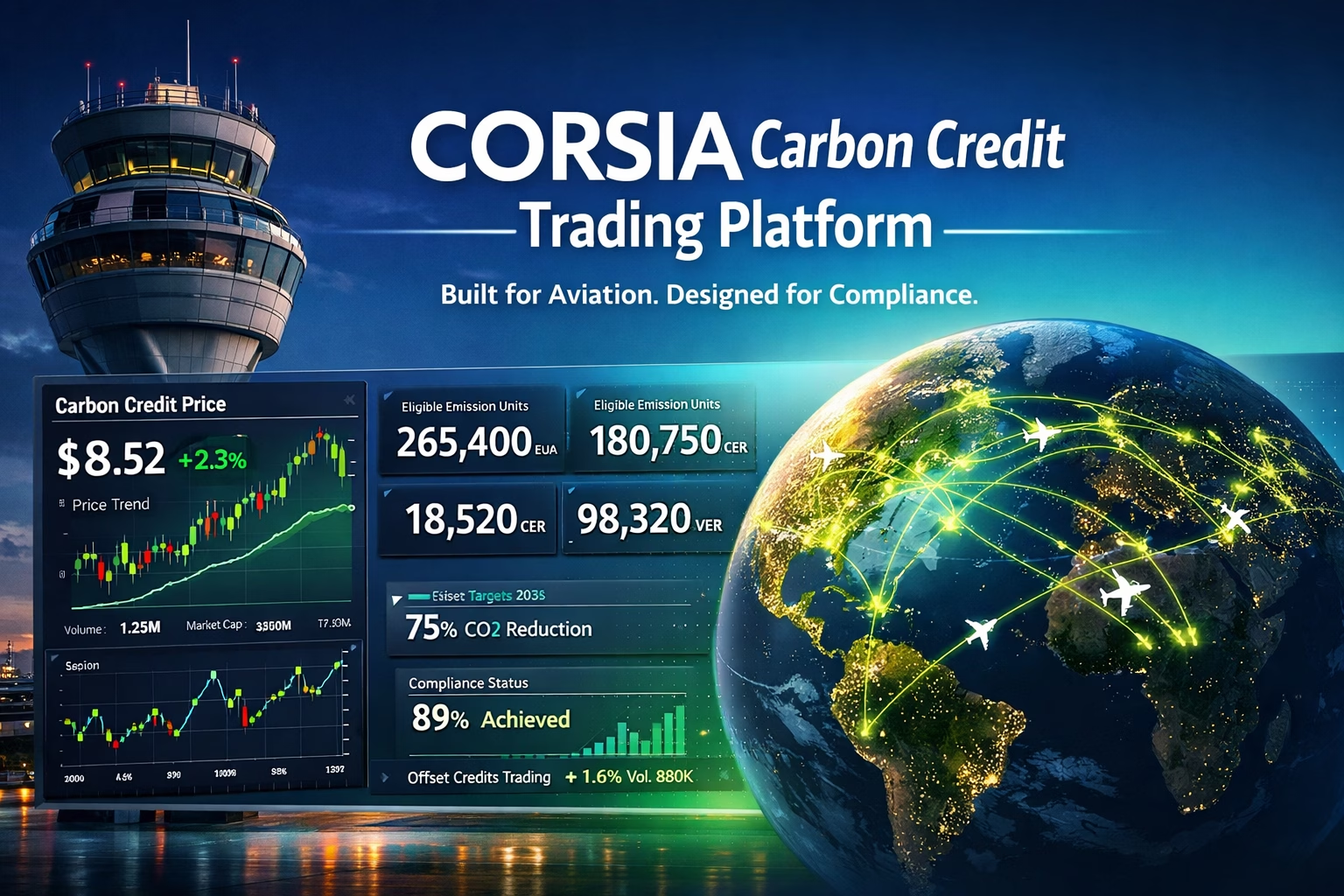
Most conversations about CORSIA start and end at compliance. What registry is approved? Which credits are eligible? How many tonnes does our airline need to offset?
Those are the wrong questions to lead with if you’re serious about turning regulatory obligation into competitive advantage.
CORSIA Phase 1 launched on January 1, 2024, requiring airlines operating international flights between 126 participating countries to offset emissions above 2019 levels using approved carbon credits. And the compliance cost is already significant, IATA estimates it will grow to $1.7 billion for 2026, up from $1.3 billion for 2025.
Here is what most airlines and aviation stakeholders are missing: the organisations that will win in this market are not the ones that simply buy credits at the last moment. They are the ones that build or commission a purpose-built CORSIA carbon credit trading platform and use it to procure smarter, faster, and with lower unit cost than their competitors.
This guide breaks down exactly how to build that platform, what it must do, and critically, what the ROI case looks like for aviation operators and intermediaries who move before Phase 2 makes participation mandatory.
CORSIA has tight rules on accepted registries and methodologies, and there is already a notable mismatch between demand and currently visible supply, with airlines expected to need between 146 to 236 million EEUs during Phase 1.
This is not a standard commodities trading problem. A CORSIA carbon credit trading platform must handle compliance-grade eligibility filtering at the asset level, Letter of Authorization (LoA) status tracking per project, corresponding adjustment verification under Article 6, and MRV (Monitoring, Reporting, and Verification) audit trails that satisfy ICAO’s Central Registry requirements. Off-the-shelf platforms were not built for this. They were built for voluntary markets where the eligibility bar is lower, and the regulatory consequences of a wrong purchase are essentially nil.
For airlines, a non-compliant credit purchase does not just waste money. It creates a compliance gap that must be remedied under a hard regulatory deadline with ICAO oversight and state-level enforcement.
Your CORSIA carbon credit trading platform must automatically filter and flag credits against the current ICAO-approved registry list, which includes Verra, Gold Standard, ART TREES, and Isometric (recently approved for carbon removal credits). ICAO has also approved Isometric to issue its verified carbon removal credits to airlines under CORSIA, meaning your platform’s eligibility layer must be updateable in near-real time as ICAO decisions evolve.
Static eligibility lists are a liability. Build a dynamic eligibility API that pulls directly from ICAO’s CORSIA Central Registry updates.
As recently as mid-2025, supply of EEUs was limited to a single ART TREES project in Guyana as a result of a bottleneck caused by the slow issuance of Letters of Authorization from carbon project host country governments. Airlines that could track LoA pipeline status in real time had a structural procurement advantage; they could commit early to credits that became eligible, locking in prices before demand spikes.
Your CORSIA carbon credit trading platform should integrate host-country LoA status feeds, registry issuance data, and forward supply forecasting so procurement teams can act on intelligence — not just availability.
The IATA Aviation Carbon Exchange connects to electronic interfaces with registries to facilitate seamless trading, and this is the baseline expectation for any serious platform. Your build needs native API integrations with Verra, Gold Standard, ART TREES, and emerging national programme registries. Credit retirement must be automated and timestamped with ICAO-formatted audit outputs, reducing the manual compliance burden on airline sustainability teams by 60–80%.
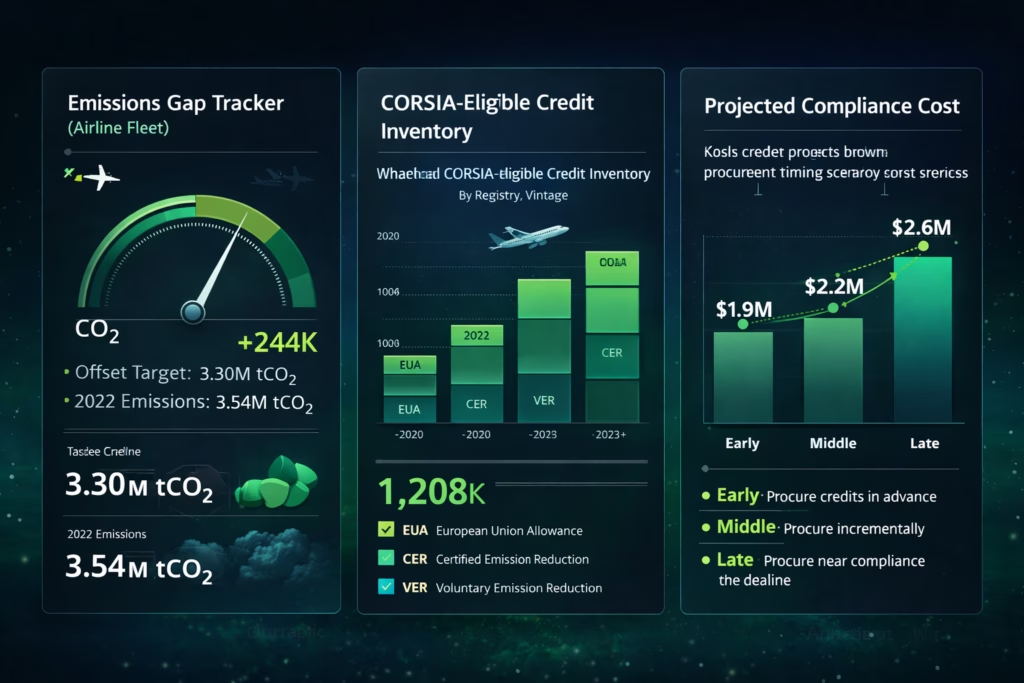
Airlines need to know their obligation in real time, not at year end. Integrate ICAO’s sector growth factor methodology with your own fleet-level emissions data to produce a live offset gap dashboard. This single module alone typically eliminates the over-procurement problem that inflates compliance costs by 15–25% for airlines operating manually.
The IATA Aviation Carbon Exchange offers seamless and secure in-fund trading for airlines using the IATA Invoicing and Clearing House system. If you are building a proprietary CORSIA carbon credit trading platform, you need equivalent settlement confidence either through integration with IATA’s clearing infrastructure or through a dedicated escrow and delivery-versus-payment framework. Counterparty risk is not theoretical in carbon markets; developer-side failures have already cost airlines access to supply they had contractually anticipated.
Let’s be direct about the economics.
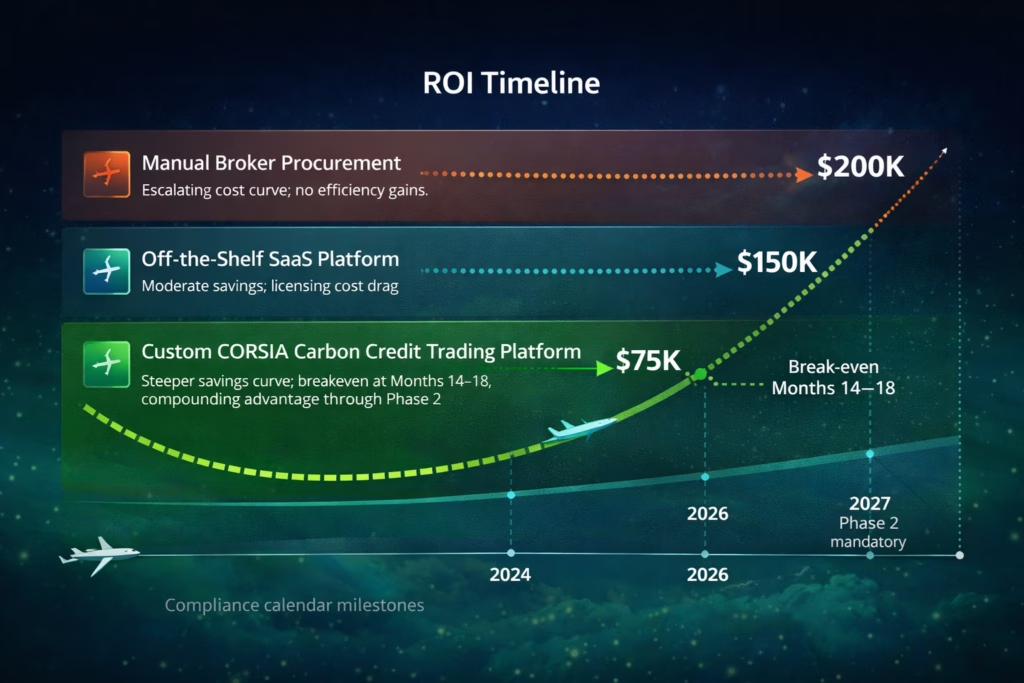
Development investment for carbon credit trading platforms typically ranges from $150,000 to $500,000 depending on complexity, and at enterprise subscription levels, that can be recovered within 12–18 months.
For a mid-sized international airline procuring 2–5 million EEUs across Phases 1 and 2, the ROI of a purpose-built CORSIA carbon credit trading platform compounds across four vectors:
Procurement timing advantage: Airlines with live supply intelligence and automated eligibility screening can execute purchases 3–6 weeks faster than those operating through brokers or manual processes. Trades under IATA’s 2024/25 sales framework have settled near USD 21.70 per tonne. A $1–2 per tonne procurement advantage across 3 million units is $3–6 million in savings from platform intelligence alone.
Compliance penalty avoidance: ICAO’s compliance deadlines are not soft. Airlines that cannot demonstrate adequate EEU retirement face reputational and regulatory consequences in participating states. A purpose-built platform eliminates the manual reconciliation errors that create compliance gaps.
Internal carbon pricing capability: Airlines that own their CORSIA carbon credit trading platform infrastructure can extend it to route-level carbon cost allocation, embedding a shadow carbon price into network planning and pricing decisions. This is not just a sustainability metric; it is a route profitability tool.
Phase 2 readiness at zero incremental cost: CORSIA’s mandatory phase begins in 2027, covering all international flights. Airlines that build their platform now amortise development cost across both phases. Those that wait face compressed timelines, premium development rates, and a market where credit prices are structurally higher.
Building a CORSIA carbon credit trading platform is not a generic fintech project. Your development partner needs demonstrated experience across three domains simultaneously: carbon market regulatory architecture (ICAO, VERRA, Article 6), financial exchange infrastructure (settlement, clearing, order management), and aviation operational data integration (fleet emissions, route-level MRV).
The platforms that fail in compliance markets almost always fail at the intersection of these three. They build excellent trading UX on top of compliance logic that hasn’t been stress-tested against real regulatory edge cases.
A partner that has built in adjacent compliance markets EU ETS, India’s CCTS, voluntary carbon registries, and understands how those frameworks interact with CORSIA’s eligibility layer will compress your build timeline by 30–40% and substantially reduce post-launch compliance risk.
The next 18–24 months will determine whether airlines can procure credits at scale, whether host countries can deliver robust Article 6 infrastructure, and whether carbon project developers can secure the insurance and investment needed to bring new supply to market.
Airlines that build their CORSIA carbon credit trading platform now will enter that supply competition with infrastructure advantage, real-time intelligence, automated eligibility screening, and settlement speed that broker-dependent competitors simply cannot match.
The compliance clock is running. The question is not whether your airline needs a CORSIA carbon credit trading platform. The question is whether you build yours before your competitors do or after.
Ready to scope a CORSIA carbon credit trading platform built specifically for your aviation compliance needs? Let’s talk about your Phase 1 obligations, Phase 2 roadmap, and the platform architecture that turns regulatory cost into strategic advantage. Visit Techaroha to know more about the Carbon Credit Trading Platform.