

The carbon credit market is no longer experimental.
Compliance markets were valued at $113.1 billion in 2024 and are projected to reach $458 billion by 2034, according to global climate finance projections from institutions such as the World Bank and market analysts at BloombergNEF.
But here’s the strategic question most enterprises miss:
Are you participating in the carbon market — or owning the infrastructure it runs on?
Because the real money isn’t in buying or selling credits.
It’s in owning the platform where they trade.
If you are considering building a carbon credit trading platform, this is not a sustainability play.
It’s a financial infrastructure play.
Stock exchanges don’t speculate on stocks.
They monetize access, execution, listings, and data.
Carbon marketplaces operate the same way.
Every event on your platform becomes billable:
The strongest carbon credit marketplace revenue model is not a single stream.
It is a layered revenue architecture.
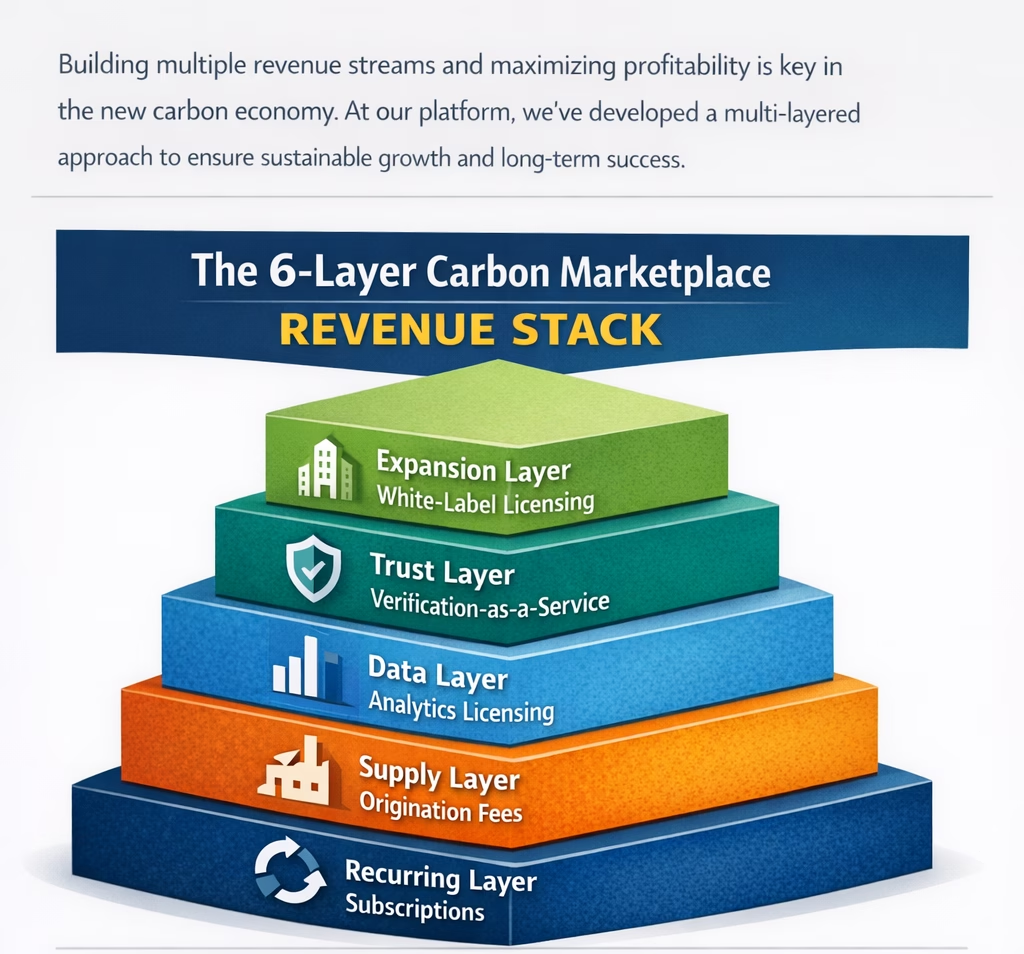
High-performing platforms activate all six.
2–5% per trade is industry standard.
Example:
500,000 tonnes annually at $40/tonne
3% fee = $600,000/year
At 2M tonnes, that becomes $2.4M/year.
Transaction fees scale automatically with liquidity.
Turn your marketplace into SaaS.
Typical structure:
Even 50 enterprise subscribers generate $2.4M/year in recurring revenue — independent of trade activity.
This stabilizes cash flow and increases valuation multiples.
Most platforms monetize buyers.
Smart platforms monetize both sides.
Charge:
Each project becomes a multi-year revenue source over a 10–25 year lifecycle.
Every trade generates proprietary data:
Package it as:
Data licensing is typically the highest-margin stream.
You build once.
You monetize repeatedly.
Premium verified credits trade significantly higher.
If your platform integrates workflows aligned with standards like:
You can charge processing fees for streamlined verification.
Trust increases price per tonne.
Higher price per tonne increases your transaction revenue.
Banks, sustainability consultancies, and energy companies may want branded exchanges without building from scratch.
White-label licensing typically includes:
This expands your footprint without proportional sales expansion.
Conservative mid-sized marketplace:
Total: $11.4M+ annually
From infrastructure built once.
This is why revenue architecture matters before development begins.
India is rapidly formalizing its compliance ecosystem through the Carbon Credit Trading Scheme (CCTS) under the guidance of the Ministry of Power and operational oversight by the Bureau of Energy Efficiency.
This signals structural demand for:
India is in an early infrastructure build phase.
That creates a first-mover advantage for enterprises that launch compliant carbon trading platforms now — before regulatory maturity locks in dominant players.
Off-the-shelf solutions:
Custom-built carbon exchange software:
Development investment typically ranges from $150,000–$500,000 depending on complexity.
At enterprise subscription levels, that can be recovered within 12–18 months.
After that, infrastructure compounds.
When voluntary markets scale toward projected multi-billion-dollar levels this decade, the largest beneficiaries will not be occasional traders.
They will be the infrastructure owners.
The enterprises that:
Those are the platforms that build durable, defensible, high-margin revenue engines.
The key question is not:
“Can we enter the carbon market?”
The real question is:
“How do we design a platform that monetizes every layer of the ecosystem?”
We work with enterprises, sustainability leaders, financial institutions, and climate-tech founders to:
If you’re serious about building infrastructure instead of renting space on someone else’s, the architecture decisions you make today determine whether you build a $2M tool — or a $20M platform.
Contact Techaroha to build robust platform for the Carbon Credit Trading Platform