

The global carbon market is no longer a distant regulatory idea on a government whiteboard. After nearly a decade of fragmented negotiations, the world finally got its answer at COP29 in Baku: Article 6.4 of the Paris Agreement is live, its rules are adopted, and the Paris Agreement Crediting Mechanism (PACM) is open for business. For CFOs and CEOs in climate-adjacent industries, financial services, or sustainability-linked businesses, this is not a policy update to bookmark and forget. This is a commercial signal — and the businesses that act on it first will own a disproportionate share of what the World Bank estimates could unlock $250 billion in annual climate finance.
This blog breaks down what Article 6.4 actually means in practice, and why the most strategic move right now is investing in carbon credit trading platform development before your competitors do.
At its core, Article 6.4 establishes a UN-supervised, centralized global carbon market — replacing the older Clean Development Mechanism (CDM) from the Kyoto Protocol era. Under this mechanism, a country or private entity can fund verified emission reduction projects in another country and receive tradable carbon credits in return. These credits — called A6.4 Emission Reductions — can then be used to meet Nationally Determined Contributions (NDCs) or sold on secondary markets.
The World Bank estimates that NDC cooperation under this mechanism could cut up to 5 billion tonnes of emissions annually by 2030, while unlocking around $250 billion in climate finance each year. That is not a niche opportunity. That is a market restructuring event.
Since COP29 rules were adopted in late 2024, demand has surged — with roughly 1,000 proposed carbon credit deals already notified under Article 6.4 prior consideration procedures, a sharp increase in just six months.
The businesses positioned to facilitate, trade, verify, and monetize these credits are the ones investing in carbon credit trading platform development right now.
Here is what most executive-level conversations miss: Article 6.4 does not just create a policy framework. It creates a massive infrastructure demand. Countries need registries. Project developers need issuance systems. Corporates need compliant trading interfaces. Brokers need matching engines. None of this happens without robust technology.
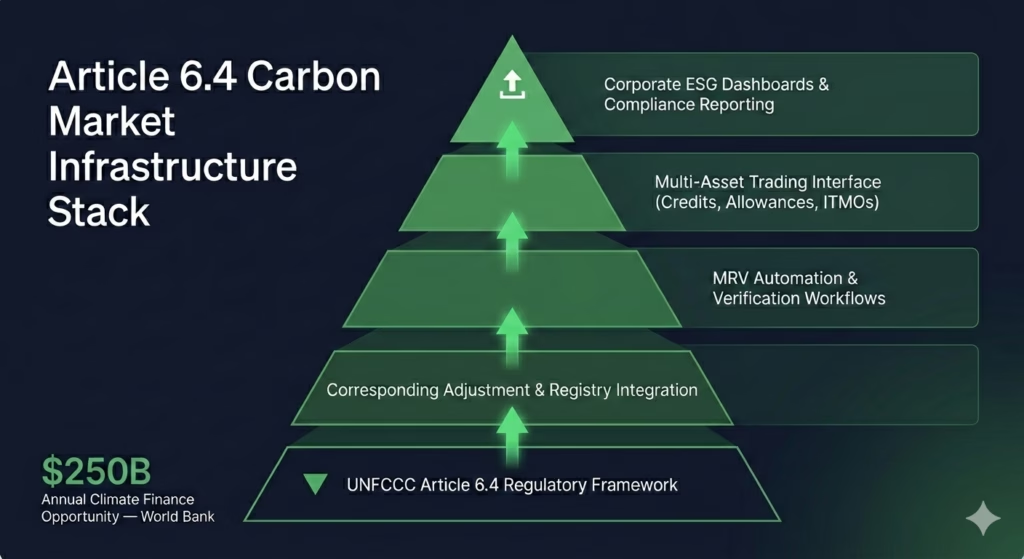
The Article 6.4 mechanism requires a governance structure, standards and approved methodologies, and a registry system — all of which need to be digitally implemented, auditable, and interoperable across borders. The CDM, its predecessor, registered more than 7,800 projects over its lifetime. Article 6.4 is designed to go significantly further, faster. And unlike the CDM, which relied on slow, bureaucratic processes, the new mechanism is built for an era of real-time data, API integration, and digital MRV (Monitoring, Reporting, and Verification).
This is precisely where carbon credit trading platform development becomes a C-suite conversation, not just a technology procurement decision.
Let us be direct. If you are a CFO reading this, you want numbers, not climate rhetoric. Here is how the ROI math works when you invest in carbon credit trading platform development at the right time.
Generic marketplace software is not enough. The Article 6.4 compliance environment requires a carbon credit trading platform development approach that addresses several specific functional requirements.
After nine years of negotiations, parties at COP29 finally adopted the Article 6.4 rules and standards essential for the functioning of carbon markets. That nine-year wait created pent-up demand. The pipeline is filling rapidly. The first methodologies are already approved. The first credits are expected in 2026. The organizations that finish their carbon credit trading platform development in 2025 will be operational when the first wave of institutional buyers enters the market. Those who wait for the market to “mature” will find they are paying a premium to enter a market already dominated by early movers.
As of March 2025, 97 bilateral agreements between 59 countries were adopted, and 155 pilot projects were recorded under Article 6.2 alone — and Article 6.4 is expected to dwarf that volume with its standardized, UN-backed framework. The pipeline of buyers and sellers exists. The regulatory clarity now exists. The only remaining variable is who builds the infrastructure they will all need.
Carbon credit trading platform development is not a generic software build. The partner you choose must understand carbon market microstructure, UNFCCC registry protocols, MRV standards, and the specific compliance requirements of Article 6.4. They should have demonstrable experience building financial exchange systems, not just commodity management tools. The architecture must be scalable, multi-tenant, and audit-ready from day one — because regulatory scrutiny in carbon markets is only increasing.
Beyond technology, the right partner delivers implementation support, integration with existing ERP and ESG reporting systems, and ongoing compliance updates as Article 6.4 methodologies evolve through COP30 and beyond.
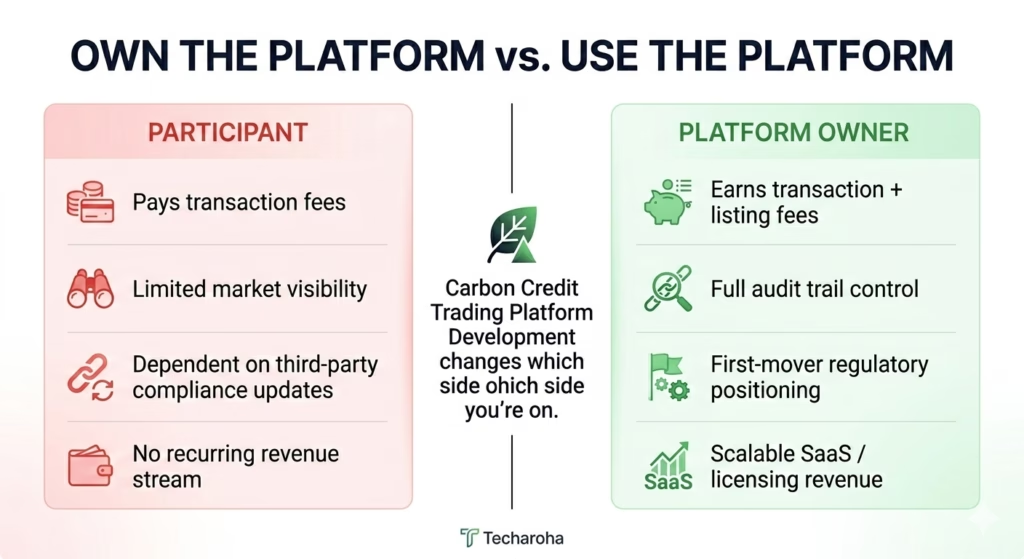
Article 6.4 is not a compliance checkbox. It is the architecture of a new global asset class worth hundreds of billions of dollars annually. The carbon credit trading platform development decisions being made in boardrooms right now will determine which companies are infrastructure owners versus participants, revenue generators versus fee payers, and market leaders versus late entrants in the most consequential commodity market of the next decade.
The window for first-mover advantage in carbon credit trading platform development is open — but it will not stay open indefinitely. The pipeline is building. The buyers are mobilizing. The regulatory framework is in place.
The question is not whether this market will scale. It already is. The question is whether your organization will be the platform other players trade on — or simply another player waiting for platform access.
If you are evaluating what carbon credit trading platform development looks like for your business model, timelines, and ROI objectives, this is the conversation to have now — not after the first wave of Article 6.4 credits hits the market.
Ready to explore what a compliant, scalable carbon credit trading platform development solution looks like for your organization? Let’s talk about your roadmap.